Who are the Non-Seculars? A (Tongue-in-Cheek) Call for the Study of a Strange Group

Nathan G. Alexander is a lecturer in history at the University of Ottawa, Canada, and project manager of the Nonreligion in a Complex Future Project. He is also the author of Race in a Godless World: Atheism, Race, and Civilization, 1850-1914 (NYU Press).
Much research in the field of secular studies understandably focuses on secular people. But more and more scholars are beginning to ask: What about the non-seculars? Who are they, and what do they believe?

It is true that the number of non-seculars is shrinking in many societies, but they are far from unimportant. In fact, they still make up a significant percentage – and in some cases even the majority – of western countries. In Canada, for example, non-seculars make up an eye-popping 65% of the population, according to the 2021 census.

Yet for too long, these non-seculars have escaped scholarly notice. This is a call for secular studies scholars to pay attention to the non-seculars and to devise a research program that will begin to investigate this “strange” group who has long been hiding in the shadows. Here I will lay out some of the critical questions such a research program might address.

There is a crisis of meaning in western societies. A research program would ask how non-seculars make meaning in their lives. (Of course, this is assuming that they can indeed have meaning in their lives, something far from certain.) Scholars have long known that secular people find meaning through a variety of methods, like being part of a community, pursuing hobbies, and engaging in creative pursuits, but it is less clear how non-seculars find meaning. Do non-seculars also pursue these common activities, or do they find meaning through uncommon practices, like reciting ancient texts, or gathering together at the same building at weekly intervals?

On the question of meaning – or lack thereof – for non-seculars, one hypothesis is that they yearn for secularity. They may even experience secular alienation: the state of being estranged from the place of secular fulfillment.[1] If this is so, researchers may seek to understand how this secular alienation can be overcome. Are non-seculars unhappy because they are not secular, and, for example, are they more likely to become alcoholics for this reason? We do not have answers to these questions yet, but they should be investigated through careful empirical study.

At a more fundamental level, research about non-seculars would seek to understand why non-seculars are the way they are. That is, why do they not become secular like so many of their fellow citizens? What psychological mechanisms explain why some remain non-secular or even convert to non-secularity if they were raised secular? In short, is there something different about the brains of non-seculars? Perhaps there is even a “secular spot” located in the brain that non-seculars lack. MRI scans of the brains of non-seculars may well yield valuable clues to these questions.

What do non-seculars believe? How do they make sense of the world outside the usual secular frameworks? Do they believe in science and naturalism, or do they believe in something else (angels, demons, deities, etc.)? Do they share commonly-held beliefs that death represents the end of life, for example, or do they have other beliefs (heaven, hell, ghosts, etc.)?

There is great diversity among non-seculars and already scholars have identified different ways of categorizing them.[2] Some, for example, are non-secular in name only. That is, while some activities they pursue may lead them to be classified as non-secular, in actual fact, their beliefs and behaviours closely align with secular people, making them almost indistinguishable. Some non-seculars, meanwhile, are simply done with secularity and have embraced a life of permanent non-secularity. They will never be won over to the secular fold, apparently content to remain non-seculars forever, with no hope of persuasion. Another subsection, the zealous non-seculars, actually seek to convert secular people to non-secularity, for example through door-knocking campaigns or by speaking through megaphones on busy streets. These non-seculars are often the most well-known given their public visibility, though they do not represent the majority of non-seculars.

Readers who have made it this far may object to the labelling of these curious people as “non-seculars.” Does this not create a negative label for this group, or frame them only in relation to the default category of secular people? These are valuable points, but it is hard to imagine an alternative term to describe this group. Some scholars have proposed terms like “a-seculars” or “un-seculars,” but, despite the nuanced reasonings in favour of such terms, they all contain the same fundamental problem. This remains an ongoing issue in the study of non-seculars.

It is hoped this short note opens the minds of scholars to consider the non-seculars more deeply. A major funding proposal to study the non-seculars is currently in preparation by the author. He is having fun experimenting with a distinctly non-secular practice by praying for its success.

The above has obviously been satirical. The point I am hoping to make is to ask us – whether we come from a religious or nonreligious perspective – to reflect on what we consider, even subconsciously, the “default” or “normal” in society, and what is the “unusual” thing that is thus in need of explanation. Using satire to flip these assumptions on their head could allow us to see things in a new way and invite new kinds of questions and answers. As our societies continue to undergo religious shifts, continually asking ourselves what counts as the “normal” state of affairs will be essential.


[1] Taking inspiration from the project, “Spiritual Yearning and the Problem of Spiritual Alienation”: https://www.templeton.org/grant/spiritual-yearning-and-the-problem-of-spiritual-alienation

[2] Taking inspiration from The Nones Project: https://www.thenonesproject.com/
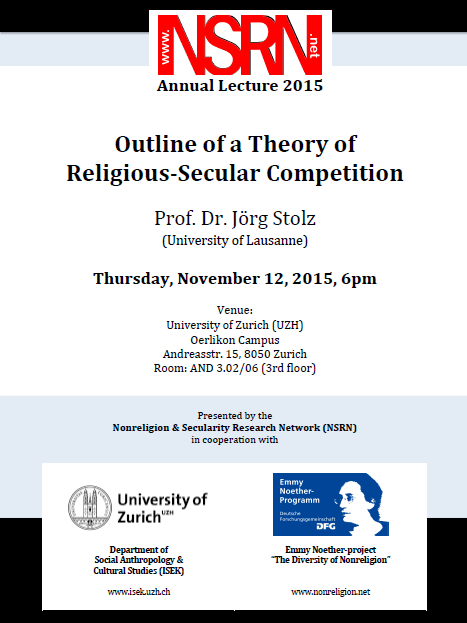
NSRN Annual Lecture 2015: Outline of a Theory of Religious-Secular Competition

We are delighted to announce our 2015 Annual Lecture, presented in cooperation with the Department of Social Anthropology & Cultural Studies (ISEK) at the University of Zurich, and the Emmy Noether-project “The Diversity of Nonreligion.”

Outline of a Theory of Religious-Secular Competition

Prof. Dr. Jörg Stolz (University of Lausanne)

Thursday, November 12, 2015, 6pm

Venue: University of Zurich (UZH) Oerlikon Campus Andreasstr. 15, 8050 Zurich Room: AND 3.02/06 (3rd floor)

A flyer can be downloaded here (pdf).

NSRN Annual Lecture

CFP: Secularism and Secularity – American Academy of Religion (AAR) Annual Meeting

CFP: Secularism and Secularity – American Academy of Religion  (AAR) Annual Meeting

Over the course of the last few decades, theoretical reappraisals of the secular have tried in a variety of ways to destabilize and revalue the notion of the secular so that it no longer means simply the “absence of religion.” Yet vernacular uses of the secular frequently continue to orbit around that very understanding. With this in mind, we invite proposals for papers or panels that explore “the secular” at its various sites of construction. In concert with this year’s conference theme, we are particularly interested in proposals that critically engage public understandings of secularism as well as those that investigate the constitution of the secular in religiously plural publics, in multiple identity formations (especially among the so-called religious “nones”), and in and through a range of social practices (for example, those related to death and dying). In addition, for a possible cosponsored session with the Death, Dying, and Beyond Group, we seek proposals on secular approaches to death.

To submit a paper proposal please follow the instructions on the AAR website found here. All proposals must be submitted no later than March 1 March 4, 2013.

Questions can be directed to the program unit co-chairs (Per Smith and Jonathan VanAntwerpen) at secularism.secularity@gmail.com

UPDATE – The AAR has extended its deadline for proposals to Monday, March 4th.

CFP: Is the Post-Colonial Secular?

Conference in Syracuse, NY
September 20-21, 2013

Description and Call for Papers:

Across the humanities, critical scholarship on the secular / secularism / secularization has recently ballooned. Scholars of history, anthropology, political theory, and religion have begun revisiting questions of enchantment and disenchantment, political theology, blasphemy, religious freedom, and much more. Charles Taylor’s A Secular Age in particular has garnered wide attention, but Taylor’s narrative focuses on the disenchantment of modern Christian Europe. Before and after A Secular Age, scholars have probed the boundaries of the secular beyond Christian Europe, and beyond the confines of intellectual history.

Some have asserted that the ideologies of secularism and colonialism are deeply intertwined. Others have asserted that post-colonial religiosity remains a symptom of colonial control of reason and affect. Still others have pointed to neo-liberalism as the shared basis of contemporary racial, religious, and post-colonial regimes.

We invite proposals that probe the question, “Is the Post-Colonial Post-Secular?” Projects may employ methods of history, literary criticism, theoretical reflection, ethnography, or cultural studies. We are interested in projects from a variety of regions and periods, for example contemporary Africa, the early U.S., or nineteenth century Haiti.

Please send 300 word abstracts, or questions, to: Owais Khan (mokhan01@syr.edu) and Vincent Lloyd (vwlloyd@syr.edu).
Deadline for abstracts: March 25; Notification: April 10.

CONFIRMED SPEAKERS: 
Gauri Viswanathan (Columbia, Literature)
Barnor Hesse (Northwestern, African American Studies)
Pamela Klassen (Toronto, Religion)
Uday Mehta (CUNY, Political Science)
Matthew Engelke (LSE, Anthropology)
Gyanendra Pandey (Emory, History)
Ludger Viefhues-Bailey (Philosophy, Le Moyne)

This symposium is sponsored by the Syracuse University Religion Department in cooperation with Le Moyne College.

Events: Forum on Religion Audra Mitchell and Stacey Gutkowski

Forum on Religion Seminar

Date: 23 January 2013
Time: 16.30-18.00
Venue: Seligman Library (OLD 6.05), Old Building, LSE

Speakers:
Audra Mitchell (University of York)
‘Bringing Secularity (Back) into International Relations: Immanence, Agency and Intervention’

and

Stacey Gutkowski (King’s College, London)
‘Secular Ways of War’

58 New Additions to the NSRN Bibliography

It may be Christmas Eve, but we have just added 58 new items to our ever-growing bibliography. They are pasted in below for your perusal.

If you notice any omissions or errors in the bibliography, please do not hesitate to get in touch with Chris.

  • Alicino, F. “Western Secularism in an Age of Religious Diversity.” International Review of Sociology 22, no. 2 (2012): 305–322.
  • Ardagh, D. “Secular, Theistic and Religious Ethical Rationales for the Relief of Extreme Poverty.” Australian Journal of Professional and Applied Ethics 12, no. 1; /2 (2010): 40–54.
  • Bekke-Hansen, S., C.G. Pedersen, K. Thygesen, S. Christensen, L.C. Waelde, and R. Zachariae. “Faith and Use of Complementary and Alternative Medicine Among Heart Attack Patients in a Secular Society.” Complementary Therapies in Medicine 20, no. 5 (2012): 306–315.
  • Billig, Michael. Banal Nationalism. London: SAGE, 1995.
  • Boeve, L. “Religious Education in a Post-secular and post-Christian Context.” Journal of Beliefs and Values 33, no. 2 (2012): 143–156.
  • Bowie, B. “Human Rights Education and the Post Secular Turn.” Journal of Beliefs and Values 33, no. 2 (2012): 195–205.
  • Bowie, B., A. Peterson, and L. Revell. “Editorial : Post-secular Trends: Issues in Education and Faith.” Journal of Beliefs and Values 33, no. 2 (2012): 139–141.
  • Bronk, A. “Secular, Secularization, and Secularism. A Review Article.” Anthropos 107, no. 2 (2012): 578–582.
  • Brown, Callum G. “Podcast: The People of No Religion.” The Religious Studies Project, December 19, 2012. http://www.religiousstudiesproject.com/brown/.
  • Bryan, H. “Reconstructing the Teacher as a Post Secular Pedagogue : a Consideration of the New Teachers’ Standards.” Journal of Beliefs and Values 33, no. 2 (2012): 217–228.
  • Burley, M. “Atheism and the Gift of Death.” Religious Studies 48, no. 4 (2012): 533–546.
  • Cahaner, L., and Y. Mansfield. “A Voyage from Religiousness to Secularity and Back : a Glimpse into `Haredi’ Tourists.” Journal of Heritage Tourism 7, no. 4 (2012): 301–321.
  • Carr, D. “Post-secularism, Religious Knowledge and Religious Education.” Journal of Beliefs and Values 33, no. 2 (2012): 157–168.
  • Castelli, M. “Faith Dialogue as a Pedagogy for a Post Secular Religious Education.” Journal of Beliefs and Values 33, no. 2 (2012): 207–216.
  • Connelly, Louise, Christopher R. Cotter, Frans Jespers, Ethan Gjerset Quillen, Steven J. Sutcliffe, and Teemu Taira. “Podcast: Studying Nonreligion Within Religious Studies.” The Religious Studies Project, December 17, 2012. http://www.religiousstudiesproject.com/2012/12/17/podcast-studying-nonreligion-within-religious-studies/.
  • Cornelissen, T., and U. Jirjahn. “Religion and Earnings : Is It Good to Be an Atheist with Religious Parental Background?” Economics Letters 117, no. 3 (2012): 905–908.
  • Cotter, Christopher R. “Secular Sacreds and the Sacred Secular.” The Religious Studies Project (November 7, 2012). http://www.religiousstudiesproject.com/2012/11/07/christopher-r-cotter-secular-sacreds/.
  • La Cour, P., and P. Gotke. “Understanding of the Word “Spirituality’’ by Theologians Compared to Lay People : An Empirical Study from a Secular Region.” Journal of Health Care Chaplaincy 18, no. 3–4 (2012): 97–109.
  • Daly, E. “The Ambiguous Reach of Constitutional Secularism in Republican France : Revisiting the Idea of Laicite and Political Liberalism as Alternatives.” Oxford Journal of Legal Studies 32, no. 3 (2012): 583–608.
  • Davie, Grace. “Podcast: Belief and Unbelief: Two Sides of a Coin.” The Religious Studies Project, December 19, 2012. http://www.religiousstudiesproject.com/davie/.
  • Van Die, M. “Secularism and Freedom of Conscience.” Journal of Church and State 54, no. 4 (2012): 648–650.
  • Eccles, Janet. “The Religious and Non-Religious Commitments of Older Women in the UK: Towards a New Typology.” Journal of Contemporary Religion 27, no. 3 (2012): 469–484. doi:10.1080/13537903.2012.722296.
  • Forbes, K.F., and E.M. Zampelli. “The Impacts of Religion, Political Ideology, and Social Capital on Religious and Secular Giving : Evidence from the 2006 Social Capital Community Survey.” Applied Economics 45, no. 17 (2013): 2481–2490.
  • Fox, J. “The Last Bastion of Secularism? Government Religion Policy in Western Democracies, 1990 to 2008.” Journal of Contemporary European Studies 20, no. 2 (2012): 161–180.
  • Francis, L.J., G. Penny, and S. Baker. “Defining and Assessing Spiritual Health : A Comparative Study Among 13- to 15-Year-Old Pupils Attending Secular Schools, Anglican Schools, and Private Christian Schools in England and Wales.” Peabody Journal of Education 87, no. 3 (2012): 351–367.
  • Garral, M.D. “The Possibility of Agnosticism : Russell’s Retreat from Atheism.” International Philosophical Quarterly 52, no. 3(207) (2012): 355–372.
  • Georgellis, Y., and T. Lange. “Traditional Versus Secular Values and the Job-Life Satisfaction Relationship Across Europe.” British Journal of Management 23, no. 4 (2012): 437–454.
  • Gul, A. “Egyptian Muslims Should Embrace Secularism.” New Perspectives Quarterly 29, no. 3 (2012): 48–51.
  • Gutkowski, Stacey. “Secularism and the Politics of Risk: Britain’s Prevent Agenda, 2005-8.” International Relations 25, no. 3 (2011): 346–362.
  • Haldane, J. “Scientism and Its Challenge to Humanism.” New Blackfriars 93, no. 1048 (2012): 671–686.
  • Hunter, I. “Charles Taylor’s A Secular Age and Secularization in Early Modern Germany.” Modern Intellectual History 8, no. 3 (2011): 621–646.
  • Iqtidar, Humeira. “Podcast: Secularization and Non-religion in Non-Western Contexts.” The Religious Studies Project, December 19, 2012. http://www.religiousstudiesproject.com/iqtidar/.
  • ———. “Secularism and Secularisation : Untying the Knots.” Economic and Political Weekly 47, no. 35 (2012): 50–58.
  • Joukovsky, N.A. “Robert Parker’s `Letters on Atheism’ : An Early Response to Shelley’s The Necessity of Atheism.” Review of English Studies 63, no. 261 (2012): 608–633.
  • Kim, D., D. McCalman, and D. Fisher. “The Sacred/Secular Divide and the Christian Worldview.” Journal of Business Ethics 109, no. 2 (2012): 203–208.
  • Kim, Y.I., and W.B. Wilcox. “Bonding Alone : Familism, Religion, and Secular Civic Participation.” Social Science Research 42, no. 1 (2013): 31–45.
  • Lanman, Jonathan. “Podcast: Atheism Explained: The Evolutionary Origins of Atheistic Thought.” The Religious Studies Project, December 19, 2012. http://www.religiousstudiesproject.com/lanman/.
  • Lee, Lois. “Being Secular: Toward Separate Sociologies of Secularity, Nonreligion and Epistemological Culture.” Unpublished PhD Thesis, University of Cambridge, 2012.
  • ———. “Podcast: Lois Lee on Nonreligion.” The Religious Studies Project, October 8, 2012. http://www.religiousstudiesproject.com/2012/10/08/podcast-lois-lee-on-non-religion/.
  • Leurs, R. “Are Faith-based Organisations Distinctive? Comparing Religious and Secular NGOs in Nigeria.” Development in Practice 22, no. 5; /6 (2012): 704–720.
  • Lust, E., G. Soltan, and J. Wichmann. “After the Arab Spring : Islamism, Secularism, and Democracy.” CURRENT HISTORY -NEW YORK THEN PHILADELPHIA- 111, no. 749 (2012): 362–364.
  • Majeed, J. “THE CRISIS OF SECULARISM IN INDIA.” Modern Intellectual History 7, no. 3 (2010): 653–666.
  • Martinez-Taboas, A., N. Varas-Diaz, D. Lopez-Garay, and L. Hernandez-Pereiera. “What Every Psychologists Practitioner Should Know About Atheist People and Atheism.” Interamerican Journal of Psychology 45, no. 2 (2011): 203–210.
  • Mirman, M.C. “An Atheist’s Guide to the Divine : Throwing Out the Bathwater but Keeping the Baby.” Research in the Social Scientific Study of Religion 23 (2012): 171–190.
  • Moser, P.K. “Undermining the Case for Evidential Atheism.” Religious Studies 48, no. 1 (2012): 83–93.
  • Osuri, G. “Secular Interventions/Hinduized Sovereignty : (Anti) Conversion and Religious Pluralism in Jodhaa Akbar.” Cultural Critique no. 81 (2012): 70–102.
  • Petersen, J.A. “Religion and Popular Music in Europe : New Expressions of Sacred and Secular Identity.” Culture and Religion 13, no. 3 (2012): 393–395.
  • Pingle, M., and T. Melkonyan. “To Believe or Not Believe…or Not Decide : A Decision-theoretic Model of Agnosticism.” Rationality and Society 24, no. 4 (2012): 408–441.
  • Quack, Johannes. “Is to Ignore to Deny? Säkularisierung, Säkularität Und Säkularismus in Indien.” In Religionspolitik, Öffentlichkeit, Wissenschaft: Studien Zur Neuformierung Von Religion in Der Gegenwart, edited by Martin Bauman and Frank Neubert, 291–317. Zürich: PANO-Verlag, 2010.
  • Radford, M. “Faith and Reason in a Post Secular Age.” Journal of Beliefs and Values 33, no. 2 (2012): 229–240.
  • Rectenwald, Michael. “Secularism and the Cultures of Nineteenth-century Scientific Naturalism.” The British Journal for the History of Science FirstView (2012): 1–24. doi:10.1017/S0007087412000738.
  • Shneer, D., and B. Springer. “Russian Jewish Intellectual History and the Making of Secular Jewish Culture.” Modern Intellectual History 9, no. 2 (2012): 435–449.
  • Siegler, E. “David Cronenberg : The Secular Auteur as Critic of Religion.” Journal of the American Academy of Religion 80, no. 4 (2012): 1098–1112.
  • Tonti-Filippini, N. “Religious and Secular Death: A Parting of the Ways.” Bioethics 26, no. 8 (2012): 410–421.
  • West, J.A. “The Post-Secular in Question : Religion in Contemporary Society.” Sociology of Religion 73, no. 3 (2012): 352–354.
  • Wilcox, M.M. ““Spiritual Sluts’’ : Uncovering Gender, Ethnicity, and Sexuality in the Post-Secular.” Womens Studies 41, no. 6 (2012): 639–659.
  • Wohlrab-Sahr, Monika. “Podcast: Multiple Secularities: Toward a Cultural Sociology of Secular-Religious Distinctions.” The Religious Studies Project, December 19, 2012. http://www.religiousstudiesproject.com/iqtidar/.
  • Woodhead, Linda. “Podcast: The Secularization Thesis.” The Religious Studies Project, April 16, 2012. http://www.religiousstudiesproject.com/2012/04/16/podcast-linda-woodhead-on-the-secularisation-thesis/.

New Book Series: Histories of the Sacred and the Secular, 1700 – 2000

Histories of the Sacred and the Secular, 1700 – 2000. Edited by David Nash, Oxford Brookes University, UK

Histories of the Sacred and the Secular (pdf flyer)

Histories of the Sacred and the Secular 1700 – 2000 reflects the awakened and expanding
profile of the history of religion within the academy in recent years. Intending to publish
exciting new and high quality work on the history of religion and belief since 1700, the series
actively encourages the production of interdisciplinary proposals and the use of innovative
methodologies. We welcome book proposals on the history of Atheism, Secularism,
Humanism and unbelief/secularity and encourage research agendas in this area alongside
those in religious belief, as well as proposals covering subjects in Britain, Europe, the United
States and Oceania. Histories of the Sacred and the Secular 1700 – 2000 aims to reflect both
the work of new scholars entering the field, alongside the work of established scholars.

Editorial Board

Professor Callum Brown, Dundee University, UK
Professor William Gibson, Oxford Brookes University, UK
Dr Carole Cusack, Sydney University, Australia
Professor Beverley Clack, Oxford Brookes University, UK
Drs Bert Gasenbeek, University of Humanistic Studies, Utrecht, Netherlands
Professor Paul Harvey, University of Colorado at Colorado Springs, USA

for more details of the series or guidelines on
submitting a proposal contact the general Editor:

Professor David Nash
dsnash@brookes.ac.uk

http://www.palgrave.com

CFP: Religion and Citizenship: Re-Thinking the Boundaries of Religion and the Secular.

Socrel / HEA Teaching and Studying Religion, 2nd Annual Symposium

The 2012 Socrel / HEA Teaching and Studying Religion symposium will explore the theme: Religion and Citizenship: Re-Thinking the Boundaries of Religion and the Secular.

The symposium is organised by Socrel, the BSA Sociology of Religion Study Group, with funding from the Higher Education Academy, Philosophy, and Religious Studies Subject Centre. Last year’s inaugural symposium was over-subscribed and therefore early submissions are encouraged.

Keynote speaker: Dr Nasar Meer, Northumbria University

Venue: BSA Meeting Room, Imperial Wharf, London
Date: 13 December 2012
10 a.m. – 5 p.m.

Religions today are implicated in a wide variety of publics. From contests over the environment and democracy to protests against capitalism, religions remain important factors in political and public life across diverse, and interconnected, global contexts. A variety of diverse responses have been articulated to the so-called ‘return of religion’ in the public sphere, drawing into question relations between the religious, the non-religious and the secular. As scholars have developed new theoretical understandings of the terms of these debates and questioned how these are bound up with cultural conceptualizations of citizenship, education – in schools, universities and less formal educational contexts – has often been a site where contestations of the religious and the secular have been acutely felt.

The aim of this symposium is to consider the interrelation between conceptions of the religious, the secular, citizenship and education, and to explore how these issues affect the study of religion in higher education. We hope to attract presentations of sufficient quality to lead to an edited publication.

The day will be highly participative and engaged. The symposium will be organised as a single stream so that the day is as much about discussion as it is about presentation, and therefore the number of formal papers will be limited.

Papers are invited from students, teachers, and researchers in the disciplines of sociology, anthropology, geography, theology, history, psychology, political science, religious studies and others where religion is taught and studied. Empirical, methodological, and theoretical papers are welcomed.

Presenters will circulate a five-page summary of their paper before the day so that all participants can come prepared for discussion. Presentations will last 10 minutes and will be structured into three sessions, each followed by a discussant drawing out key points. The day will conclude with a discussant-led, focused panel discussion.

Key questions to be addressed may include, but are not limited to:

  • What are the relationships between the religious, the secular and the public sphere, and how do these affect the study of religion, in both universities and schools?
  • How do different historical constructions of religion and secularity shape understandings of the civil sphere and citizenship, and what are the implications of this for the study of religion?
  • Does the increased public visibility of religion in national and global contexts affect how we study it?
  • What is the role of religious education (school and/or university) in forming citizens and shaping understandings of citizenship?
  • Are there distinct regional, national or international conceptions of the secular?
  • Are there distinct regional, national or international conceptions of citizenship?
  • How do different disciplines approach and study these conceptions, and what are the advantages and disadvantages of these approaches?

Abstracts of 200 words are invited by September 15 2012. Please send these to: Dr Paul-François Tremlett p.f.tremlett@open.ac.uk

Costs: £36.00 for BSA/SocRel members; £45.00 for non-members; £20.00 for SocRel/BSA Postgraduate members; £25.00 for Postgraduate non-members.


CFP: Kongress “Rethinking Europe with(out) Religion” nächsten Februar in Wien

International Congress: Rethinking Europe with(out) religion. Deadline for abstracts 30 September 2012

Full details as PDF can be found here CFP_Rethinking Europe with(out) Religion

Sehr geehrte Interessierte an der Forschungsplattform RaT! Liebe Kolleginnen und Kollegen!

Die Forschungsplattform „Religion and Transformation in Contemporary European Society“ (RaT) möchte Sie hiermit auf den im Februar 2013 stattfindenden Kongress „Rethinking Europe with(out) Religion“ aufmerksam machen.
Details sowie ein Anmeldeformular finden Sie auf der Kongress-Homepage: http://www.rethinkingeurope.at

Die Kolleginnen und Kollegen an Universitäten und Bildungseinrichtungen bitte ich, diese Information im Rahmen der Ihnen zur Verfügung stehenden Möglichkeiten weiterzuleiten. Bitte machen Sie Studierende auf diesen Kongress aufmerksam! Für alle Fälle hänge ich den CfP an.
Mit freundlichen Grüßen und allen guten Wünschen für einen erholsamen Sommer!

Angelika Walser

Dr. Angelika Walser
Plattformmanagerin
RaT (Religion and Transformation
In Contemporary European Society)
Schenkenstr. 8-10
1010 Wien
T.: 0664-60277-23803

Beschreibung: RaT_Logo