Unbelief and Nonreligiosity in Iran: Survey Evidence for a Nationwide Phenomenon

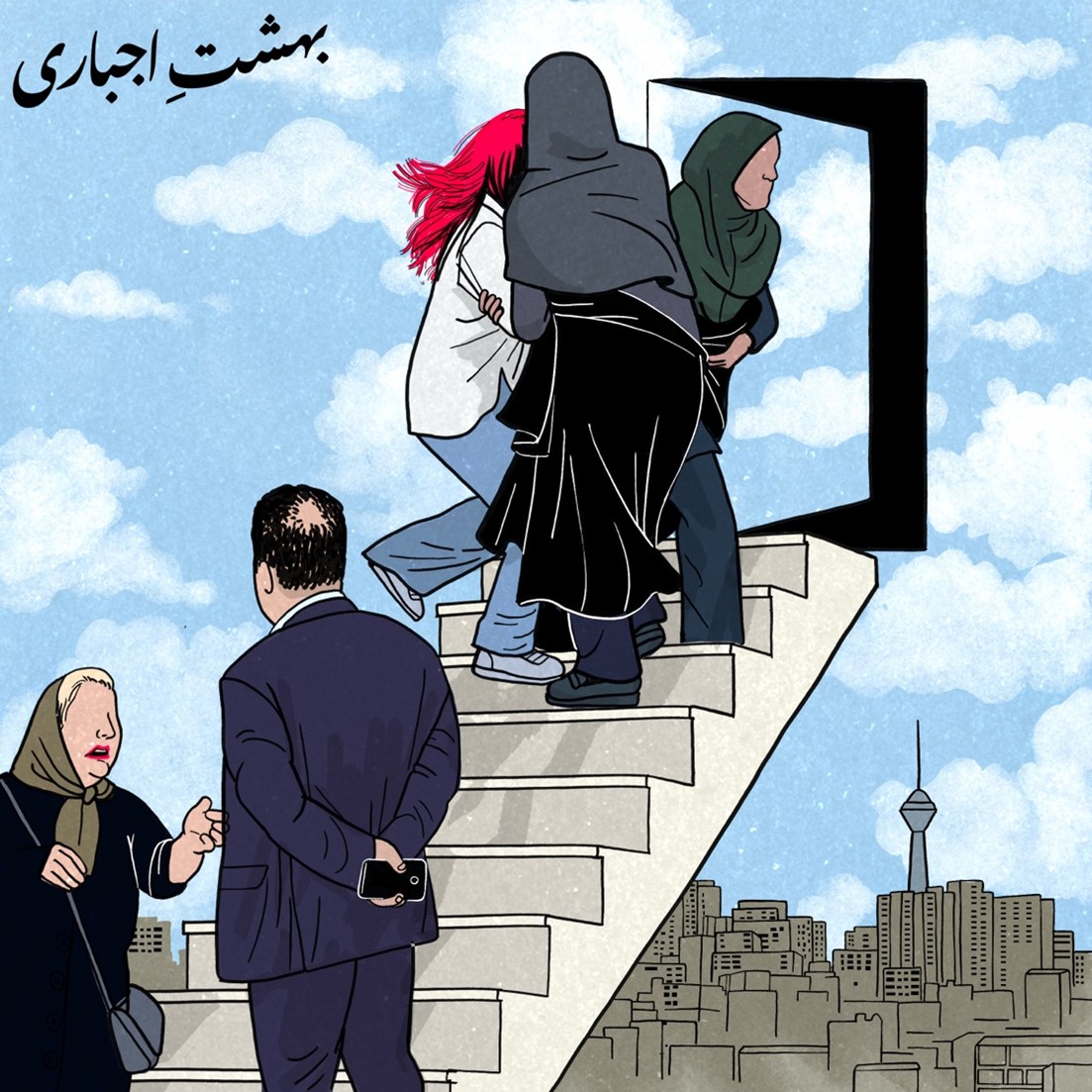
Mandatory Heaven. Digital illustration by Elham Ataieazar. Posted on Instagram @elham.ataeiazar, April 18, 2024.

Blog post description: In a forthcoming chapter in the Oxford Handbook of Apostasy and Religious Deconversion, edited by Phil Zuckerman and Alexandr Zamușinski, Pooyan Tamimi Arab and Ammar Maleki present survey evidence showing that unbelief and nonreligiosity in Iran are nationwide phenomena. To do so, they experimented with conducting surveys via social media and communication apps and what they call VPN sampling to circumvent state-induced fear that affects conventional face-to-face or telephone surveys.

Pooyan Tamimi Arab is Associate Professor of Secular and Religious Studies at Utrecht University and PI of Iran’s Secular Shift, a mixed methods project funded by the Dutch Research Council. He is a member of GAMAAN, the Group for Analyzing and Measuring Attitudes in Iran. Email: p.tamimiarab@uu.nl.

Keywords: Iran, secularization, atheism, surveys, preference falsification.

It isn’t novel to highlight the fact of secularization in Iran. This process has long been observed by social scientists, humanities scholars, artists, writers, and journalists. Anxious clerics and worried political leaders have decried it. Millions of ordinary citizens in the country, as well as their friends and families in the diaspora, have, in one way or another, experienced the trend in their lifetime.

In academic studies on Iran, the concept of secularization is often used to describe trends in changes in institutions, discourses, and behaviors. Declining identification as Muslims is also described, but less so. An obvious reason for this has been a decades-long lack of reliable quantitative evidence.

Questionable, totalizing numbers, on the other hand, have from the start played a role in the legitimation of the Islamic Republic. In 1979, when a referendum established Iran’s new political system, the ominous coupling of “Islamic” with “Republic” was justified by a 98% Yes vote. The new republic sought the strong establishment of Islam in the state, so strong that Islam could permeate all of society, from squares and streets to schools, hospitals, and cemeteries, to even citizens’ homes, and, when they resisted, it violated the space of their inner convictions in inquisition-like show trials. That’s why the country’s political system became internationally known as a theocracy, and rightly so, one that in the 1980s mass executed its opponents, who were accused of apostasy, atheism, and heresy, in what Shahin Nasiri, a philosopher and a scholar of these atrocities, has described as “religious genocide.”[i]

Iran, imagined with this dark history in mind, served many in academia as an example of the possibility of the reversibility of secularization, as, for instance, in Jürgen Habermas’s 2019 tome, Also A History of Philosophy.[ii]

Survey research and census data have supported the totalitarian image of a society in which all identify as the same, as Muslims, if not earnestly, then at least by name. The little attention to unbelievers is striking, given that those familiar with Iranians know that irreligiosity and even antireligious sentiments, which grew in reaction to the theocratic state,[iii] are widely prevalent. In the Oxford Handbook of Atheism, the anthropologist Samuli Schielke writes that Atheists in much of the Islamic world are publicly invisible, making them “difficult to estimate.” He also writes, however, that in Iran they constitute a “small minority” of 0.1%,[iv] based on the 2005 World Values Survey results, i.e., based on a face-to-face survey. The percentage identifying as Muslim that year was 98.7%. Surveys conducted through landline telephones produced the same picture, and the latest Iranian census to date, conducted in 2016, went so far as to claim that 99.5% of the population were Muslims. Conventional surveys also reported overwhelming support for theocracy. Spectacular iconoclastic events, such as women setting fire to the mandatory hijab in 2022, and protestors even setting fire to mosques in 2026, however, have pushed international audiences to recognize a different reality.

In a chapter in the forthcoming Oxford Handbook of Apostasy and Religious Deconversion, Ammar Maleki and I present survey evidence that unbelief and nonreligiosity in Iran are nationwide phenomena. We conducted survey experiments that take the phenomenon of preference falsification, caused by a fear of the state, seriously. Our survey research – conducted as GAMAAN, the Group for Analyzing and Measuring Attitudes in Iran – started by sampling through social media and communication applications. We then moved to include VPN sampling and finally came to rely on it. 

VPN sampling means the survey was distributed directly to people in Iran when they connected their devices to the tool. We’ve done this work in voluntary collaborations, primarily with Psiphon VPN alongside Lantern VPN and MahsaNet, a free tool used by 4 to 7 million Iranians every day in the 2020s, with peaks of around 10 million. This year, after the Internet shutdown following the mass murder of protestors in January and the subsequent war with the United States and Israel, tools facilitating connections – VPNs and apps like Psiphon’s Conduit – became more urgent than ever: connections spiked in May, when access was restored, but at the time of writing have fallen back below the levels seen in previous years.

In other words, our approach is designed in response to the Islamic Republic’s censorship, which is among the world’s most extreme. Over the years, the regime blocked commonly used apps and websites such as YouTube, Instagram, and WhatsApp. The high Internet penetration in Iran – 85% of the population uses the Internet – and the unusually high usage of VPN tools to circumvent state censorship – according to some estimates, as high as 90% of all users – allow for combining scale and anonymity in a nonprobability survey that depends on users themselves opting in. In September 2025, for example, in between wars and information lockdowns, we were able to collect thirty thousand secured responses from inside Iran.

While this would obviously introduce sampling bias, as is the case in all nonprobability surveys, the alternative isn’t convincing. If many Iranians don’t answer honestly on the sensitive topic of religion, there really isn’t much the survey researcher can do to figure out the truth. The fact that leaving Islam or converting to another religion is illegal in Iran, and can be – and has been – met with capital punishment shouldn’t be underestimated. But if respondents do tell us the truth, because we can guarantee their anonymity, we can weight the data and thus produce a sample that is as representative as possible, considering the situation in Iran. This hypothesis was confirmed by actually conducting the surveys and finding out about the diversity of Psiphon users.

Sometimes, assumptions about who are likely to participate in our surveys and thus the direction of sampling bias turned out to be correct. For example, educated people participate more often, though many thousands without higher education, in some surveys even tens of thousands, also participate. Sometimes, however, assumptions, such as that tech-savvy youngsters would participate more often, turn out to be incorrect. We found that VPN sampling is more effective at obtaining samples from middle-aged people. The features of Iran’s digital context, including digital behavior, should, in other words, be examined rather than assumed.

To test representativeness, we compare our survey results on politically nonsensitive questions with probability surveys’ results, for example, on which healthcare insurance people have, or which language they speak at home (for sample characteristics, weighting information, and external benchmark tests see the survey reports at gamaan.org; for a presentation about our approach, see this WAPOR methodology webinar).
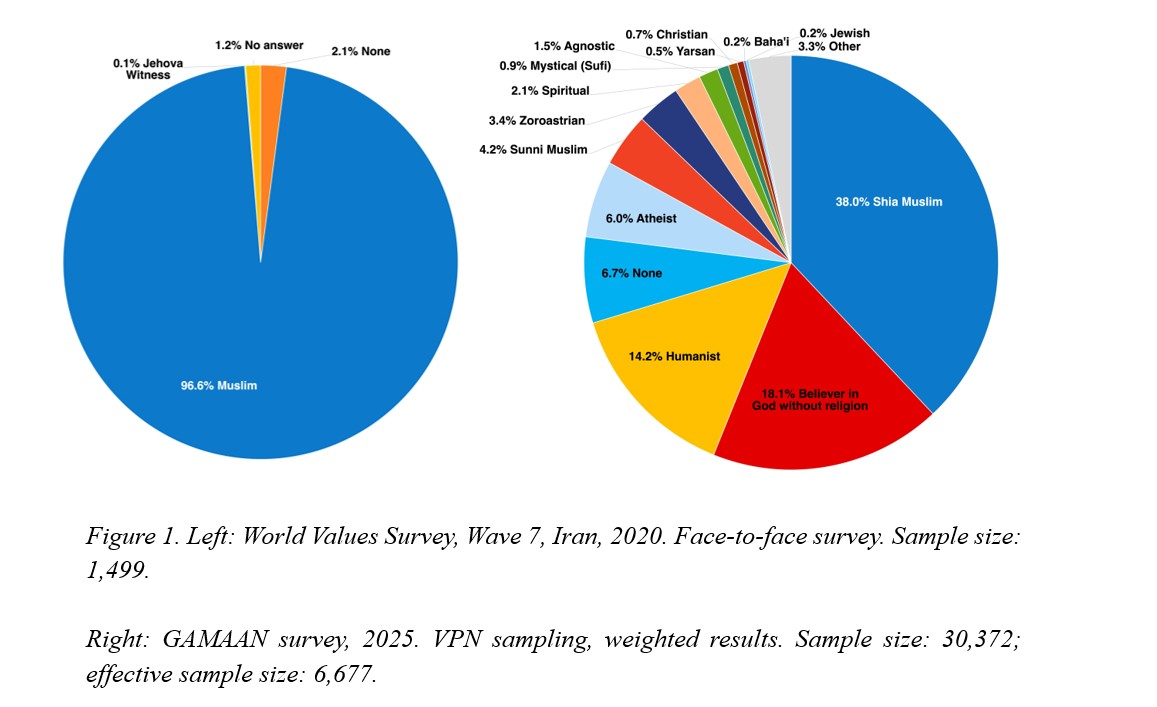
But the point of this work isn’t only to say that we can approximate the target population of literate adults. It’s to show that, in some cases, as with the question on religious identification, the results don’t merely reveal a different quantitative degree of an existing reality but a qualitatively different one. Instead of a homogeneous picture, as provided by the World Values Survey in 2020, in which only one stubborn Jehovah’s Witness accounts for the country’s minority religions, GAMAAN’s diagram shows persecuted identities like Atheist and Baha’i that often don’t even show up in conventional surveys’ results. Other results denote a contextually meaningful move away from institutional religion, such as those who identify as Humanists or Nonreligious Believers.

Focusing on Atheists (in Persian: ātiīst or khudānābāvar, meaning “nonbeliever in God”), we found that their share is much higher than previously estimated, at around 6%. They are also not limited, as the stereotype would have it, to young, urban, educated, wealthy people.

Across three surveys conducted with VPN sampling between 2023 and 2025 – using the same survey question, identity labels, and weighting based on the most recently available demographic statistics – we found that the percentage of Atheists remained consistent. At the same time, clear patterns emerge: highly urbanized provinces such as Tehran and Alborz show slightly higher percentages (7–8%), while more rural provinces such as South Khorasan, Sistan and Baluchistan, and Kerman score a few points lower. As far as we know, this is the first time that survey evidence has shown that Atheists live in all of Iran’s provinces. 

As expected, we found that people under the age of 30 are two or three times as likely to identify as Atheists when compared with those between 30 and 50 years old, and those above 50. But that also means that unbelievers are present in all age categories. Similarly, Atheists tend to have higher incomes and higher education levels than people who identify with other labels. But the phenomenon of unbelief is not at all limited to these demographic groups either. The assumption that poor people must be extremely religious, and that they support the Islamic Republic, is probably more affected by prejudice than that it’s based on quantitative evidence. 

In other words, secularization isn’t fully determined by class or intellectual elite status, as it isn’t elsewhere either.[i] In fact, our weighted results show that the majority of self-identified Atheists had not received higher education.

These findings support the general view that modernization contributes to secularization. But in Iran, contemporary secularization isn’t facilitated by a state that guarantees religious freedom. Rather, it emerges in a digitally connected society that is aware of the freedoms available elsewhere in the world and is shaped by disillusionment with Iran’s theocratic political system.

Forthcoming chapter:

Tamimi Arab, P., and Maleki, A. In press. “Unbelief and Nonreligiosity in Iran: Survey Evidence for Nationwide Phenomena.” In The Oxford Handbook of Apostasy and Religious Deconversion, edited by Phil Zuckerman and Alexandr Zamușinski.


[i] Cragun, Ryan T., and Jesse M. Smith. 2024. Goodbye Religion: The Causes and Consequences of Secularization. New York: New York University Press, pp. 46–48.


[i] Nasiri, Shahin. 2025. Clerical Sovereignty and its Absolute Others: Religious Genocide in Iran. Journal of Genocide Research. Online preprint.

[ii] Habermas, Jürgen. 2023 [2019]. Also a History of Philosophy, Volume 1: The Project of a Genealogy of Postmetaphysical Thinking. Translated by Ciaran Cronin. Cambridge: Polity, p. 20.

[iii] See, for example, Khosrokhavar, Farhad. 2024. Revolt Against Theocracy: The Mahsa Movement and the Feminist Uprising in Iran. Cambridge: Polity.

[iv] Schielke, Samuli. 2013. “The Islamic World.” In The Oxford Handbook of Atheism, edited by Stephen Bullivant and Michael Ruse, 638–650. Oxford: Oxford University Press, pp. 647–648.

BABEL/NSRN 2026 International Conference

Call for papers

BABEL/NSRN 2026 international conference
KU Leuven, 3-4 December 2026
Conference title:
Entangled Lives: Religion, Nonreligion, and the Spaces In-Between


This two-day interdisciplinary conference invites critical and creative engagement with the evolving
dynamics between religion and nonreligion, with particular attention to how these interactions unfold
within intimate, everyday contexts. Focusing on micro- and meso-level encounters – between partners,
family members, friends, neighbors, or colleagues – the conference will move beyond treating religion
and nonreligion as fixed or binary categories. Instead, it will center on the everyday lived experiences,
relational negotiations, and hybridities that occur across diverse (non)religious worldviews, seeking to
illuminate the processes through which beliefs, doubts, spiritualities, and meaning-making practices
are co-constructed, contested, or transformed in ordinary life.

We welcome contributions from across the disciplinary spectrum, including – but not limited to –
religious studies, theology, sociology, anthropology, history, psychology, philology, and philosophy.
By fostering interdisciplinary dialogue, the conference aims to deepen scholarly understanding of how
individuals and communities navigate (non)religious difference, as well as the tensions, solidarities,
and unexpected transformations that arise in the process.

Importantly, the scope of the conference also includes the ambiguous and overlapping spaces of
(non)belief: secularity, spirituality, mysticism, ritual innovation, and personal meaning-making. We
invite scholars to explore how these hybrid or “in-between” positions disrupt conventional
categorizations and open new modes of living and relating throughout historical, contemporary, and
emerging contexts.


Key guiding questions include:
  • How do individuals and communities navigate (non)religious diversity?
  • How are (non)religious worldviews expressed and negotiated in everyday relationships?
  • What tensions, transformations, and solidarities might emerge through these encounters?
  • How can we study these dynamics in a way that resists oversimplification or cultural
  • anachronism, without losing analytical clarity?
  • How have such dynamics been shaped historically, and what can this tell us about continuities
  • and changes over time?


This conference seeks to move beyond binary categories, fostering conversation across disciplines and
worldviews to explore what it means to live together meaningfully in a plural and shifting landscape.

Format and Submission

For individual paper proposals:

  • Abstract length: ~200-350 words
  • Presentation length: ~15-20 minute presentation (+10 minutes of discussion)
  • Submission: email your submission document (Word or PDF file) to sofia.nikitaki@kuleuven.be with subject line “BABEL/NSRN 2026 paper”
  • Please include the following details in your submission: paper title; abstract; author name(s)
    and affiliation(s); contact email

For panel proposals:

  • Panel composition: 3-4 papers plus a chair (one participant may serve as chair)
  • Submission: email your submission document (in Word or PDF file) to
    sofia.nikitaki@kuleuven.be with subject line “BABEL/NSRN 2026 panel”. Please make
    sure to include the following details:
    • Panel title and short rationale (200-300 words) stating the theme and contribution
    • 3-4 short paper abstracts (each 200-250 words) with titles
    • Names, affiliations, and contact emails for panel participants and panel chair
Key Dates
  • Abstract/panel submission deadline (extension): 30 April 2026
  • Notification of acceptance: Between 15 May and 15 June 2026
Practicalities

Further details on registration, program, and practical arrangements will follow upon acceptance.
For questions, please contact sofia.nikitaki@kuleuven.be

Who are the Non-Seculars? A (Tongue-in-Cheek) Call for the Study of a Strange Group

Nathan G. Alexander is a lecturer in history at the University of Ottawa, Canada, and project manager of the Nonreligion in a Complex Future Project. He is also the author of Race in a Godless World: Atheism, Race, and Civilization, 1850-1914 (NYU Press).

Much research in the field of secular studies understandably focuses on secular people. But more and more scholars are beginning to ask: What about the non-seculars? Who are they, and what do they believe?

It is true that the number of non-seculars is shrinking in many societies, but they are far from unimportant. In fact, they still make up a significant percentage – and in some cases even the majority – of western countries. In Canada, for example, non-seculars make up an eye-popping 65% of the population, according to the 2021 census.

Yet for too long, these non-seculars have escaped scholarly notice. This is a call for secular studies scholars to pay attention to the non-seculars and to devise a research program that will begin to investigate this “strange” group who has long been hiding in the shadows. Here I will lay out some of the critical questions such a research program might address.

There is a crisis of meaning in western societies. A research program would ask how non-seculars make meaning in their lives. (Of course, this is assuming that they can indeed have meaning in their lives, something far from certain.) Scholars have long known that secular people find meaning through a variety of methods, like being part of a community, pursuing hobbies, and engaging in creative pursuits, but it is less clear how non-seculars find meaning. Do non-seculars also pursue these common activities, or do they find meaning through uncommon practices, like reciting ancient texts, or gathering together at the same building at weekly intervals?

On the question of meaning – or lack thereof – for non-seculars, one hypothesis is that they yearn for secularity. They may even experience secular alienation: the state of being estranged from the place of secular fulfillment.[1] If this is so, researchers may seek to understand how this secular alienation can be overcome. Are non-seculars unhappy because they are not secular, and, for example, are they more likely to become alcoholics for this reason? We do not have answers to these questions yet, but they should be investigated through careful empirical study.

At a more fundamental level, research about non-seculars would seek to understand why non-seculars are the way they are. That is, why do they not become secular like so many of their fellow citizens? What psychological mechanisms explain why some remain non-secular or even convert to non-secularity if they were raised secular? In short, is there something different about the brains of non-seculars? Perhaps there is even a “secular spot” located in the brain that non-seculars lack. MRI scans of the brains of non-seculars may well yield valuable clues to these questions.

What do non-seculars believe? How do they make sense of the world outside the usual secular frameworks? Do they believe in science and naturalism, or do they believe in something else (angels, demons, deities, etc.)? Do they share commonly-held beliefs that death represents the end of life, for example, or do they have other beliefs (heaven, hell, ghosts, etc.)?

There is great diversity among non-seculars and already scholars have identified different ways of categorizing them.[2] Some, for example, are non-secular in name only. That is, while some activities they pursue may lead them to be classified as non-secular, in actual fact, their beliefs and behaviours closely align with secular people, making them almost indistinguishable. Some non-seculars, meanwhile, are simply done with secularity and have embraced a life of permanent non-secularity. They will never be won over to the secular fold, apparently content to remain non-seculars forever, with no hope of persuasion. Another subsection, the zealous non-seculars, actually seek to convert secular people to non-secularity, for example through door-knocking campaigns or by speaking through megaphones on busy streets. These non-seculars are often the most well-known given their public visibility, though they do not represent the majority of non-seculars.

Readers who have made it this far may object to the labelling of these curious people as “non-seculars.” Does this not create a negative label for this group, or frame them only in relation to the default category of secular people? These are valuable points, but it is hard to imagine an alternative term to describe this group. Some scholars have proposed terms like “a-seculars” or “un-seculars,” but, despite the nuanced reasonings in favour of such terms, they all contain the same fundamental problem. This remains an ongoing issue in the study of non-seculars.

It is hoped this short note opens the minds of scholars to consider the non-seculars more deeply. A major funding proposal to study the non-seculars is currently in preparation by the author. He is having fun experimenting with a distinctly non-secular practice by praying for its success.

The above has obviously been satirical. The point I am hoping to make is to ask us – whether we come from a religious or nonreligious perspective – to reflect on what we consider, even subconsciously, the “default” or “normal” in society, and what is the “unusual” thing that is thus in need of explanation. Using satire to flip these assumptions on their head could allow us to see things in a new way and invite new kinds of questions and answers. As our societies continue to undergo religious shifts, continually asking ourselves what counts as the “normal” state of affairs will be essential.


[1] Taking inspiration from the project, “Spiritual Yearning and the Problem of Spiritual Alienation”: https://www.templeton.org/grant/spiritual-yearning-and-the-problem-of-spiritual-alienation

[2] Taking inspiration from The Nones Project: https://www.thenonesproject.com/

Nonbelieving Clergy

Alexandr Zamușinski is a scholar of religion specializing in secularism, nonreligion, and religious change. He holds a PhD from the University of California, Riverside and is currently Instructor at the Defense Language Institute, Monterey, CA. Email: alexandr.zamusinski@dliflc.edu / ORCID https://orcid.org/0009-0006-7807-8811

Keywords: The Clergy Project, nonbelieving clergy, nonreligion, secularism, behaving without believing

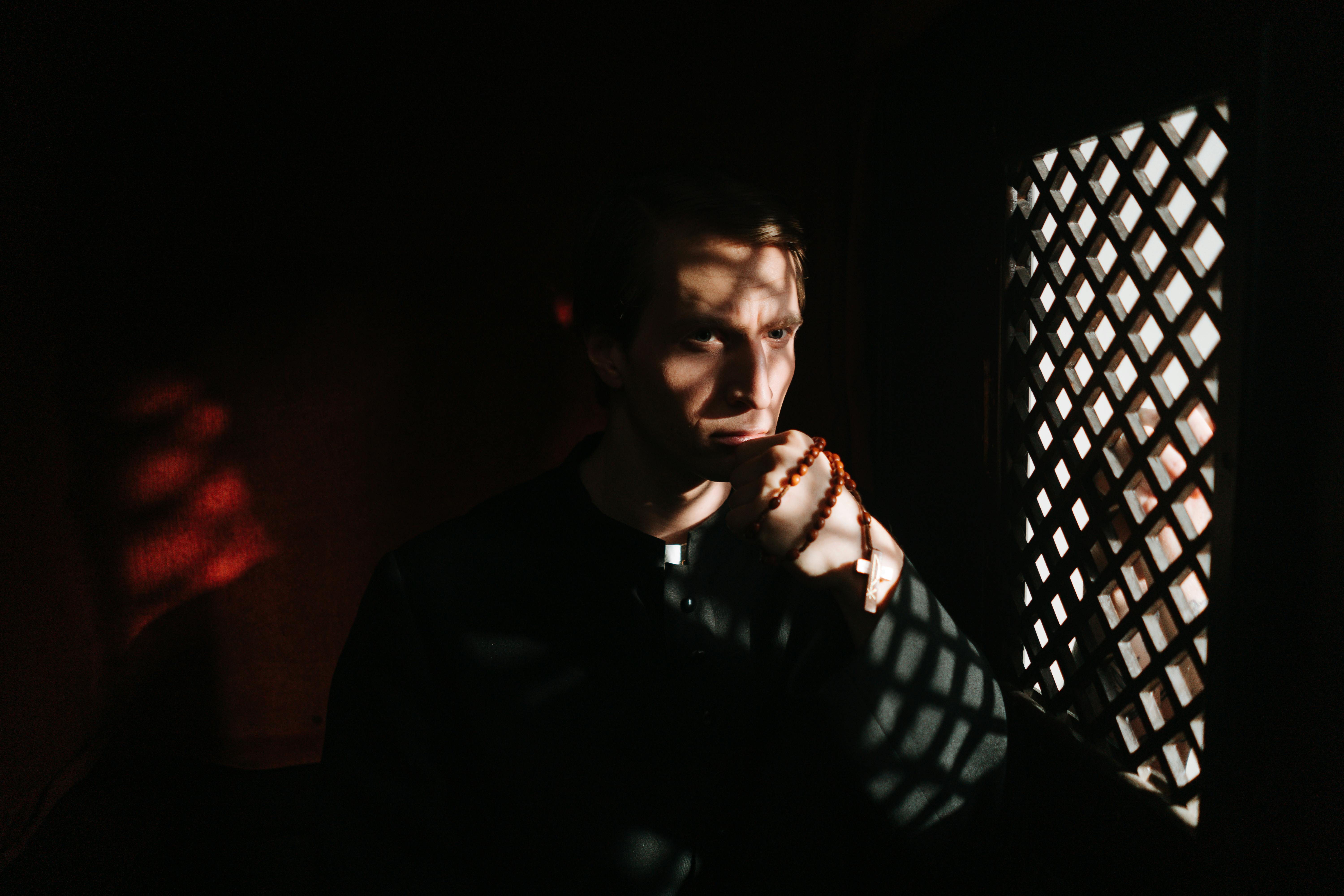
When we think about people leaving religion, we usually imagine ordinary believers quietly drifting away from faith. But there’s another group—smaller, quieter, and far more complicated—whose stories are rarely told: religious professionals who have lost their faith yet often continue to serve within their institutions. These are the nonbelieving clergy. Pastors, priests, rabbis, imams, ministers, monks, and nuns—people whose lives and identities are built around religious leadership but who privately no longer believe in God or the supernatural. Studying them might sound like a narrow niche, but in reality, this group offers one of the most revealing windows into how religion and nonreligion intersect.

For more than a decade, The Clergy Project (TCP)—an online support network for current and former religious professionals who no longer believe in supernatural[i]—has quietly provided a safe space for people in this position. Since its founding in 2011, TCP has grown to nearly 1,400 members from over 50 countries. My research draws on more than five years of engagement with TCP members, including interviews, surveys, and analysis of narratives across diverse traditions[ii]. These people once stood at the heart of religious institutions, trained to guide others in faith and ritual. Yet over time, they moved from supernatural belief to a naturalistic worldview. Their stories— often marked by secrecy, doubt, and deep moral struggle—offer rare sociological insight into what happens when belief collapses within the very institutions meant to sustain it.

The Hidden Side of Deconversion

For many people, leaving religion is already difficult. For clergy, it can be an identity earthquake. Their livelihoods, reputations, and social worlds are often tied to the institutions they serve[iii]. When belief collapses, it’s not just a private loss—it can mean losing family, community, income, and belonging all at once. Some clergy leave openly. But many stay, continuing to preach and perform rituals long after faith has faded[iv]. They do so for many reasons—financial stability, fear of rejection, stigma against nonreligion, or simply not wanting to hurt the people they love. Family is often central here. Many choose silence to avoid causing their parents or spouses pain, or making them feel like they failed as believers[v]. For example, Jim, an ex-clergy from Ontario, Canada, stated: “My mother is 80 and would not understand. It would be a tragedy for her. So, I keep it quiet.” Another poignant account comes from Oliver, a current Baptist deacon in South Africa, who remarked: “My exit strategy at this point in time is to continue maintaining my social life and ties to the church until my parents have passed on and my children have all finished High School. I have no intention of putting further strain on my parents, especially my mother whose health is not good. At that stage, after their death, I will make my lack of belief known and allow my children to decide for themselves the path of life they wish to follow.” This tension between authenticity and belonging produces what I call performative religiosity.[vi] It isn’t hypocrisy—it’s empathy and survival. These clergy navigate a world where their professional role demands belief, but their private conscience no longer allows it.

Behaving Without Believing

We often assume that religion is held together primarily by belief. For most members of TCP, that is indeed the case—once belief disappears, so does religious commitment, and they exit. Yet for others, who may wish to leave religion entirely but cannot due to social or material constraints, religion represents something deeper. It is sustained not only by faith, but by relationships. For many nonbelieving clergy, what keeps them within their religious communities is not doctrine but love—family bonds, communal rituals, shared expectations, or economic dependence, coupled with limited prospects for new employment if they were to come out openly. Another common factor is the pervasive anti-atheist stigma and the fear of ostracism[vii].

This is why studying this group can be valuable for scholars of nonreligion. Their experiences blur the neat boundary between “religious” and “nonreligious.” They reveal how people inhabit the gray zones in between—how belonging and behaving can outweigh believing, and how emotional and moral ties can sustain, or even compel, participation long after faith itself has faded. Such behaving without believing offers crucial insight into secularization. It reminds us that the shift toward nonreligion is not merely about the loss of faith, but also about how individuals and communities renegotiate identity, loyalty, and meaning when belief no longer aligns with behavior.

The Emotional Cost of Secrecy and Disclosure

What struck me most in these stories is the profound emotional cost of living a double life. Imagine standing before a congregation each week, preaching words you no longer believe, all while concealing your disbelief to protect your livelihood or shield your loved ones from distress. For many clergy, this state of secrecy becomes a kind of “closet”. The secrecy is exhausting, but often motivated by care. Remaining closeted can be a way of shielding loved ones from distress or confusion—a form of moral sacrifice that places compassion above personal authenticity[viii].

For those who do “come out” as nonbelievers, the costs can be equally severe—sometimes even greater. Coming out often entails the loss of employment, reputation, and community, and in some cases, family. What one experiences as intellectual honesty or existential integrity, others may interpret as betrayal, arrogance, or moral collapse. The aftermath can be devastating: profound loneliness, social exile, and the painful process of rebuilding one’s life from the ground up. Many of my respondents spoke of rejection not only from their congregations but also from close friends and even family members, including spouses and children. Divorce, isolation, and stigma are common outcomes. For those in midlife, the challenge is especially acute. After decades spent in ministry, many find themselves forced to begin again—searching for new communities, and new sources of meaning. The transition can be profoundly disorienting. Individuals who once served as moral authorities and spiritual guides within their congregations suddenly face the loss of that status and identity. Moving from the pulpit to ordinary forms of employment—driving a taxi, working as a substitute teacher, cleaning, or taking shifts in a supermarket—represents not only a practical adjustment but also an existential one. For many, it feels like a collapse of the very framework through which they once understood their purpose and self-worth. The contrast between who they were and who they have become often brings a deep sense of grief, humility, and alienation. For many, networks like TCP become lifelines—a place to find understanding and support amid upheaval.

Of course, it is essential not to overgeneralize from the example of clergy. They represent a distinctive and highly visible segment of the broader population of nonbelievers. Their experiences of deconversion and disclosure differ markedly from those of lay individuals. Even among clergy, the trajectories of loss and adaptation vary widely. Some choose public transparency—publishing memoirs, giving interviews, or engaging in activism—while others remain silent, disclosing their nonbelief only to a few trusted confidants.

The Clergy Project offers a rare glimpse into this hidden world. It reminds researchers that behind the public face of religion are private, untold stories that complicate our assumptions about faith, doubt, and belonging[ix]. These clergy are not villains or hypocrites. They are people caught in a web of obligations and compassion, trying to balance authenticity with care. Their stories illuminate the emotional, relational, and moral dimensions of deconversion that statistics alone can’t capture. By listening to them, we gain a fuller picture of what it means to move from belief to nonbelief—not as a sudden break, but as a deeply human journey through the spaces in between.

Endnotes


[i] Upon joining TCP, during the application process on the web-site and during the entrance interview, all members are required to declare that they no longer believe in the supernatural.  For example, they must check the box under the statement: “I consider myself to be a non-theist who does not believe in a supernatural dimension. Specifically, I do not believe in an order of existence that is beyond the visible observable universe appearing to transcend the laws of nature, a mystical dimension, an afterlife, or a god.” – See section “Becoming a TCP Participant” – https://clergyproject.org/nonbelieving-clergy-join/.

[ii] Zamușinski, Alexandr. 2025a. “Understanding the Role of the Clergy Project: Misconceptions and Realities of a Support Network for Nonbelieving Clergy”, Secularism and Nonreligion, 14(1), p. 1-14. https://doi.org/10.5334/snr.211.

[iii] Dennett, Daniel, and Linda LaScola. 2013. Caught in the Pulpit: Leaving Belief Behind. Durham: Pitchstone Publishing.

[iv] Zamușinski, Alexandr. 2025c. “Hidden Apostasy: What Prevents Nonbelieving Clergy from Disclosing Their Lack of Faith?” Journal of Contemporary Religion. 40(3) (pages TBD), October 2025. https://doi.org/10.1080/13537903.2025.2580133

[v] Ibid.

[vi] Ibid.

[vii] Zamușinski, Alexandr. 2025b. “How Anti-Atheist Prejudice Keeps Non-Believing Clergy Silent: The Clergy Project Participants Share Their Pain”. The Journal of Religion and Culture. Vol. 30 p. 5-34. https://www.jrc-concordia.ca/wp-content/uploads/2025/05/Article1_ZamusinskiAlex_JRCVol30_2025.pdf

See also Abbott, Dena, and Debra Mollen. 2018. “Atheism as a Concealable Stigmatized Identity: Outness, Anticipated Stigma, and Well-Being.” The Counseling Psychologist 46 (6): 685-707.

Frost, Jacqui, Christopher Scheitle, and Elaine Howard Ecklund. 2023. “Patterns of Perceived Hostility and Identity Concealment Among Self-Identified Atheists.” Social Forces 101 (3): 1580–1605.

[viii] Zamușinski, 2025c. See also Gull, B. (2021). ‘We Are the Women Our Parents Warned Us Against’: Identity Reconstruction and the Re-imagining of Gender After High-Cost Religious Disaffiliation. Symbolic Interaction 45 (1): 97-122.

[ix] See also Fader, Ayala. 2020. Hidden Heretics: Jewish Doubt in the Digital Age. Princeton: Princeton University Press.

Brewster, Melanie. 2014. Atheists in America. New York Chichester: Columbia University Press.

Brooks, Marshall. 2018. Disenchanted Lives: Apostasy and Ex-Mormonism Among the Latter-day Saints. New Brunswick: Rutgers University Press.

Cottee, Simon. 2015. The Apostates: When Muslims Leave Islam. London: C. Hurst & Co.

Beyond Smudge and Creator: Recognizing Indigenous Nonbelievers in Canada

Jonathan Simmons is a sociologist specializing in nonreligion, atheism, and religious change. He holds a PhD from the University of Alberta and is currently on staff at the University of Alberta. Email: jssimmon@ualberta.ca

Keywords: Indigenous nonreligion, atheism, secularism, Canada, spirituality

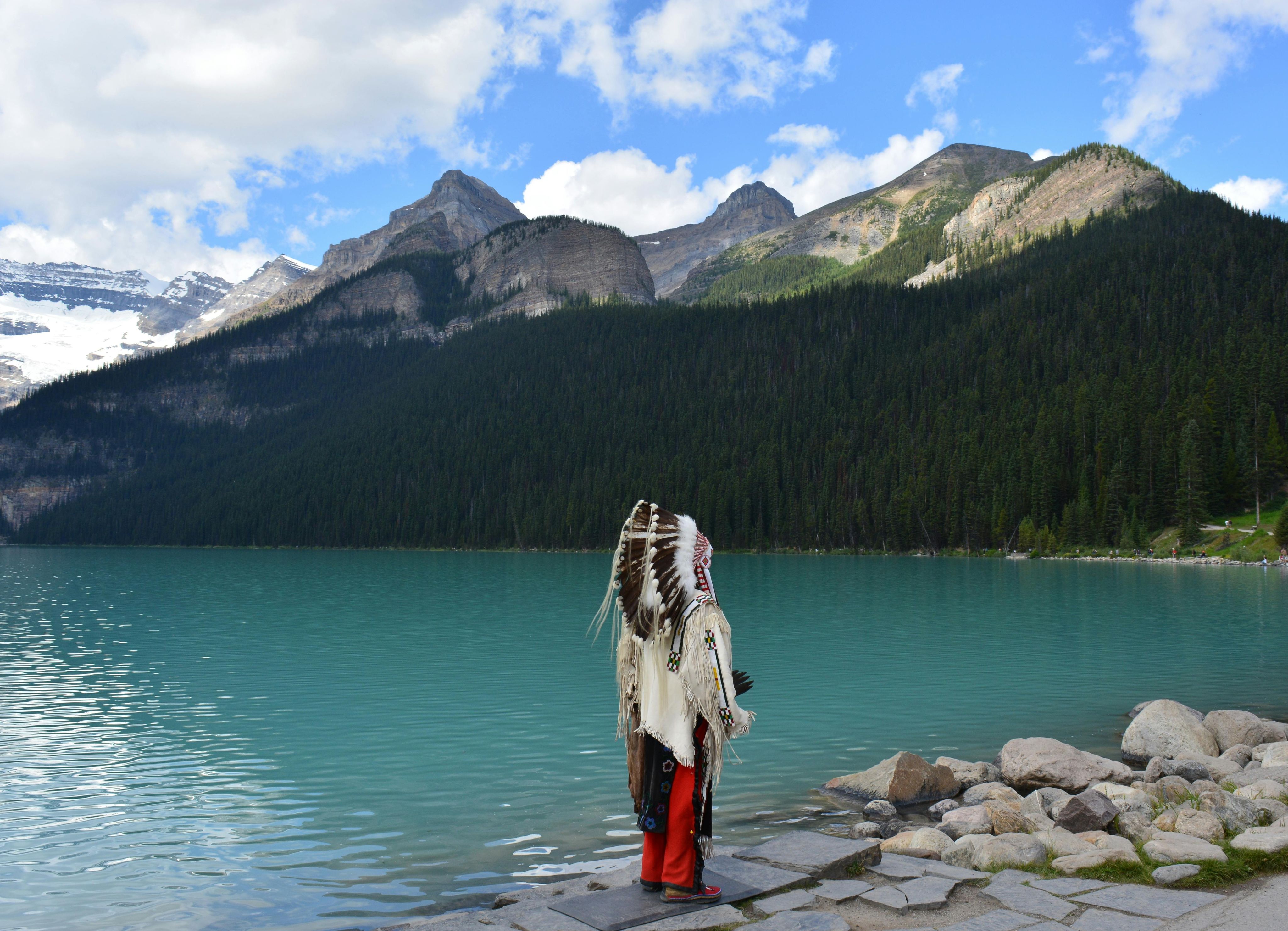
A common, often unexamined, assumption clouds discussions about Indigenous peoples in Canada: the conflation of Indigeneity and spirituality. This widespread idea suggests Indigenous identity is inherently and uniformly linked to spiritual beliefs and practices. Such a perspective, for example, often assumes universal participation in traditional ceremonies like smudging (a spiritual cleansing ritual) or a ubiquitous belief in a “Creator.” This view frequently overlooks the many Indigenous people who do not hold such beliefs, contributing to what can be termed the “invisible atheism” among Indigenous populations. This conflation creates a significant gap in our understanding and research of Indigenous nonreligion.


To fully appreciate this diverse population, clarifying “Indigenous” in the Canadian context is essential. The term encompasses First Nations, Métis, and Inuit peoples, the original inhabitants of the lands now known as Canada. These diverse nations and communities each possess unique cultures, languages, and histories spanning thousands of years. Understanding this immense cultural richness makes the prevailing research oversight concerning nonreligion all the more striking.

It is this gap that my own work seeks to address. My research, based on in-depth interviews with 18 Indigenous atheists in Canada, specifically challenges the pervasive assumption that Indigenous identity is monolithically spiritual. As I argue, “By overlooking Indigenous nonreligion, scholars not only miss an important aspect of atheist experiences, but they also perpetuate a Western-centric perspective that homogenizes Indigenous people as inherently spiritual and religious” [1]. This post aims to bring some of these research findings to a broader audience.

Data from Canada’s 2021 Census underscores this diversity. Nearly half of Indigenous people reported “No religion and secular perspectives,” a significant increase from 20% in 2011. This category, as Statistics Canada clarifies, includes those identifying as atheist, agnostic, or humanist. In contrast, about 4.5% reported “Traditional (North American Indigenous) spirituality” [2]. These figures clearly demonstrate a substantial and growing nonreligious demographic among Indigenous peoples in Canada. Recognizing this diversity is necessary for supporting Indigenous self-determination. For international readers, this principle affirms the right of Indigenous peoples to freely determine their political status and pursue their economic, social, and cultural development. Indeed, for such self-determination to be authentic and effective, it must be based on an accurate understanding of Indigenous communities in all their variety, including their nonreligious members, ensuring all voices can shape their collective future.

My research identifies various pathways Indigenous individuals take toward nonreligious identities, with intellectual inquiry being one of the most common. Many participants described a process of systematically questioning supernatural claims in favor of scientific or evidence-based explanations. This commitment to a consistent, evidence-based worldview was a core theme. For example, one participant, whose perspective is further detailed in my forthcoming work (Simmons, forthcoming 2026), explained that his sense of intellectual consistency (and humility) required him to examine traditional spiritual claims with the same critical lens he used for Christianity. He felt it would be dishonest to reject one set of beliefs for lacking evidence while accepting another without that same scrutiny [3]. This is not unique to a Canadian context. It in fact strongly parallels recent findings by Rahmani, Adds, and Senanayake (2024) in their work with Māori atheists in Aotearoa New Zealand. They also identified a pattern of “intellectual doubt,” where participants described a similar process of elimination in examining and rejecting religious frameworks [5]. This parallel across different Indigenous communities underscores the significance of this skeptical, evidence-based pathway to a nonreligious identity.

This critical stance sometimes extends to how Indigenous ways of knowing are positioned against what some participants termed “regular science.” While the Canadian government and many Indigenous scholars rightly advocate for recognizing Indigenous Science as a distinct, time-tested knowledge system, some Indigenous atheists in my research expressed a clear preference for empirical, non-supernatural explanations of the world, applying their skepticism broadly. This careful navigation of knowledge systems is also articulated by other Indigenous thinkers. David “Maheengun” Cook, an Anishinaabe atheist humanist, for example, emphasizes the importance of epistemological clarity, valuing cultural heritage alongside the distinct methods of scientific inquiry. [4].

Religious trauma also contributes significantly to Indigenous individuals becoming nonreligious. The devastating legacy of Canada’s residential schools is central here. These church-run institutions inflicted deep intergenerational harm. For many, this trauma directly leads to a rejection of organized religion and, for some, extends to all supernatural beliefs. A poignant familial example captures this sentiment: “I didn’t realize that it’s 100% a response to residential school. [My father’s] atheism isn’t just philosophical; it’s a direct reaction to religious trauma” [3]. Such responses to colonial religious imposition, framing atheism as a decolonizing act, are not unique to Canada. Similar motivations are found among Māori atheists in Aotearoa New Zealand, who often view the rejection of colonial religion as a form of resistance and cultural reclamation [5].


The experience of being an Indigenous atheist is often marked by navigating stigma. Many of my participants felt societal pressure to believe, and worried about being judged, sometimes fearing that openly identifying as atheist could be seen as a betrayal of their culture or as not being “‘Native’ enough” [1]. This pressure to conform can lead to what I term “navigating disclosure,” where individuals carefully manage how and when they reveal their nonbelief.


The growing presence of Indigenous nonbelievers has important consequences for ongoing reconciliation efforts. Reconciliation aims to build a renewed, respectful relationship between Indigenous peoples and Canadian society. If public understanding and institutional responses are based on the conflation of Indigeneity and spirituality, however, these efforts may fall short. For example, initiatives creating “smudge-friendly spaces” in public institutions, while intended to affirm Indigenous cultures, are centered on a spiritual practice. This focus can inadvertently marginalize Indigenous atheists, agnostics, or those of other faiths. While the provision of culturally relevant spiritual support is rightly seen as vital for many Indigenous individuals seeking to connect with their heritage and find healing, particularly in challenging environments such as correctional facilities [6], it is equally important that public understanding and institutional responses do not presume universal spirituality. Such presumptions risk deepening what my research identifies as a growing divide within Indigenous communities between those who practice traditional spirituality and those who embrace a more secular and naturalistic worldview [1]. Inclusivity requires acknowledging the full spectrum of Indigenous (non)belief.

A nuanced perspective is also important in areas like healthcare. My research found that for some participants, “spirituality” was associated with “complementary and alternative medicine, magic, and various contemplative practices,” and some expressed concern that “spirituality and pseudoscience often went together” [1]. While traditional Indigenous medicines hold cultural value, some nonreligious Indigenous people may prioritize evidence-based medical treatments exclusively, particularly if they perceive some traditional spiritual healing practices as lacking empirical support. An overemphasis on traditional spirituality in healthcare, without acknowledging secular or skeptical Indigenous perspectives, can create tension. Recognizing diverse Indigenous viewpoints is key to developing healthcare that is both culturally sensitive and medically effective.

A critical advancement in Indigenous studies and related disciplines necessitates moving beyond simplistic, spiritualized conceptualizations of Indigenous peoples. Future research must prioritize the recognition of Indigenous individuals as contemporary subjects possessing a wide spectrum of beliefs, experiences, and identities. Engaging with this inherent heterogeneity does not constitute a dilution of Indigenous identity; rather, it affirms its dynamism and resilience.

Endnotes

[1] Simmons, J. (2024). Indigenous Atheists in Canada: Challenging Assumptions and Navigating Belonging. Secular Studies, 6(1), 62–83. [Page 64 for “By overlooking…”; Page 63 for “Jackie” quote; Page 74 for “Native enough”; Page 71 for “spirituality and pseudoscience”]. doi:10.1163/25892525-bja10060.

[2] Statistics Canada. (2022). Table 98-10-0288-01 Religion by Indigenous identity: Canada, provinces and territories. Release date: October 26, 2022. Retrieved from https://tinyurl.com/37z6n4tn.

[3] Simmons, J. (forthcoming 2026). De-Converting from North American Religious Traditions. In The Oxford Handbook of Apostasy and Religious Deconversion. Eds. Zuckerman and Zamușinski.

[4] Jacobsen, S. D. (2025, April 22). Navigating Indigenous Identity and Atheist Humanism. Humanists International Blog. (https://humanists.international/blog/navigating-indigenous-identity-atheism-humanism/; the content is based on an interview with David “Maheengun” Cook).

[5] Rahmani, M., Adds, P., & Senanayake, R. (2024). Māori atheism: a decolonising project? Kōtuitui: New Zealand. Journal of Social Sciences Online, 19(4), 522-541. doi:10.1080/1177083X.2024.2333544. Available at https://doi.org/10.1080/1177083X.2024.2333544

[6] See, for example, Tetrault, J. E. C. (2022). Indigenizing Prisons: A Canadian Case Study. Crime and Justice, 51(1), 637-680. doi:10.1086/720943. Tetrault’s research highlights the value incarcerated Indigenous peoples place on Indigenized programming, including spiritual supports, for cultural connection and healing.

PhD position in nonreligion

Three full-time four-year paid PhD positions are available at the School of Theology and Religious Studies, University of Tartu. The positions are fully funded and successful candidates will be hired as Junior Research Fellows for the duration of their PhD studies.

There are no predetermined research areas or focuses, the candidate has to propose one’s own topic – and projects on nonreligion are very welcome. For that, contact dr Atko Remmel: atko.remmel@ut.ee.

NB! Application deadline is very soon, May 15. For more information see https://usuteaduskond.ut.ee/en/news/open-call-three-full-time-paid-phd-positions-theology-and-religious-studies.

NSRN Annual Lecture 2025

You are cordially invited to the NSRN Annual Lecture 2025, which will be given by Anna Strhan and Rachael Shillitoe. The title of the lecture is Growing Up Godless: Childhood and the Formation of Non-Religion.

How are children’s non-belief and non-religion formed in everyday life? While previous studies have shown that what happens during childhood is crucial in driving the growth of non-religious populations, we know little about the experiences of the growing numbers of children for whom being non-religious is the “new normal” or about how their non-religion and non-belief are formed in everyday life. Drawing on rich ethnographic fieldwork and in-depth interviews with children, their parents, and teachers across different parts of England, this lecture addresses this scholarly gap, examining the formation of children’s non-religious identities and perspectives and how these relate to shifting moral landscapes.

The lecture will take place via Zoom on May 22, 2025, 9.30 am PDT / 12.30 pm EDT / 5.30 pm BST / 6.30 pm CEDT.

Registration is open at: https://ut-ee.zoom.us/meeting/register/riF2v789QDGz_i_3JK1_Zw.

New Book: Families and Religion (2025)

Families and Religion: Dynamics of Transmission across Generations

Edited by Christel Gärtner, Linda Henning, Olaf Müller.

This comparative study examines the transmission of religion in families in Germany, Italy, Hungary, Finland and Canada. The authors rely on the widely shared argument that religious change can primarily be understood as an intergenerational process. Based on a mixed-methods design, the book investigates the question of how, when exactly and under what conditions the following generations become less religious than the previous ones. From the perspective of familial and historical generations, the authors examine the significance of (religious) socialization for the transmission of (non-)religious worldviews, affiliation, practice, and identity. According to a central finding, religious change takes place primarily in the phase of adolescence against the background of the respective social context.

Link to publisher’s website.

NSRN 2025 conference CfP – Extended

Nonreligion and Secularity Research Network Conference

8-10 September 2025

Institute of Ethnology and Social Anthropology at the Slovak Academy of Sciences, Comenius University in Bratislava, Slovakia

Scholarly discussions on nonreligion often begin by noting that nonreligion and its related phenomena are primarily studied within Western, particularly Anglophone contexts, with recent efforts to expand global perspectives. However, these broad categorizations – “Western,” “Anglophone,” or “global North or South” – oversimplify the notable diversity of nonreligion within those demarcations. Various phenomena that are considered nonreligious emerge from complex intersections of national histories, political contexts, and religious influences – or the absence thereof – while simultaneously being shaped by global media and generational dynamics.

The Nonreligion and Secularity Research Network (NSRN) invites paper and session proposals for its 2025 conference, Nonreligion and Secularity at Cultural Crossroads. We aim to explore how secularity and nonreligion function and are manifested in various contexts, social and cultural interconnections, and power relations. Potential topics include, but are not limited to:

  • Theoretical and methodological challenges of studying nonreligion and secularity – (alternative) conceptualizations of nonreligion; liminalities and ambiguous forms of nonreligion; nonreligion and language
  • Nonreligion among minority and majority populations – how its reach affects the perceived boundaries of nonreligion and its “important others”
  • Virtual secularities and nonreligion – how nonreligion is shaped within social networks on the internet
  • Secularity and state – different aspects of the position of non-religion in different states; regional and global forms and manifestations of nonreligion
  • Nonreligion and values – nonreligion in changing cultural landscapes and how the cultural context influences what is considered nonreligion
  • Nonreligion and demographics – the aspects of age, gender, and generations, socialization into nonreligion

We welcome scholars at any career stage (we especially encourage PhD-students) from sociology, anthropology, religious studies, demography, and other fields to apply and bring interdisciplinary approaches and methodologies.

The 2025 NSRN conference will take place as a face-to-face conference that will be held in partnership with the Institute of Ethnology and Social Anthropology at the Slovak Academy of Sciences, Bratislava, Slovakia, and Comenius University in Bratislava.

We expect the participants who present their papers, to join us in person in Bratislava, Slovakia from 8-10 September 2025. However, there will be an opportunity to listen to the presentations and ask questions via Zoom throughout the conference. There will be no fee to attend the 2025 NSRN conference either in person or virtually.

Instructions for submitting session and paper proposals:

Each individual may only present one paper at the 2025 conference, on top of being a co-author on other papers, chairing/organizing a session, and/or being part of an author-meets-critics session. Each session will be allocated a 1h30min time slot during the conference.

To submit a paper proposal:

  • Title of the paper
  • Abstract of the paper (max. 150 words)
  • First and last name, institutional affiliation, title/position, and contact e-mail address of the primary author
  • First and last name(s), institutional affiliation(s), title(s)/position(s), and contact e-mail address(es) of the co-author(s) (if applicable)

To submit a session proposal (with 3-4 papers and a chair):

  • Title of the session
  • Abstract of the session (max. 150 words)
  • First and last name(s), institutional affiliation(s), title(s)/position(s), and contact e-mail address(es) of the session chair and organizer
  • Titles of each of the (3-4) papers
  • Abstracts of each of the (3-4) papers (150 words max. each)
  • First and last names, institutional affiliations, titles/positions, and contact e-mail addresses for each paper’s primary author and co-author(s)

To submit an author-meets-critics session:

  • Book title, publication year, and press
  • Book abstract (150 words max.)
  • First and last name, institutional affiliation, title/position, and contact e-mail address of the session organizer
  • First and last name(s), institutional affiliation(s), title(s)/position(s), and contact

e-mail address(es) of the book’s author(s)

  • First and last names, institutional affiliations, titles/positions, and contact e-mail addresses for each of the (2-4) critics

All paper and session proposals must be e-mailed to nsrnconference2025@gmail.com by the end of the day on 31 March 2025. Notifications of acceptance will be e-mailed to conference participants by April 15, 2025. Preliminary program will be sent out by the end of May 2025, registration date is June 30, 2025 at the latest.

For any questions, please contact us by e-mail at nsrnconference2025@gmail.com.