
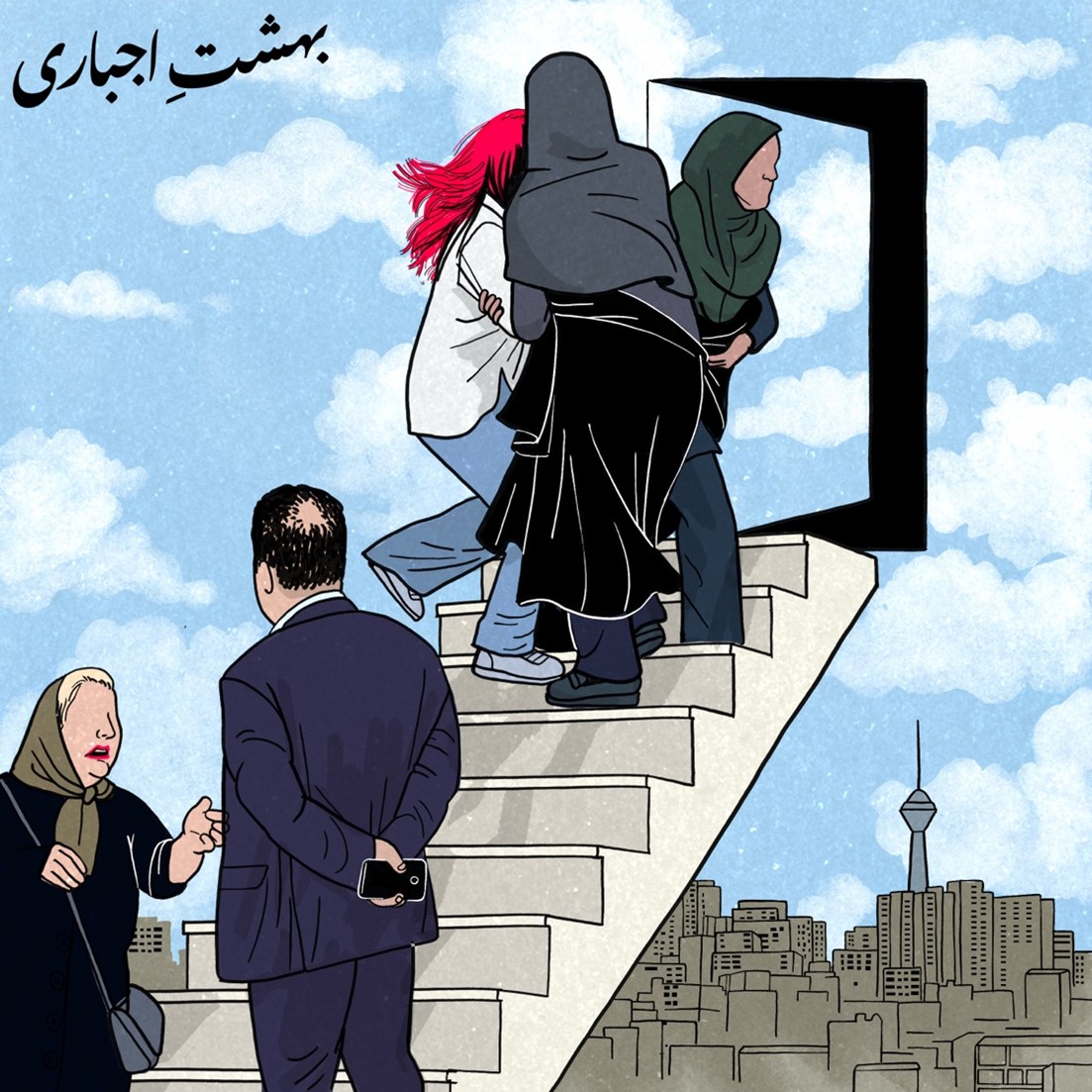
Mandatory Heaven. Digital illustration by Elham Ataieazar. Posted on Instagram @elham.ataeiazar, April 18, 2024.
Blog post description: In a forthcoming chapter in the Oxford Handbook of Apostasy and Religious Deconversion, edited by Phil Zuckerman and Alexandr Zamușinski, Pooyan Tamimi Arab and Ammar Maleki present survey evidence showing that unbelief and nonreligiosity in Iran are nationwide phenomena. To do so, they experimented with conducting surveys via social media and communication apps and what they call VPN sampling to circumvent state-induced fear that affects conventional face-to-face or telephone surveys.
Pooyan Tamimi Arab is Associate Professor of Secular and Religious Studies at Utrecht University and PI of Iran’s Secular Shift, a mixed methods project funded by the Dutch Research Council. He is a member of GAMAAN, the Group for Analyzing and Measuring Attitudes in Iran. Email: p.tamimiarab@uu.nl.
Keywords: Iran, secularization, atheism, surveys, preference falsification.
It isn’t novel to highlight the fact of secularization in Iran. This process has long been observed by social scientists, humanities scholars, artists, writers, and journalists. Anxious clerics and worried political leaders have decried it. Millions of ordinary citizens in the country, as well as their friends and families in the diaspora, have, in one way or another, experienced the trend in their lifetime.
In academic studies on Iran, the concept of secularization is often used to describe trends in changes in institutions, discourses, and behaviors. Declining identification as Muslims is also described, but less so. An obvious reason for this has been a decades-long lack of reliable quantitative evidence.
Questionable, totalizing numbers, on the other hand, have from the start played a role in the legitimation of the Islamic Republic. In 1979, when a referendum established Iran’s new political system, the ominous coupling of “Islamic” with “Republic” was justified by a 98% Yes vote. The new republic sought the strong establishment of Islam in the state, so strong that Islam could permeate all of society, from squares and streets to schools, hospitals, and cemeteries, to even citizens’ homes, and, when they resisted, it violated the space of their inner convictions in inquisition-like show trials. That’s why the country’s political system became internationally known as a theocracy, and rightly so, one that in the 1980s mass executed its opponents, who were accused of apostasy, atheism, and heresy, in what Shahin Nasiri, a philosopher and a scholar of these atrocities, has described as “religious genocide.”[i]
Iran, imagined with this dark history in mind, served many in academia as an example of the possibility of the reversibility of secularization, as, for instance, in Jürgen Habermas’s 2019 tome, Also A History of Philosophy.[ii]
Survey research and census data have supported the totalitarian image of a society in which all identify as the same, as Muslims, if not earnestly, then at least by name. The little attention to unbelievers is striking, given that those familiar with Iranians know that irreligiosity and even antireligious sentiments, which grew in reaction to the theocratic state,[iii] are widely prevalent. In the Oxford Handbook of Atheism, the anthropologist Samuli Schielke writes that Atheists in much of the Islamic world are publicly invisible, making them “difficult to estimate.” He also writes, however, that in Iran they constitute a “small minority” of 0.1%,[iv] based on the 2005 World Values Survey results, i.e., based on a face-to-face survey. The percentage identifying as Muslim that year was 98.7%. Surveys conducted through landline telephones produced the same picture, and the latest Iranian census to date, conducted in 2016, went so far as to claim that 99.5% of the population were Muslims. Conventional surveys also reported overwhelming support for theocracy. Spectacular iconoclastic events, such as women setting fire to the mandatory hijab in 2022, and protestors even setting fire to mosques in 2026, however, have pushed international audiences to recognize a different reality.
In a chapter in the forthcoming Oxford Handbook of Apostasy and Religious Deconversion, Ammar Maleki and I present survey evidence that unbelief and nonreligiosity in Iran are nationwide phenomena. We conducted survey experiments that take the phenomenon of preference falsification, caused by a fear of the state, seriously. Our survey research – conducted as GAMAAN, the Group for Analyzing and Measuring Attitudes in Iran – started by sampling through social media and communication applications. We then moved to include VPN sampling and finally came to rely on it.
VPN sampling means the survey was distributed directly to people in Iran when they connected their devices to the tool. We’ve done this work in voluntary collaborations, primarily with Psiphon VPN alongside Lantern VPN and MahsaNet, a free tool used by 4 to 7 million Iranians every day in the 2020s, with peaks of around 10 million. This year, after the Internet shutdown following the mass murder of protestors in January and the subsequent war with the United States and Israel, tools facilitating connections – VPNs and apps like Psiphon’s Conduit – became more urgent than ever: connections spiked in May, when access was restored, but at the time of writing have fallen back below the levels seen in previous years.
In other words, our approach is designed in response to the Islamic Republic’s censorship, which is among the world’s most extreme. Over the years, the regime blocked commonly used apps and websites such as YouTube, Instagram, and WhatsApp. The high Internet penetration in Iran – 85% of the population uses the Internet – and the unusually high usage of VPN tools to circumvent state censorship – according to some estimates, as high as 90% of all users – allow for combining scale and anonymity in a nonprobability survey that depends on users themselves opting in. In September 2025, for example, in between wars and information lockdowns, we were able to collect thirty thousand secured responses from inside Iran.
While this would obviously introduce sampling bias, as is the case in all nonprobability surveys, the alternative isn’t convincing. If many Iranians don’t answer honestly on the sensitive topic of religion, there really isn’t much the survey researcher can do to figure out the truth. The fact that leaving Islam or converting to another religion is illegal in Iran, and can be – and has been – met with capital punishment shouldn’t be underestimated. But if respondents do tell us the truth, because we can guarantee their anonymity, we can weight the data and thus produce a sample that is as representative as possible, considering the situation in Iran. This hypothesis was confirmed by actually conducting the surveys and finding out about the diversity of Psiphon users.
Sometimes, assumptions about who are likely to participate in our surveys and thus the direction of sampling bias turned out to be correct. For example, educated people participate more often, though many thousands without higher education, in some surveys even tens of thousands, also participate. Sometimes, however, assumptions, such as that tech-savvy youngsters would participate more often, turn out to be incorrect. We found that VPN sampling is more effective at obtaining samples from middle-aged people. The features of Iran’s digital context, including digital behavior, should, in other words, be examined rather than assumed.
To test representativeness, we compare our survey results on politically nonsensitive questions with probability surveys’ results, for example, on which healthcare insurance people have, or which language they speak at home (for sample characteristics, weighting information, and external benchmark tests see the survey reports at gamaan.org; for a presentation about our approach, see this WAPOR methodology webinar).
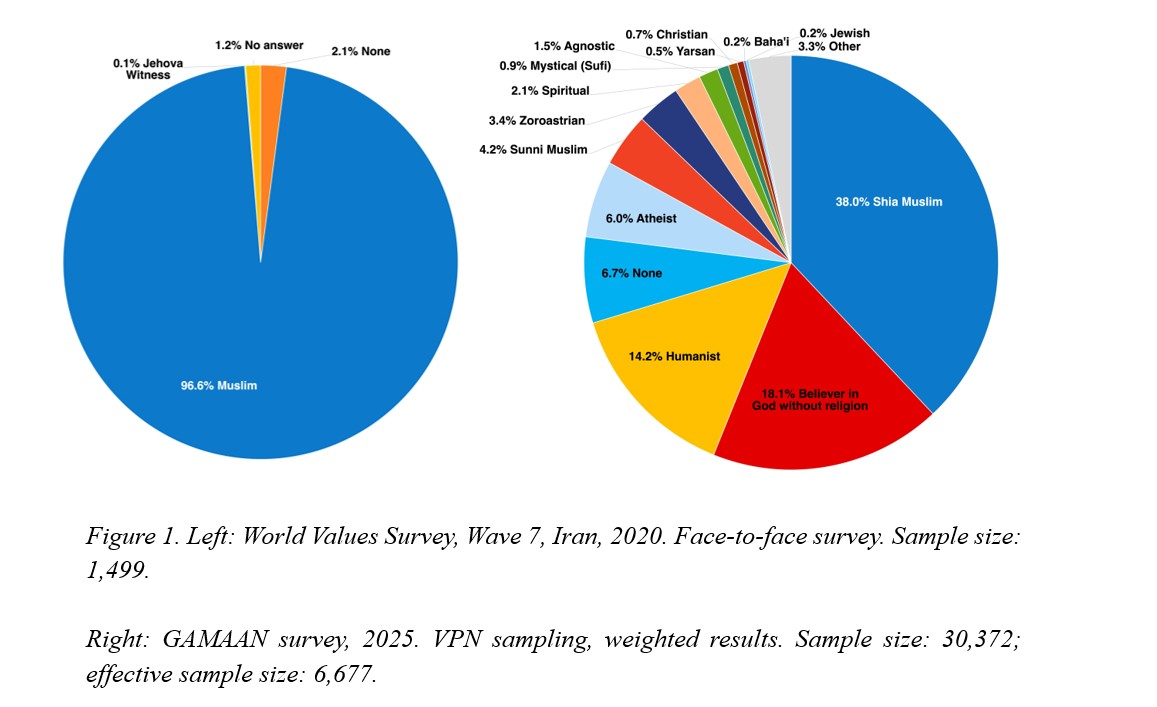
But the point of this work isn’t only to say that we can approximate the target population of literate adults. It’s to show that, in some cases, as with the question on religious identification, the results don’t merely reveal a different quantitative degree of an existing reality but a qualitatively different one. Instead of a homogeneous picture, as provided by the World Values Survey in 2020, in which only one stubborn Jehovah’s Witness accounts for the country’s minority religions, GAMAAN’s diagram shows persecuted identities like Atheist and Baha’i that often don’t even show up in conventional surveys’ results. Other results denote a contextually meaningful move away from institutional religion, such as those who identify as Humanists or Nonreligious Believers.
Focusing on Atheists (in Persian: ātiīst or khudānābāvar, meaning “nonbeliever in God”), we found that their share is much higher than previously estimated, at around 6%. They are also not limited, as the stereotype would have it, to young, urban, educated, wealthy people.
Across three surveys conducted with VPN sampling between 2023 and 2025 – using the same survey question, identity labels, and weighting based on the most recently available demographic statistics – we found that the percentage of Atheists remained consistent. At the same time, clear patterns emerge: highly urbanized provinces such as Tehran and Alborz show slightly higher percentages (7–8%), while more rural provinces such as South Khorasan, Sistan and Baluchistan, and Kerman score a few points lower. As far as we know, this is the first time that survey evidence has shown that Atheists live in all of Iran’s provinces.
As expected, we found that people under the age of 30 are two or three times as likely to identify as Atheists when compared with those between 30 and 50 years old, and those above 50. But that also means that unbelievers are present in all age categories. Similarly, Atheists tend to have higher incomes and higher education levels than people who identify with other labels. But the phenomenon of unbelief is not at all limited to these demographic groups either. The assumption that poor people must be extremely religious, and that they support the Islamic Republic, is probably more affected by prejudice than that it’s based on quantitative evidence.
In other words, secularization isn’t fully determined by class or intellectual elite status, as it isn’t elsewhere either.[i] In fact, our weighted results show that the majority of self-identified Atheists had not received higher education.
These findings support the general view that modernization contributes to secularization. But in Iran, contemporary secularization isn’t facilitated by a state that guarantees religious freedom. Rather, it emerges in a digitally connected society that is aware of the freedoms available elsewhere in the world and is shaped by disillusionment with Iran’s theocratic political system.
Forthcoming chapter:
Tamimi Arab, P., and Maleki, A. In press. “Unbelief and Nonreligiosity in Iran: Survey Evidence for Nationwide Phenomena.” In The Oxford Handbook of Apostasy and Religious Deconversion, edited by Phil Zuckerman and Alexandr Zamușinski.
[i] Cragun, Ryan T., and Jesse M. Smith. 2024. Goodbye Religion: The Causes and Consequences of Secularization. New York: New York University Press, pp. 46–48.
[i] Nasiri, Shahin. 2025. Clerical Sovereignty and its Absolute Others: Religious Genocide in Iran. Journal of Genocide Research. Online preprint.
[ii] Habermas, Jürgen. 2023 [2019]. Also a History of Philosophy, Volume 1: The Project of a Genealogy of Postmetaphysical Thinking. Translated by Ciaran Cronin. Cambridge: Polity, p. 20.
[iii] See, for example, Khosrokhavar, Farhad. 2024. Revolt Against Theocracy: The Mahsa Movement and the Feminist Uprising in Iran. Cambridge: Polity.
[iv] Schielke, Samuli. 2013. “The Islamic World.” In The Oxford Handbook of Atheism, edited by Stephen Bullivant and Michael Ruse, 638–650. Oxford: Oxford University Press, pp. 647–648.
 NSRN Online