Unbelief and Nonreligiosity in Iran: Survey Evidence for a Nationwide Phenomenon

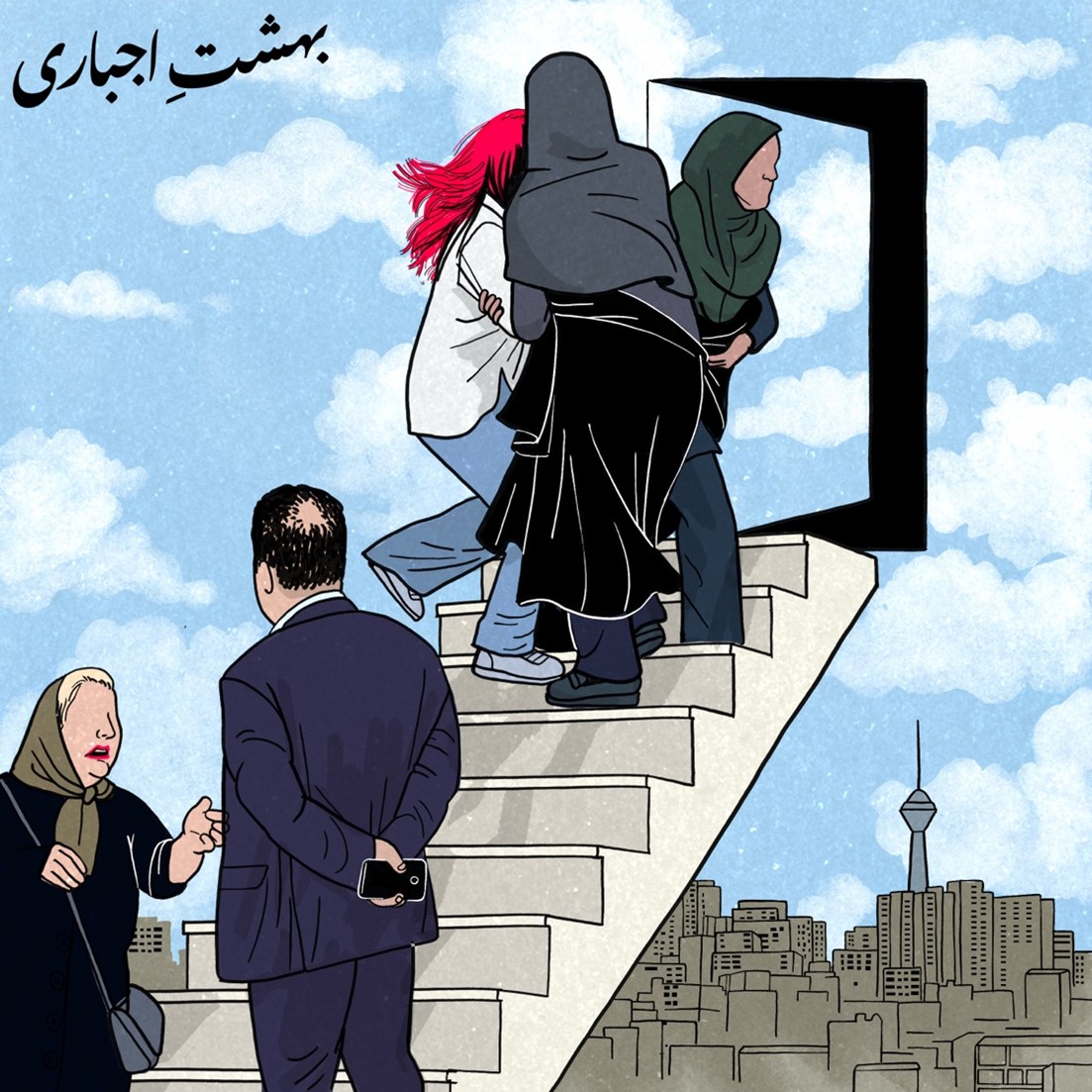
Mandatory Heaven. Digital illustration by Elham Ataieazar. Posted on Instagram @elham.ataeiazar, April 18, 2024.

Blog post description: In a forthcoming chapter in the Oxford Handbook of Apostasy and Religious Deconversion, edited by Phil Zuckerman and Alexandr Zamușinski, Pooyan Tamimi Arab and Ammar Maleki present survey evidence showing that unbelief and nonreligiosity in Iran are nationwide phenomena. To do so, they experimented with conducting surveys via social media and communication apps and what they call VPN sampling to circumvent state-induced fear that affects conventional face-to-face or telephone surveys.

Pooyan Tamimi Arab is Associate Professor of Secular and Religious Studies at Utrecht University and PI of Iran’s Secular Shift, a mixed methods project funded by the Dutch Research Council. He is a member of GAMAAN, the Group for Analyzing and Measuring Attitudes in Iran. Email: p.tamimiarab@uu.nl.

Keywords: Iran, secularization, atheism, surveys, preference falsification.

It isn’t novel to highlight the fact of secularization in Iran. This process has long been observed by social scientists, humanities scholars, artists, writers, and journalists. Anxious clerics and worried political leaders have decried it. Millions of ordinary citizens in the country, as well as their friends and families in the diaspora, have, in one way or another, experienced the trend in their lifetime.

In academic studies on Iran, the concept of secularization is often used to describe trends in changes in institutions, discourses, and behaviors. Declining identification as Muslims is also described, but less so. An obvious reason for this has been a decades-long lack of reliable quantitative evidence.

Questionable, totalizing numbers, on the other hand, have from the start played a role in the legitimation of the Islamic Republic. In 1979, when a referendum established Iran’s new political system, the ominous coupling of “Islamic” with “Republic” was justified by a 98% Yes vote. The new republic sought the strong establishment of Islam in the state, so strong that Islam could permeate all of society, from squares and streets to schools, hospitals, and cemeteries, to even citizens’ homes, and, when they resisted, it violated the space of their inner convictions in inquisition-like show trials. That’s why the country’s political system became internationally known as a theocracy, and rightly so, one that in the 1980s mass executed its opponents, who were accused of apostasy, atheism, and heresy, in what Shahin Nasiri, a philosopher and a scholar of these atrocities, has described as “religious genocide.”[i]

Iran, imagined with this dark history in mind, served many in academia as an example of the possibility of the reversibility of secularization, as, for instance, in Jürgen Habermas’s 2019 tome, Also A History of Philosophy.[ii]

Survey research and census data have supported the totalitarian image of a society in which all identify as the same, as Muslims, if not earnestly, then at least by name. The little attention to unbelievers is striking, given that those familiar with Iranians know that irreligiosity and even antireligious sentiments, which grew in reaction to the theocratic state,[iii] are widely prevalent. In the Oxford Handbook of Atheism, the anthropologist Samuli Schielke writes that Atheists in much of the Islamic world are publicly invisible, making them “difficult to estimate.” He also writes, however, that in Iran they constitute a “small minority” of 0.1%,[iv] based on the 2005 World Values Survey results, i.e., based on a face-to-face survey. The percentage identifying as Muslim that year was 98.7%. Surveys conducted through landline telephones produced the same picture, and the latest Iranian census to date, conducted in 2016, went so far as to claim that 99.5% of the population were Muslims. Conventional surveys also reported overwhelming support for theocracy. Spectacular iconoclastic events, such as women setting fire to the mandatory hijab in 2022, and protestors even setting fire to mosques in 2026, however, have pushed international audiences to recognize a different reality.

In a chapter in the forthcoming Oxford Handbook of Apostasy and Religious Deconversion, Ammar Maleki and I present survey evidence that unbelief and nonreligiosity in Iran are nationwide phenomena. We conducted survey experiments that take the phenomenon of preference falsification, caused by a fear of the state, seriously. Our survey research – conducted as GAMAAN, the Group for Analyzing and Measuring Attitudes in Iran – started by sampling through social media and communication applications. We then moved to include VPN sampling and finally came to rely on it. 

VPN sampling means the survey was distributed directly to people in Iran when they connected their devices to the tool. We’ve done this work in voluntary collaborations, primarily with Psiphon VPN alongside Lantern VPN and MahsaNet, a free tool used by 4 to 7 million Iranians every day in the 2020s, with peaks of around 10 million. This year, after the Internet shutdown following the mass murder of protestors in January and the subsequent war with the United States and Israel, tools facilitating connections – VPNs and apps like Psiphon’s Conduit – became more urgent than ever: connections spiked in May, when access was restored, but at the time of writing have fallen back below the levels seen in previous years.

In other words, our approach is designed in response to the Islamic Republic’s censorship, which is among the world’s most extreme. Over the years, the regime blocked commonly used apps and websites such as YouTube, Instagram, and WhatsApp. The high Internet penetration in Iran – 85% of the population uses the Internet – and the unusually high usage of VPN tools to circumvent state censorship – according to some estimates, as high as 90% of all users – allow for combining scale and anonymity in a nonprobability survey that depends on users themselves opting in. In September 2025, for example, in between wars and information lockdowns, we were able to collect thirty thousand secured responses from inside Iran.

While this would obviously introduce sampling bias, as is the case in all nonprobability surveys, the alternative isn’t convincing. If many Iranians don’t answer honestly on the sensitive topic of religion, there really isn’t much the survey researcher can do to figure out the truth. The fact that leaving Islam or converting to another religion is illegal in Iran, and can be – and has been – met with capital punishment shouldn’t be underestimated. But if respondents do tell us the truth, because we can guarantee their anonymity, we can weight the data and thus produce a sample that is as representative as possible, considering the situation in Iran. This hypothesis was confirmed by actually conducting the surveys and finding out about the diversity of Psiphon users.

Sometimes, assumptions about who are likely to participate in our surveys and thus the direction of sampling bias turned out to be correct. For example, educated people participate more often, though many thousands without higher education, in some surveys even tens of thousands, also participate. Sometimes, however, assumptions, such as that tech-savvy youngsters would participate more often, turn out to be incorrect. We found that VPN sampling is more effective at obtaining samples from middle-aged people. The features of Iran’s digital context, including digital behavior, should, in other words, be examined rather than assumed.

To test representativeness, we compare our survey results on politically nonsensitive questions with probability surveys’ results, for example, on which healthcare insurance people have, or which language they speak at home (for sample characteristics, weighting information, and external benchmark tests see the survey reports at gamaan.org; for a presentation about our approach, see this WAPOR methodology webinar).
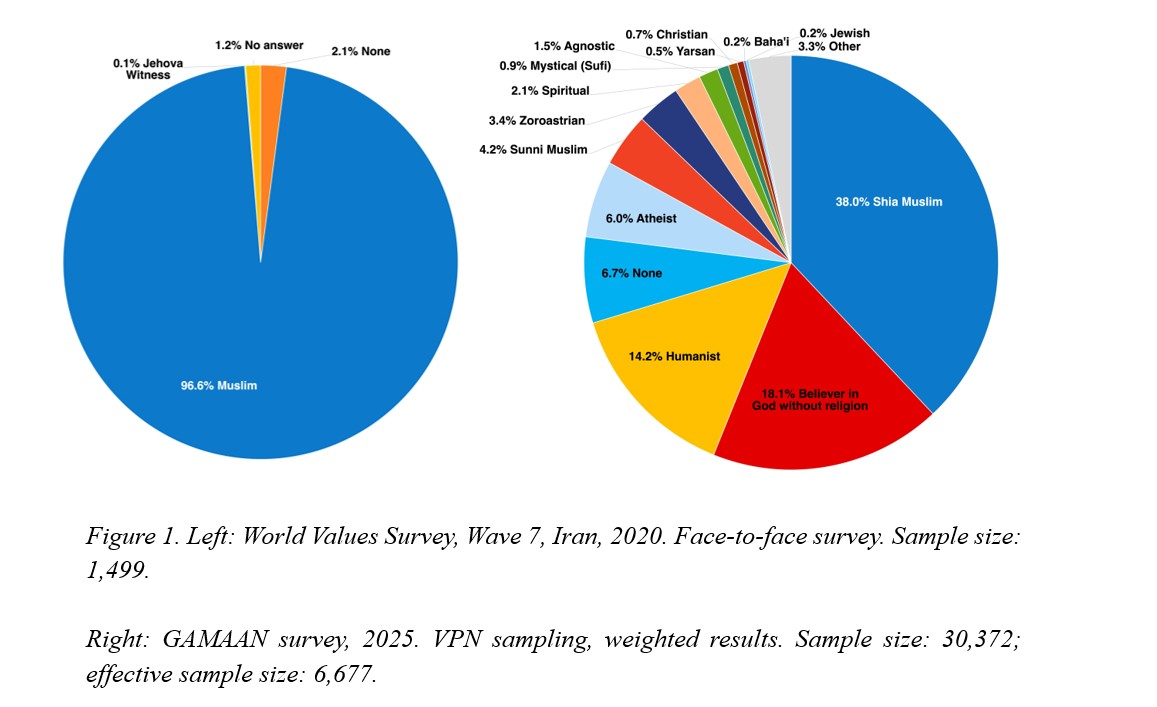
But the point of this work isn’t only to say that we can approximate the target population of literate adults. It’s to show that, in some cases, as with the question on religious identification, the results don’t merely reveal a different quantitative degree of an existing reality but a qualitatively different one. Instead of a homogeneous picture, as provided by the World Values Survey in 2020, in which only one stubborn Jehovah’s Witness accounts for the country’s minority religions, GAMAAN’s diagram shows persecuted identities like Atheist and Baha’i that often don’t even show up in conventional surveys’ results. Other results denote a contextually meaningful move away from institutional religion, such as those who identify as Humanists or Nonreligious Believers.

Focusing on Atheists (in Persian: ātiīst or khudānābāvar, meaning “nonbeliever in God”), we found that their share is much higher than previously estimated, at around 6%. They are also not limited, as the stereotype would have it, to young, urban, educated, wealthy people.

Across three surveys conducted with VPN sampling between 2023 and 2025 – using the same survey question, identity labels, and weighting based on the most recently available demographic statistics – we found that the percentage of Atheists remained consistent. At the same time, clear patterns emerge: highly urbanized provinces such as Tehran and Alborz show slightly higher percentages (7–8%), while more rural provinces such as South Khorasan, Sistan and Baluchistan, and Kerman score a few points lower. As far as we know, this is the first time that survey evidence has shown that Atheists live in all of Iran’s provinces. 

As expected, we found that people under the age of 30 are two or three times as likely to identify as Atheists when compared with those between 30 and 50 years old, and those above 50. But that also means that unbelievers are present in all age categories. Similarly, Atheists tend to have higher incomes and higher education levels than people who identify with other labels. But the phenomenon of unbelief is not at all limited to these demographic groups either. The assumption that poor people must be extremely religious, and that they support the Islamic Republic, is probably more affected by prejudice than that it’s based on quantitative evidence. 

In other words, secularization isn’t fully determined by class or intellectual elite status, as it isn’t elsewhere either.[i] In fact, our weighted results show that the majority of self-identified Atheists had not received higher education.

These findings support the general view that modernization contributes to secularization. But in Iran, contemporary secularization isn’t facilitated by a state that guarantees religious freedom. Rather, it emerges in a digitally connected society that is aware of the freedoms available elsewhere in the world and is shaped by disillusionment with Iran’s theocratic political system.

Forthcoming chapter:

Tamimi Arab, P., and Maleki, A. In press. “Unbelief and Nonreligiosity in Iran: Survey Evidence for Nationwide Phenomena.” In The Oxford Handbook of Apostasy and Religious Deconversion, edited by Phil Zuckerman and Alexandr Zamușinski.


[i] Cragun, Ryan T., and Jesse M. Smith. 2024. Goodbye Religion: The Causes and Consequences of Secularization. New York: New York University Press, pp. 46–48.


[i] Nasiri, Shahin. 2025. Clerical Sovereignty and its Absolute Others: Religious Genocide in Iran. Journal of Genocide Research. Online preprint.

[ii] Habermas, Jürgen. 2023 [2019]. Also a History of Philosophy, Volume 1: The Project of a Genealogy of Postmetaphysical Thinking. Translated by Ciaran Cronin. Cambridge: Polity, p. 20.

[iii] See, for example, Khosrokhavar, Farhad. 2024. Revolt Against Theocracy: The Mahsa Movement and the Feminist Uprising in Iran. Cambridge: Polity.

[iv] Schielke, Samuli. 2013. “The Islamic World.” In The Oxford Handbook of Atheism, edited by Stephen Bullivant and Michael Ruse, 638–650. Oxford: Oxford University Press, pp. 647–648.
Who are the Non-Seculars? A (Tongue-in-Cheek) Call for the Study of a Strange Group

Nathan G. Alexander is a lecturer in history at the University of Ottawa, Canada, and project manager of the Nonreligion in a Complex Future Project. He is also the author of Race in a Godless World: Atheism, Race, and Civilization, 1850-1914 (NYU Press).

Much research in the field of secular studies understandably focuses on secular people. But more and more scholars are beginning to ask: What about the non-seculars? Who are they, and what do they believe?

It is true that the number of non-seculars is shrinking in many societies, but they are far from unimportant. In fact, they still make up a significant percentage – and in some cases even the majority – of western countries. In Canada, for example, non-seculars make up an eye-popping 65% of the population, according to the 2021 census.

Yet for too long, these non-seculars have escaped scholarly notice. This is a call for secular studies scholars to pay attention to the non-seculars and to devise a research program that will begin to investigate this “strange” group who has long been hiding in the shadows. Here I will lay out some of the critical questions such a research program might address.

There is a crisis of meaning in western societies. A research program would ask how non-seculars make meaning in their lives. (Of course, this is assuming that they can indeed have meaning in their lives, something far from certain.) Scholars have long known that secular people find meaning through a variety of methods, like being part of a community, pursuing hobbies, and engaging in creative pursuits, but it is less clear how non-seculars find meaning. Do non-seculars also pursue these common activities, or do they find meaning through uncommon practices, like reciting ancient texts, or gathering together at the same building at weekly intervals?

On the question of meaning – or lack thereof – for non-seculars, one hypothesis is that they yearn for secularity. They may even experience secular alienation: the state of being estranged from the place of secular fulfillment.[1] If this is so, researchers may seek to understand how this secular alienation can be overcome. Are non-seculars unhappy because they are not secular, and, for example, are they more likely to become alcoholics for this reason? We do not have answers to these questions yet, but they should be investigated through careful empirical study.

At a more fundamental level, research about non-seculars would seek to understand why non-seculars are the way they are. That is, why do they not become secular like so many of their fellow citizens? What psychological mechanisms explain why some remain non-secular or even convert to non-secularity if they were raised secular? In short, is there something different about the brains of non-seculars? Perhaps there is even a “secular spot” located in the brain that non-seculars lack. MRI scans of the brains of non-seculars may well yield valuable clues to these questions.

What do non-seculars believe? How do they make sense of the world outside the usual secular frameworks? Do they believe in science and naturalism, or do they believe in something else (angels, demons, deities, etc.)? Do they share commonly-held beliefs that death represents the end of life, for example, or do they have other beliefs (heaven, hell, ghosts, etc.)?

There is great diversity among non-seculars and already scholars have identified different ways of categorizing them.[2] Some, for example, are non-secular in name only. That is, while some activities they pursue may lead them to be classified as non-secular, in actual fact, their beliefs and behaviours closely align with secular people, making them almost indistinguishable. Some non-seculars, meanwhile, are simply done with secularity and have embraced a life of permanent non-secularity. They will never be won over to the secular fold, apparently content to remain non-seculars forever, with no hope of persuasion. Another subsection, the zealous non-seculars, actually seek to convert secular people to non-secularity, for example through door-knocking campaigns or by speaking through megaphones on busy streets. These non-seculars are often the most well-known given their public visibility, though they do not represent the majority of non-seculars.

Readers who have made it this far may object to the labelling of these curious people as “non-seculars.” Does this not create a negative label for this group, or frame them only in relation to the default category of secular people? These are valuable points, but it is hard to imagine an alternative term to describe this group. Some scholars have proposed terms like “a-seculars” or “un-seculars,” but, despite the nuanced reasonings in favour of such terms, they all contain the same fundamental problem. This remains an ongoing issue in the study of non-seculars.

It is hoped this short note opens the minds of scholars to consider the non-seculars more deeply. A major funding proposal to study the non-seculars is currently in preparation by the author. He is having fun experimenting with a distinctly non-secular practice by praying for its success.

The above has obviously been satirical. The point I am hoping to make is to ask us – whether we come from a religious or nonreligious perspective – to reflect on what we consider, even subconsciously, the “default” or “normal” in society, and what is the “unusual” thing that is thus in need of explanation. Using satire to flip these assumptions on their head could allow us to see things in a new way and invite new kinds of questions and answers. As our societies continue to undergo religious shifts, continually asking ourselves what counts as the “normal” state of affairs will be essential.


[1] Taking inspiration from the project, “Spiritual Yearning and the Problem of Spiritual Alienation”: https://www.templeton.org/grant/spiritual-yearning-and-the-problem-of-spiritual-alienation

[2] Taking inspiration from The Nones Project: https://www.thenonesproject.com/

‘Christianity Showed Its Face’: The Role of Power in the Process of Christian Exiting and Formation as a Religious None

Tess Starman, Howard University

Keywords: secularization, politicized religion, deconstruction, deconversion


U.S. Christianity has seen a sharp decline in affiliation over the last 20 years. Scholars have often associated this decline with the growing secularization of society and other forces including industrialization, rationalization, and urbanization.[i] However, one alternative explanation for religious decline is the concept of political backlash, positing that Christianity’s growing conservativeness has led moderates and liberals to reject religion.[ii] Given the increasing association of Christianity with republicanism in the public square and growing nationalism, I aimed to see how political backlash might be at play in Christianity’s accelerating decline in the United States.  

My work aims to test how Christianity’s maintenance and support of larger societal systems of inequality have contributed to disaffiliation and deconversion. My larger dissertation study answers several research questions: (1) What is the process of leaving Christianity, and how does Christianity’s maintenance of power systems impact this process? and (2) How do ex-Christians form their social and political identity after leaving religion? Here I present three key findings from preliminary analysis of interviews with 58 ex-Christians.

Building Discontentment

Participants were overwhelmingly committed Christians who had robust knowledge of tradition and scripture. This commitment to their religion led most to explore inconsistencies from a young age. For many, their questions date back to learning about the biblical creation story. A biblically literal seven-day creation story conflicted with what they learned about in library books and science classes. When Matt (a 30-something Black male ex-Evangelical) learned about the creation story, he recalls asking his pastor, “but what about the dinosaurs?” Matt felt disappointed in the reductionistic answer from his pastor: “well they just must not have made it onto the arc.” He also felt this answer did not match with an image of God as master and creator of all things. Why create dinosaurs, only to have them die in the flood?

Other commonly discussed sources of discontent amongst participants were a lack of women in leadership and anti-LGBTQ sentiment. Jules (a 30-something white female ex-Mainline protestant) noted her discontentment with the role of women in her church:

“There were no women in “real” leadership roles, like the only woman ‘leader’ was the worship pastor who was also the lead pastor’s wife… But they never let women preach. It always bothered me, but not enough to say something about it, like I get you using the bible and this tradition of patriarchy to justify these gender roles.”

These topics were early and ongoing sources of discomfort with religion. Questions or inconsistencies themselves were just one side of the discontentment coin; the other side was that religious authorities lacked in-depth critical engagement with these issues. Nearly all participants attempted to reconcile these feelings of tension on their own, engaging in a deeper study of scripture and church history. In other words, their initial response was not to pull away, but to lean in.

Pivotal Movement  

While attempts to reconcile inconsistencies and discontentment varied, all participants came to a pivotal moment where they felt they could no longer be part of Christianity. Oftentimes, this moment was neither large nor devastating, but simply one final straw that broke the camel’s back. Rose (a 30-something white female ex-Evangelical) shared her pivotal moment:

“I was invited to dinner at this church family’s house. I had been to dinner there several times and they were so inclusive of me as a single person in the church. I had known them for maybe 4-5 years at this point. When we’re getting ready to sit down for dinner, [the son] looked at me and said, ’I am missing a $20 from my wallet… did you take it? No, [he laughed] you didn’t take my money, you’re not Black.’ and I was appalled…It was willful ignorance, and that, coupled with everything else, was the turning point for me.”

Like Rose, many participants’ pivotal moments revolved around maintenance of systems of power, or more specifically, Christianity’s support of sexism, heteronormativity, racism, and conservative-bent nationalism. Sometimes moments came in direct response to an event, but other moments were smaller, internal dialogues. Amber’s (a 30-something white female Ex-Mainline) pivotal moment occurred when reading an article about Christian support of Trump before the 2020 election and thinking, “this is not my religion.” Avery (a 20-something Black gender queer ex-Evangelical) described a similar moment before the 2016 election: “Evangelical Christianity showed its face, and I couldn’t be a part of it anymore.” A seemingly decisive moment came after years of trying to see love and goodness in what they described as a “toxic religion.” Carlos (a 30-something Latino) eloquently described this process as an avalanche. All of the questions, problems, and tensions were not individually enough to walk away. But eventually one more light snowfall creates an avalanche, thus dismantling a mountain of faith.

Political and Social Formation as a None

Since leaving Christianity, participants shared that they feel more free to express progressive and liberal social attitudes. Many participants noted their direct support for abortion access, the Black Lives Matter movement, belief in gender equity, support for LGBTQIA+ rights, and many more progressive and contrarian attitudes. Most describe these attitudes as a direct response to their religious socialization, be it an internal response as a coping mechanism or a social response as a form of activism.

Even when Christian, many participants believed in these stances as fundamentally just, but they were not able to express that in their religious context. Others note that they supported and even participated in the pro-life movement and patriarchal and white supremacist structures, but after leaving their religion, they reassessed and changed their stances on these topics. Many are taking intentional efforts to engage in the political process or social movements to try and undo some of the wrong they believed they did while Christian. Some attended women’s marches and free Palestine rallies, while others found smaller forms of resistance, like assessing their household’s gendered division of labor.

Each participant’s social and political formation as a non-religious person is complex, with many seeking mental health services and communities of other ex-Christians for support. Leaving religion is greater than leaving a community. It involves leaving a worldview, belief systems, support network, and sometimes, family.  

These preliminary findings lend support to the proposed political backlash concept. The unique politicization and growing ideological conservatism of Christianity in the United States has been a direct catalyst for many to opt out of religion. While each story is unique and nuanced, many formerly devoted Christians recognize recent politicization as an example of Christianity’s use of power to maintain the status quo. Unwilling to be complicit and unable to reconcile this with their lived experiences and surrounding social realities, they feel like they have no option but to leave.


Tess Starman (she/they) is a PhD Candidate in Sociology at Howard University. Her research specializes on intersections of race, gender, sexuality, and power at the nexus of religion and politics. She studies progressive Christian attitudes, religious exiting, and religion’s impact on political attitudes and engagement. Her dissertation, entitled, “A Corrupted Faith: The Role of Power in the Process of Christian Disaffiliation and Rise of the Religious Nones,” examines the religious exiting process and non-religious identity formation of ex-Christians. She serves as the Research Assistant for Howard University’s Initiative on Public Opinion. Tess is the co-chair of the American Sociological Association’s Student Advisory Board and serves on the Pedagogy Committee of Sociological Forum


References

[i] See for example Calhoun, Juergensmeyer, and VanAntwerpen 2011; Kasselstrand, Zuckerman, and Cragun 2023; Voas and Chaves 2016

[ii] See for example Chaves 2017; Fischer and Hout 2008

Calhoun, Craig, Mark Juergensmeyer, and Jonathan VanAntwerpen, eds. 2011. Rethinking Secularism. Oxford: Oxford University Press.

Chaves, Mark A. 2017. American Religion: Contemporary Trends. Second. Princeton, NJ: Princeton University Press.

Fischer, Claude S., and Michael Hout. 2008. “How Americans Prayed: Religious Diversity and Change.” in Century of Difference: How America Changed in the Last One Hundred Years (The Russell Sage Foundation Census Series), edited by C. S. Fischer and M. Hout. New York: Russell Sage Foundation.

Kasselstrand, Isabella, Phil Zuckerman, and Ryan T. Cragun. 2023. Beyond Doubt: The Secularization of Society. New York: NYU Press.

Voas, David, and Mark Chaves. 2016. “Is the United States a Counterexample to the Secularization Thesis?” American Journal of Sociology 121(5):1517–56. doi: 10.1086/684202.


[CFP] SocRel Response Day 2016

SocRel Response Day 2016: Connecting for Change: emerging research and policy on religion and belief in the public sphere

Friday 21st October, 10 a.m. -4 p.m.

BSA Meeting Room, Imperial Wharf, London

Keynote Speaker: Professor Tariq Modood (University of Bristol)

The public sphere has been both prominent and turbulent in recent times, and in common with other interests and disciplines, the study of religion and belief has been exploring the questions which are raised. From the role of faith in public life, to media representations, legal cases and controversies, and the future of school RE, a plethora of research and reports has been underway which connect religion and belief with policy and practice. This event will present key examples, with an emphasis on sociology of religion, including as it connects with other disciplines, and with policy and practice.

The goal is to explore the connections between religion and belief research, policy and the public sphere through presentations, questions and discussions. We invite proposals for papers and/or (small) panels of 40 minutes (including time for questions), which present research which has connected with – or is planned to – any aspect of policy or practice (such as education, health, housing, welfare, law, employment, politics, government and others).

Registration now open: http://portal.britsoc.co.uk/public/event/eventBooking.aspx?id=EVT10587

Key Dates:

  • Abstract submission closes: 9th September 2016
  • Decision notification: 13th September 2016
  • Registration closes: 7th October 2016

To deliver a paper, please send an abstract of no more than 250 words, alongside a biographical note of no more than 50 words. To deliver a panel, please send an abstract of no more than 500 words alongside a biographical note of no more than 50 words for each contributor. Please send abstracts to Professor Adam Dinham at a.dinham@gold.ac.uk by Friday 9th September 2016.

Costs: £36.00 for BSA members; £41 for Socrel members; £46.00 for non-members; £15 for BSA Concessionary members; £20.00 for Socrel Concessionary members; £25.00 for non-members concessionary.

Should you have any queries about the day, please do not hesitate to contact the event organizers, Professor Adam Dinham a.dinham@gold.ac.uk or Rachael Shillitoe r.shillitoe@worc.ac.uk. For further details, visit the SocRel website www.socrel.org.uk.  For further details about the BSA visit www.britsoc.co.uk

New Books in NSRN Book Series

The NSRN and De Gruyter are pleased to announce the first three publications in their book seriesReligion and its Others: Studies in Religion, Nonreligion, and Secularity:

For more on the series, see here: http://nsrn.net/book-series/

Download Flyer

NSRN Series 2

CFP: Rethinking Boundaries in the Study of Religion and Politics

Postgraduate Conference: Rethinking Boundaries in the Study of Religion and Politics

11-12 September 2015

University of Aberdeen

Submission Deadline: 19 June 2015

A common approach to the study of religion and politics frames the inquiry using boundaries. Such boundaries include religion/secular, private/public, belief/practice and theism/atheism, to name just a few. It may be argued that these categorisations are analytically useful in understanding social phenomena because, for example, what is ‘religious’ should be analysed in relation to what is ‘secular.’ Another approach may instead point to the problem with the construction of such binaries in that empirically these distinctions become blurred, so that framing an action, for example as ‘public’ or ‘private’, does not reflect the diversity of human experience. Continue reading

CFP: International Conference on Religion and Spirituality in Society

Sixth International Conference on Religion and Spirituality in Society

23-24 May 2016

The Catholic University of America


Washington D.C., USA

Current Submission Deadline*:
 18 March 2015

PLEASE NOTE: The Fifth International Conference on Religion and Spirituality in Society is taking place at the University of California at Berkley, 16-17 April 2015. Proposals are still being accepted for a short time. Click here for more details.

Continue reading

CFP: The European Conference on Ethics, Religion and Philosophy 2015

The European Conference on Ethics, Religion and Philosophy 2015

Thistle Brighton, Brighton, East Sussex, United Kingdom

Monday, July 6, 2015 – Wednesday, July 8, 2015 (All Day)

Abstract Submission Deadline: March 1, 2015 

Registration Deadline for Presenters: June 1, 2015

Abstract Submission Process: In order to present at the conference, your abstract must first pass a double blind peer review. Upon payment of registration fees, your presentation will be confirmed.

  • Results of abstract reviews returned to authors: Usually within two weeks of submission
  • Full paper submission: August 1, 2015

How to Submit


Ways to Present

Individual Presenter (30 minutes)The standard format for presentation — oral presentations are thirty minutes in length.Poster Presenter (90 minutes)Posters allow presenters to reach a large audience and engage interested participants directly. These sessions give participants a chance to network with other delegates who may be interested in similar research or other disciplines.Virtual Presenter. Some presenters will be unable to make the trip to the UK to present their paper, mainly due to financial and/or political restrictions on travel. Virtual presentations allow authors the same publication opportunities as regular presenters.

  • We do not allow presentations by video-conferencing but presenters have the opportunity to submit a video of their presentation, which will be placed on the official YouTube channel. Information on how to do this will be sent following registration.
  • Following the conference you will be mailed a conference pack, including a printed receipt of payment, certificate of participation, and a printed copy of the conference programme.

Workshop (60 to 90 minutes) A workshop is a brief intensive course lasting 60 to 90 minutes led by an experienced practitioner, usually someone with a PhD. It emphasises group interaction and the exchange of information usually amongst a smaller number of participants than at a plenary session.Often a workshop involves problem solving, skills training, or the dissemination of new content or disciplinary approaches. Conference workshops are typically more instructional and interactive in nature than oral presentations and involve participants working with the workshop leader on a particular topical issue.Panel (90 minutes) As the organiser of a proposed panel, submit a proposal for the panel through the online system.

  • Panels must have at least four participants (including the chair).
  • All the panel participants must be listed in the submission, with the chair leader as the primary author, and the other presenters as co-authors.
  • If your proposal is accepted you will be invited to register for the conference. Please ensure that you send the submission reference number to the other members of your panel and have them register in a timely fashion. Upon payment of the registration fee of all participants, your panel will be scheduled in the conference programme.
  • If you, as the panel chair, wish to publish a joint paper associated with the panel in the conference proceedings, please upload one through the online system.
  • If you and your panel members wish to publish separate papers, they may register individually and submit their proposals for review.

Conference Theme and Streams

Conference Theme: “Power

The conference theme is “Power” and the organizers encourage submissions that approach this theme from a variety of perspectives. However, the submission of other topics for consideration is welcome and we also encourage sessions within and across a variety of disciplines and fields related to Ethics, Religion and Philosophy, including the following streams:

Philosophy:

  • Philosophy and Religion
  • Philosophy and the Arts
  • Philosophy and Public Policy
  • Philosophy and Technology
  • Philosophy and Culture
  • Philosophy and Education
  • Philosophy and Peace Studies
  • Comparative Philosophy
  • Linguistics, Language and Philosophy

Ethics:

  • Medical Ethics
  • Business and Management Ethics
  • Ethics in Education
  • Ethics, Law, and Justice
  • Ethics and Globalization
  • Ethics and Science
  • Comparative Ethics
  • Linguistics, Language and Ethics

Religion:

  • Theism and Atheism
  • Feminism and Religious Traditions
  • Religion and Education
  • Religion and Peace Studies
  • Mysticism, Faith, and Scientific Culture
  • Interfaith Dialogue
  • Comparative Religion
  • Linguistics, Language and Religion

Interdisciplinary:

  • Conflict Resolution and Mediation Studies

For further information – please see the ECERP2015: Call For Papers website.

Event: American Academy of Religion Annual Meeting

American Academy of Religion Annual Meeting

22-25 November 2014

San Diego, CA, USA

The American Academy of Religion brings thousands of professors and students, authors and publishers, religious leaders and interested laypersons to its Annual Meeting each year. Co-hosted with the Society of Biblical Literature, the Annual Meetings are the largest events of the year in the fields of religious studies and theology. More than 1,000 events—academic sessions, additional meetings, receptions, tours, and workshops—will be offered.

Most sessions will take place at the San Diego Convention Center located at 111 W Harbor Drive, San Diego, CA 92101. Conference hotels are located within easy walking distance of the Convention Center. San Diego is just 120 miles south of Claremont, CA, where the 2014 NSRN Conference takes place 19-20 November. Several NSRN presenters and attendees will also be present at the AAR Annual Meeting.

Tomorrow: LSE Forum on Religion, featuring Audra Mitchell and Stacey Gutkowski

LONDON SCHOOL OF ECONOMICS

DEPARTMENT OF ANTHROPOLOGY – Programme for the Study of Religion and Non-religion

FORUM ON RELIGION

Date: Wednesday, 23 January 2013
Time: 16.30-18.00
Venue: Seligman Library (OLD 6.05), Old Building, LSE

Speakers:


Audra Mitchell (University of York)
‘Bringing Secularity (Back) into International Relations: Immanence, Agency and Intervention’

and

Stacey Gutkowski (King’s College London, Middle East and Mediterranean Studies Programme)
‘Secular Ways of War’


http://www2.lse.ac.uk/anthropology/research/PRNR/Events/events.aspx