Call for Papers – New Forms of Public Religion 5-7 September 2012


Please see below, details of CFP for a conference on New Forms of Public Religion organised as part of the  AHRC/ESRC funded Religion and Society Programme. The conference will take place at the Divinity School, St John’s College, Cambridge, CB2 1TW

Call for Papers

The fact that religion has not privatised, but remains an important aspect of public life, is now well recognised.  But talk of ‘public religion’ can be vague and unfocused. The aim of this conference is to explore – with new findings – the forms which public religion is taking today, not only in the West, but elsewhere in an increasingly connected world.

The conference streams indicate the main arenas in relation to which public religion will be discussed, and on which papers are invited. Additional suggestions are also welcome:

  • The Market and Religion
  • Politics and Religion
  • Law and Religion
  • Religion, Media and Civil Society
  • Violence (State and Non-state) and Religion
  • Religion in Public Places and Spaces
  • Religion, Health and Welfare
  • Religion and Education
  • Religion and Migration

Speakers include:

Lori Beaman

José Casanova

The Rt Hon Charles Clarke

Grace Davie

Pamela Dickey-Young

Stewart Hoover

The Rt Revd Graham James

Meredith McGuire

Nancy Nason-Clark

Jim Spickard

Linda Woodhead

The conference will showcase thirty or so projects funded by the Religion and Society Programme which have new findings in this area. These will be supplemented by the papers received through this open call.

Individual paper proposals (max. 200 words) should be submitted to:  Peta Ainsworth:  p.ainsworth@lancaster.ac.uk by 30th April 2012.

The conference is subsidised by the sponsors and costs £100 per delegate, £50 for postgraduates/unwaged (for the entire conference) or £50 per day, £25 for postgraduates/unwaged.  The conference fee excludes accommodation and evening meals.  For further details and registration go to:http://www.religionandsociety.org.uk/events/programme_events/show/new_forms_of_public_religion

A limited number of bursaries are available for postgraduates in the UK who need to travel some distance to Cambridge.  Please send an email with your registration form to Peta Ainsworth stating in one paragraph why you require assistance and how much your travel costs will be.

Stathis Gourgouris, Lessons in Secular Criticism, Thinking Out Loud 2012

Thinking Out Loud: The Sydney Lectures in Philosophy and Society” aims to bring a leading international thinker to UWS annually to present a series of public lectures. The lectures presented by each speaker will have a common theme and they will subsequently be published by Fordham University Press.

  • Lecture 1: Monday, 21 May, “Secular Criticism as Poetics and Politics”
  • Lecture 2: Wednesday, 23 May, “Why I Am Not A Post-Secularist”
  • Lecture 3: Friday, 25 May, “The Prohibitive Politics of Political Theology”

Times: 5.30 pm (for 6 pm) to 8 pm
Place: State Library of New South Wales, Metcalfe Auditorium

Registering is essential for each lecture. You can register on the State Library’s website.
Click to register for Lecture 1Lecture 2Lecture 3.

Download the Seminar Flyer

Deadline reminder 27 April 2012 and Updated CFP for the NSRN Annual Conference

NONRELIGION AND SECULARITY RESEARCH NETWORK 

CONFERENCE 2012

Call for Papers| 4-6 July 2012, Goldsmiths, University of London

 Nonreligion and the Secular: New Horizons for Multidisciplinary Research

Registration now open!

Conveners: Lois Lee (ll317@cam.ac.uk), Stacey Gutkowski (stacey.gutkowski@kcl.ac.uk), and Stephen Bullivant (stephen.bullivant@smuc.ac.uk)

Conference Coordinator: Katie Aston (k.aston@gold.ac.uk)

There is an urgent need to bring discussions of micro-level nonreligion, atheism and secularity into contact with treatments of political and institutional secularism – a pressing and vibrant area of academic discussion which has so far focused on the protection and constraining of religion, and not sufficiently considered nonreligious and atheist actors.

This conference welcomes which engage with this core problem, or with nonreligion, atheism and/or secularism in isolation. Topics include:

  • The relationship between nonreligion, atheism, and/or humanism and secular polities and secularist ideologies.
  • The nature of secularity, secularism and postsecularism
  • The nature of nonreligion, atheism and/or humanism in contemporary society and in global context
  • The representation of secularism, nonreligion etc in law and policy / treatment of nonreligion and atheism in theories of multiculturalism, religious pluralism and postsecularism
  • The role of New Atheism is society, culture and politics – and its relationship to ‘lay atheisms’ or other nonreligious and secularist discourses
  • The psychology of secularism or nonreligion, atheism, etc.
  • Secularism, nonreligion and atheism in material culture
  • Conceptual and empirical relationships between religionand nonreligion and/or secularism
  • Research development, methodological issues and teaching in these subject areas

Following decades of neglect, the academic study of nonreligion has grown rapidly in the past five years. The primary aim of this conference is to bring together scholars across a range of academic disciplines (sociology, anthropology, theology, political science, psychology, history, international relations, area studies) to begin to untangle the confused and individually contested concepts of nonreligion and the secular. Is nonreligion a subcategory of the secular or vice versa? How do the two terms structure one another? What are the practical and theoretical implications of the concepts, such as they are and/or in alternative formulations? The aim of this international conference is to contribute to addressing this lacuna. While discussions of nonreligion and the secular have been running largely in parallel, they are potentially mutually enriching topics with significant bearing outside of the academy. This conference will consolidate the achievements already made over the past five years by nonreligion scholars and forge new, multidisciplinary dialogue between these researchers and those primarily working with the concept of the secular. This conference will bring together a range of internationally renowned scholars, including keynote speakers Gracie Davie (Exeter), Callum Brown (Dundee), Monika Wohlrab-Sahr (Leipzig), and Humeira Iqtidar (King’s College London).

This conference will interrogate three dimensions and welcomes both empirically- and theoretically-based paper contributions which address the following:

1) Nonreligion as a concept in its own right

2) The nonreligious in relation to notions of the secular

3) The implications of nonreligion research for pressing social and political issues associated with discussions of the secular

Publication Outcome: We are planning to publish a selection of the papers presented at the conference in an edited volume.

 The deadline for abstract submission (250 words max) is 27 April 2012. Please send your abstract together with a short biographical note to Katie Aston at k.aston@gold.ac.uk

In collaboration with:

_____________________________________________________________________________

Registration is now open!

Full conference (exc. accommodation and evening meals): £145 (£110 unwaged); day rate: £65 (£45 unwaged).

First events listed for the new programme of the Study of Religion and Non-Religion at the London School of Economics.

The Forum on Religion is pleased to announce the establishment of a new Programme for the Study of Religion and Non-Religion at the London School of Economics.

The Programme for the Study of Religion and Non-Religion, based in the Department of Anthropology, aims to bring together staff and research students from across LSE, and within the wider academic and policy communities, working on issues to do with religion, secularism, and “non-religious” practices, beliefs, and traditions. The main aims of the Programme are to:

• Foster and provide a framework for primary research

• Facilitate academic and public discussions on issues relevant to religion, atheism, secularism, humanism and post-humanism

• Provide a platform for researchers and stakeholders to showcase and communicate their findings to broader academic, public, and public policy audiences

The Forum on Religion is becoming part of the new Programme for the Study of Religion and Non-Religion and will continue to host public lectures and an interdisciplinary seminar series. For more information on the Programme, visit the website or contact Dr Matthew Engelke at m.engelke@lse.ac.uk

We will continue to advertise Forum on Religion events through their mailing list.

FORTHCOMING EVENTS

Seminar

Religion and Non-Religion: A Roundtable Discussion
With Dr Amanda van Eck (INFORM), Dr Matthew Engelke (LSE Anthropology), Dr Simon Glendinning (LSE, European Institute), Dr John Madeley (LSE Government), Rev James Walters (LSE Chaplaincy)
9 May 2012, 16.30-18.00
Seligman Library, Department of Anthropology, Old Building, LSE

Public lectures

At the Origins of Modern Atheism
Speaker: Rev Dr Giles Fraser
Discussant: Prof John Gray (London School of Economics)
Chair: Dr Matthew Engelke (London School of Economics)
6 June 2012, 18.30-20.00
Sheikh Zayed Theatre, New Academic Building, LSE
This event will be followed by a reception and marks the public launch of the Programme for the Study of Religion and Non-Religion

Ethics as Piety
Speaker: Prof Webb Keane (University of Michigan)
Discussant: Dr Faisal Devji (Oxford University)
27 June 2012, 18.00-19.30
New Academic Building LG.09, LSE

ALL EVENTS ARE FREE AND OPEN TO THE PUBLIC

Registration Now Open for the NSRN Annual Conference

Registration for the NSRN annual conference is now open.

The conference will take 4-6 July 2012, at Goldsmiths, University of London further details and a programme will be published in late May 2012

Full conference (waged) £145
Full conference (unwaged) £110
Day registration, (waged) £65
Day registration, (unwaged) £45

Please download, complete and return the Registration Form, NSRN conference 2012.doc to k.aston@gold.ac.uk

Please note, a late registration fee – of £30 for full conference registration and £10 for day rates – will be added after 17 May.

For details of accommodation in the local area, please see the following link

New Events Report: Non-Religiosity, Identity, and Ritual

The NSRN announces the publication of a new Events Report by Christopher R. Cotter (NSRN), Rebecca Aechtner (University of Edinburgh) and Johannes Quack (McGill University) on the “Non-Religiosity, Identity, and Ritual” Panel Session at the 2011 annual conference of the European Association for the Study of Religions (EASR), “New Movements in Religion” (September 18-22, 2011).

Please see the details and link to the document below:

Non-Religiosity, Identity, and Ritual Panel Session
Hungarian Culture Foundation, Budapest, Hungary
Report by Christopher R. Cotter (NSRN), Rebecca Aechtner (University of Edinburgh) & Johannes Quack (McGill University)
Published by the NSRN, 18 April 2012

CFP: Radical Secularization? Deadline 1 May 2012

20-22 September  2012, Universiteit Antwerpen will host a conference on secularization theory. Conference organizers are currently accepting abstracts and will do so through May 1

“This three day international conference tries to frame a status quaestionis of secularization theory in the field of contemporary philosophy. It starts off with an assessment of the classic Löwith-Blumenberg debate. This debate centers around the relationship between monotheism and Christianity on one hand, and Modernity on the other. The focus of the conference then shifts to contemporary debates, with Charles Taylor and Marcel Gauchet as exemplary protagonists. The debate will revolve around ‘transcendent’ versus ‘immanent’ readings of Christianity. On its last day, the question of religion in the public sphere comes to the fore.

Though the conference is philosophical in nature, it hopes to explore interdisciplinary crossroads with theology, sociology, and the social sciences in general.”

Religion and Belief in Higher Education, Derby 15 June 2012

Please see details below for a symposium on religion and belief in higher education, please note the inclusion of Dr Rebecca Catto and Dr Janet Eccles project findings, ‘Forming and Expressing Non-Religious Beliefs in Higher Education’.

RELIGION & BELIEF IN HIGHER EDUCATION

How are students and staff negotiating religion and belief in universities today? This symposium will bring together researchers examining the role of religion and belief in higher education and showcase a range of recent research projects. We will examine evidence from large-scale surveys and local case studies, and from projects spanning a range of faith and belief groups. Topics include multi-faith spaces on campus, non-religious students, Muslim chaplaincy and student Christianity. The symposium will bring together scholars from a range of disciplines, including sociology, religious studies, social policy, architecture, Islamic studies and theology.

SPEAKERS:

Professor Paul Weller & Nicki Moore (Derby) ‘Religion and Belief in Higher Education: Findings, Questions and Reflections from a Research Project for the Equality Challenge Unit’

Jacqueline Stevenson (Leeds Metropolitan) ‘Struggling, Striving, Strategising, Surviving: Religious students in UK higher education’

Dr Ataullah Siddiqui (Markfield Institute) ‘Bridging the Gap between the “Islamic Studies” and “Islamic Sciences”: Some Challenges’

Dr Mike Higton (Cambridge) ‘A Theology of Higher Education’

Dr Adam Dinham (Goldsmith’s) ‘An Ambiguous Role for Religion in the Universities: A Case Study in Practice’

Dr Andrew Crompton (Liverpool) ‘The Architecture of the Multifaith Space: Designing for Inclusion’

Dr Rebecca Catto & Dr Janet Eccles (Lancaster) ‘Forming and Expressing Non-Religious Beliefs in Higher Education’

Maulana Dr M. Mansur Ali (Cambridge Muslim College) ‘Muslim Chaplaincy in UK and US Higher Education: A Comparative Study’

Dr Kristin Aune (Derby) ‘Student Christianity in English Universities’

DATE: Friday 15th June 10am-4.45pm

VENUE: The Enterprise Centre, University of Derby, Bridge Street, DE1 3LA

REGISTRATION: No charge but places are limited so please register soon. Vegetarian lunch and refreshments provided.
Register by email to Frauke Uhlenbruch (f.uhlenbruch@derby.ac.uk) by Friday 18th May

Dr. Kristin Aune
Senior Lecturer in Sociology
Head of the Society, Religion & Belief Research Group
Faculty of Education, Health & Sciences
University of Derby
Kedleston Road
Derby DE22 1GB
Tel: 01332 591428

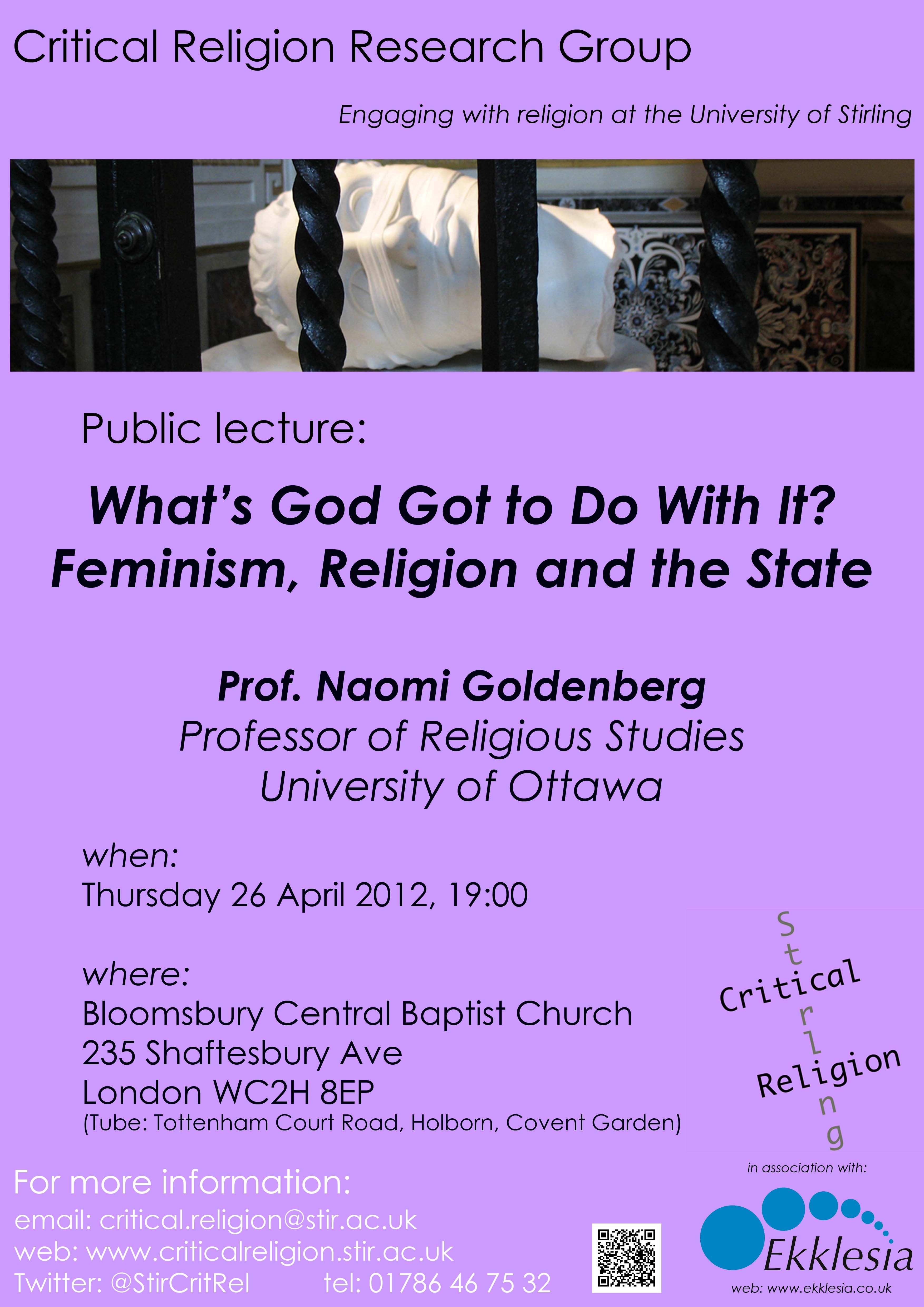
The Critical Religion Research Group Host Naomi Goldenberg April 2012

April 2012 Naomi Goldenberg visit hosted by the Critical Religion Research Group. On their website she states: 

Conceptualizing religions as vestigial states has value for clarifying matters pertaining to supposed qualitative differences between ‘religious’ and ‘secular’ law.  According to my reasoning, such a distinction is more productively thought of as occurring between two forms of ‘states’ with markedly similar processes involving contingency, debate and compromise, something I will draw out further in my forthcoming presentations.
 

Please see details below of three events with Naomi Goldenberg over April.

The Critical Religion Research Group is delighted to be hosting Naomi Goldenberg,Professor of Religious Studies (Department of Classics and Religious Studies, University of Ottawa), for a visit to the UK in April 2012.

Prof. Goldenberg will be speaking in three locations: StirlingAberdeen and London.  Details for each location are noted below, as are some notes about her current research.  The Critical Religion Research Group is also happy to facilitate media enquiries regarding Prof. Goldenberg’s visit.  Unless otherwise noted, all general enquiries should be directed to Dr Tim Fitzgerald.

In advance of her visit, Prof. Goldenberg has also written guest blog entries that discuss her work.

Stirling – Monday, 23.4.12

What’s God Got to Do With It? Contemporary Statecraft, Gender and the Category of Religion”

Room E26, Pathfoot Building, University of Stirling, at 15:00.

Aberdeen – Tuesday, 24.4.12

Prof. Goldenberg is speaking at a day workshop entitled Modernity and the Category of Religion, organised by Dr Trevor Stack of Aberdeen University’s Centre for Citizenship, Civil Society and Rule of Law.

Other speakers include Dr Stack, Dr Tamas Gyorfi, Stirling’s Dr Fitzgerald, Dr Suzanne Owen and Dr Brian Bock; Stirling’s Dr Jasper is a discussant.

Please email Louise Harkins with any queries.

London – Thursday, 26.4.12

What’s God Got to Do With It? Feminism, Religion and the State”

Bloomsbury Central Baptist Church, Covent Garden, London, at 19:00.

Posters for this event can be sent on request, and are available for download here in jpg format: A3 sizeA4 size.

The London event is organised in conjunction with our partner, Ekklesia.

Theme

Prof. Goldenberg writes:

I will argue that religions function as vestigial states within contemporary nation-states.  By ‘vestigial states’ I mean sets of institutions and practices that originate in particular histories with reference to former sovereignties within present governmental jurisdictions.  Vestigial states are both tolerated and encouraged as attenuated and marginalized governments within fully functioning nation states.  However, they compete with contemporary nation states and therefore are always problematic in varying degrees – especially if a vestigial state challenges the exclusive right of the present state to control violence.  Indeed, vestigial states have a propensity to behave as once and future states.  Nevertheless, although vestigial states can contest contemporary governments, they also work to ground the powers that authorize them by recalling earlier, now mystified forms of sovereignty from which present states arise. They are thus storehouses of nostalgia for fictional, beneficent male hegemonies that present states are thought of as representing in less magical (i.e. ‘secular’) incarnations.

Because vestigial states always embody and perform patriarchal power through citing former male-dominated governments, they support the notion that the only truly legitimate political authority is male.  Although women can exercise some authority in contemporary nation states, this power is so novel that it lacks cultural roots and social gravitas.  Rights and responsibilities tend to be provisional, partial, and subject to restriction.  In order for recent, progressive feminist gains worldwide to be both secured and furthered, the role of vestigial states – i.e. religions – in the maintenance of male control of contemporary nation states must be more vigorously interrogated.

We also encourage you to read Prof. Goldenberg’s guest blog contributions.