
Again, for the keen eyed this is a little slow in being posted on here, but still worth sharing. The ImmanentFrame have posted an except from Charles Taylor’s chapter in the edited volume Rethinking Secularism (Oxford University Press, 2011).
Publication: New Statesman’s Jonathan Derbyshire interviews Charles Taylor on his new book Secularism and Freedom of Conscience
A little slow in publishing this but still worth a read.
New Statesman‘s Jonathan Derbyshire interviews Charles Taylor on his new book Secularism and Freedom of Conscience
Publication:Democracy, Islam, and Secularism in Turkey
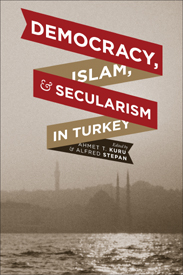
Democracy, Islam, and Secularism in Turkey
Edited by Ahmet T. Kuru and Alfred Stepan
Published by Columbia University Press, February 2012
While Turkey has grown as a world power, promoting the image of a progressive and stable nation, several choices in policy have strained its relationship with the East and the West. Providing historical, social, and religious context for this behavior, the essays in Democracy, Islam, and Secularism in Turkey examine issues relevant to Turkish debates and global concerns, from the state’s position on religion to its involvement with the European Union.
Written by experts in a range of disciplines, the chapters explore the toleration of diversity during the Ottoman Empire’s classical period; the erosion of ethno-religious heterogeneity in modern, pre-democratic times; Kemalism and its role in modernization and nation building; the changing political strategies of the military; and the effect of possible EU membership on domestic reforms. The essays also offer a cross-Continental comparison of “multiple secularisms,” as well as political parties, considering especially Turkey’s Justice and Development Party in relation to Europe’s Christian Democratic parties. Contributors tackle critical research questions, such as the legacy of the Ottoman Empire’s ethno-religious plurality and the way in which Turkey’s assertive secularism can be softened to allow greater space for religious actors. They address the military’s “guardian” role in Turkey’s secularism, the implications of recent constitutional amendments for democratization, and the consequences and benefits of Islamic activism’s presence within a democratic system. No other collection confronts Turkey’s contemporary evolution so vividly and thoroughly or offers such expert analysis of its crucial social and political systems.
Publication: The Post-Secular in Question: Religion in Contemporary Society
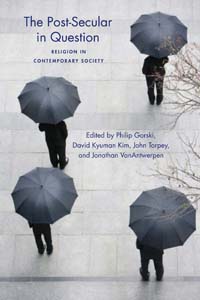
Due to be published this month, The Post-Secular in Question: Religion in Contemporary Society
Edited By Philip Gorski, David Kyuman Kim, John Torpey and Jonathan Van Antwerpen
ISBN: 9780814738726
A review of the book, by James K.A. Smith can be found on his blog, fors clavigera
More details about the book can be found on the New York University Press site
CFP: Journal for the Academic Study of Religion: Special Postgraduate Issue
Religion and Rethinking the Human
The ‘human,’ like that of ‘religion,’ is a category always under contestation. In current Euro-American scholarship and public culture, there is an acute anxiety about humans’ excessive reliance on technology, its environmental costs, and the ominous prospect of a post-human dystopia. These anxieties have been recognised, theorised, and allayed by a number of academic sub-disciplines in the humanities and social sciences. It is therefore noteworthy that the study of ‘religion,’ ultimately concerned with the consideration of one of the most enduring products of the ‘human,’ has yet to wholeheartedly embrace a deconstruction of this seemingly transparent category.
Although ‘humans’ are credited with creating ‘religion,’ ‘religion’ itself has played a central role in constructing the ‘human’ as we understand it today. This symbiotic relationship is multifaceted, multivalent, and under-theorised within much of the current field of the contemporary study of religion. In order to bridge this gap between the study of religion and the plethora of recent ‘turns’ in academic scholarship that trouble the ‘human,’ the Journal for the Academic Study of Religion (formerly the Australian Religion Studies Review) seeks papers that provide a valuable insight into this issue of endurance and relevance from a variety of interdisciplinary and methodological perspectives.
Articles may present viewpoints, arguments, and analyses on broad delineations of religion, religiosity, and any of the following, or other and divergent, topics:
- The historical construction of the human
- The human and the non-human, super-human, or post-human
- Anthropocentrism and the biopolitical processes that bring about the centrality of the human and of certain humans
- Notions of sentience, identity, and individualism
- Human rights, law, governance, politics, media, and relations with ‘nature,’ climate, and the environment
- Interspecies relations, especially between the human, the animal, the plant, the microbial, and the technological
- Human evolution and cognition
- The politics and governance of death, dying, and decomposition
This issue of the Journal for the Academic Study of Religion is a special issue that will be edited by postgraduate students featuring contributions from national and international postgraduate students. We are hoping that this will provide students not only with an important platform from which to share their research interests and efforts, but also an invaluable opportunity for the academic community at large to sample the high quality work and the innovation of scholars at a postgraduate level. We are seeking unique essays on the subject of Religion and Rethinking the Human that showcase the original research of students, and we welcome a variety of submissions that provide a unique insight into this highly pertinent issue.
If you would like to contribute to this Special Issue, please send your abstract to the guest postgraduate editors: George Ioannides (george.ioannides@sydney.edu.au) and Venetia Robertson (venetia.robertson@sydney.edu.au) by 1 July 2012. Abstracts should be no longer than 500 words and accompanied by a brief author biographical statement. Authors will be notified by the end of July, and the deadline for submission of complete articles (6000 words) will be 1 December 2012. Papers will be published subject to peer review. This special issue of the Journal for the Academic Study of Religion will be published in December 2013.
CFP: Religion on the Move 12-14 September, 2012
Migration is a key concern in secularity studies, regarding the response of non-religious groups to incoming religious practice and the apparent rise of religiosity which appears as religions change and adapt through migration.
Call for Papers: Religion on the Move
How Motion and Migration influence Religion
10th Conference of the SIEF Working Group on Ethnology of Religion
Szeged, Hungary 12-14 September, 2012
In many ways movement is an important aspect of religion and spirituality. Not only has the significance of motion within the practice of religion and rituality increased (Coleman & Eade 2004), but also, through the movement and migration of people all over the world, religions and religious practices are relocating and changing (Jenkins 2007). Movement is significant for the practice of many religions. It seems that motion has been gaining in importance and that the performative expression and execution of religious practice play a stronger part than they used to do. There might be related to the more participative role of believers in religion and rituality and the enhanced relevance of individuals ‘doing’ religion. The popularity of walking the many pilgrim ways through Europe is an example of that trend, while other expressions of movement like dancing, meditations, processions and other rituals also seem to be more in focus.
A second strand of movement is connected to migration for, by moving, people bring faiths and religious practices to other places in the world where they were not previously known or practised. Nowadays, through mass migrations, refugees, displacements because of war and other translocations, religions and beliefs can expand both spatially and quantitatively. These are processes in which the faiths which are moving are being transformed, and the religion(s) of the areas in which people and their religion are newly settled are likewise affected (examples include Islam in Europe and the new Christians from Africa in Europe). Sometimes beliefs are appropriated through tourism or by ‘spiritual seekers’; aspects of Eastern religion and esoterism have been imported to Western society. In that regard the Internet has become a migratative instrument, in its capacity of ‘posting’ religion all over the globe and into people’s homes, regardless of what religion is practised there. The extension of religion through (digital) migration has an impact on social, cultural and political contexts (Woodhead et al. 2002). The movement of religion might lead to an adaptation to new circumstances, to inculturation, but also potentially to a transformation in the religious constituents of the local culture as well. Sometimes there is openness and religion finds new host communities. Evangelical, Pentecostal, neo-Pentecostal churches have spread across the Atlantic Ocean to Europe (Coleman 2007) and so have Afro-American religions, as Candomblé, Umbanda, or Santeria cubana (Capone 2004; Saraiva 2010). Sometimes the members of the host country become involved in such new practices, but movement may also lead to segregation within host communities and contested situations.
Papers connected to these two research strands on movement and religion are welcomed; one could for example think of the following topics:
• The influence of migration on religion
• Movement as constituative element in religion and rituality
• Effects of globalisation and transnationalism on religion
• Changes in religion through digital movement, via the Internet.
• Movement and spatiality related to the practice of religion
Format: the conference takes place over two days, followed by an excursion on the third day. Paper presentations are limited to 20 minutes each, followed by ten minutes of discussion. In total 20 paper presenters will be selected. Colleagues who do not present a paper are welcome to participate in the conference and its discussions. A business meeting of the SIEF Working Group on Ethnology of Religion will be held during the conference. Organizers: the conference is organized by the Department of Ethnology and Cultural Anthropology of the University of Szeged together with the Bálint Sándor Institute for Research on religion and the International Society for Ethnology and Folklore (SIEF).
Venue: University of Szeged and Gál Ferenc Theological College of Szeged Fee: the conference fee is 60 €, including conference materials, reception, coffee, brunch, excursion. Participants are responsible for travel and accommodation; there is no funding for expenses available.
Application: submit an abstract of your paper of maximum 300 words, together with your name, position, and institutional affiliation to Dr. István Povedák povedak@yahoo.com by March 15, 2012. The selection of the papers will be done in collaboration with the Board of the SIEF Working Group on Ethnology of Religion. The final selection will be communicated by April 1, 2012.
Contacts: povedak@yahoo.com; peter.jan.margry@meertens.knaw.nl
CFP: Exploring the Extraordinary 22-23 September, 2012
The “extraordinary” strikes as an interesting ground between organised non-religion and religion, a ground which cannot be easily claimed by either group. The extraordinary may even be an interesting phenomena for exploring the terrain between these two binary positions, allowing for nuance in the field.
CALL FOR PAPERS
Exploring the Extraordinary 4th Conference
22nd-23rd September, 2012
Holiday Inn, York
Since its inception in 2007, members of Exploring the Extraordinary have organised three successful academic conferences that have brought together researchers from a variety of different disciplines and backgrounds. The purpose of these events has been to encourage a wider dissemination of knowledge and research, and an interdisciplinary discussion of extraordinary phenomena and experience. By ‘extraordinary’ we refer to phenomena and experiences that are considered to be beyond the mundane, referring to those that have been called supernatural, paranormal, mystical, transcendent, exceptional, spiritual, magical and/or religious, as well as the relevance of such for human culture.
We are looking for submissions for our fourth conference, and would like to invite presentation proposals on topics related to the above. Please submit a 300-500 word paper abstract to Dr Madeleine Castro and Dr Hannah Gilbert (ete.network@gmail.com) by the 6th April 2012. Accepted papers should be on powerpoint, no longer than 20 minutes in length, and intended for an interdisciplinary audience. Please include contact information and a brief biographical note.
For more information, and to see past conference schedules, please visit http://etenetwork.weebly.com
Ideology and the Secular Student Conference. Monday, 12 March from 2-5pm.

The Anthropology students of Goldsmiths University College welcome you to have a public conference being held on Monday 12 March, 2012 and Monday 19 March 2012
The panels are as follows:
12 March
Atheism, Land Reborn and Secular Missionaries
19 March
Violence, Nationalism and Empathy
The panels are a result of a new addition to the Anthropology Syllabus – Ideology and Secularism a course for 3rd Year BA students.
Event: Booking now open, Prophecy in the New Millennium: When Prophecies Persist Saturday 12 May 2012
Prophecy in the New MillenniumProgramme
Please see details of the event “PROPHECY IN THE NEW MILLENNIUM: When Prophecies Persist”. Alongside general interest, the network may find Wendy Grossman’s Panel “Chasing the Horizon: Prophecy in Secular Contexts” particularly relevant.
INFORM Seminar XLVIII
PROPHECY IN THE NEW MILLENNIUM:
When Prophecies Persist
Wolfson Theatre, New Academic Building,
London School of Economics, Saturday 12 May 2012
http://www.lse.ac.uk/resources/mapsAndDirections/howToGetToLSE.htm
To register: WE ARE NOW TAKING PAYPAL BOOKINGS: http://inform.ac/node/1550
Or post a booking form (attached) and a cheque payable to ‘Inform’ to Inform, Houghton St., London WC2A 2AE. (Inform@lse.ac.uk; 020 7955 7677).
Tickets (including buffet lunch, coffee and tea) paid by 16 April 2012 cost £38 each (£18 students/unwaged).
NB. Tickets booked after 16 April 2012 will cost £48 each (£28 students/unwaged).
A limited number of seats will be made available to A-Level students at £10 before 16 April 2012 (£20 after 16 April). A party of 5 or more A-Level students from one school can include one member of staff at the same price.
PROVISIONAL PROGRAMME
The presence of speakers on an Inform programme does not mean that Inform endorses their position.
The aim of Inform Seminars is to help participants to understand, or at least recognise, different perspectives.
For Inform’s codes of practice see www.Inform.ac
9.30-10.00 Registration
10.00-10.10 Professor Eileen Barker (Professor, LSE; Chair & Honorary Director, Inform) Welcome
10.10-10.20 Dr Suzanne Newcombe and Sarah Harvey (Research Officers, Inform) Introduction
10.20-10.45 Dr Simon Dein (UCL and University of Durham) “Prophecy: Social Scientific Perspectives”
10.45-11.10 Sheila Tremlett (former member of the Worldwide Church of God) “To a Place of Safety? The Elect in the Great Tribulation”
11.10-11.35 Coffee
11.35-12.00 Dr Hugh Beattie (The Open University) “The Mahdi and the End-Times in Islam”
12.00-12.25 Abi Freeman (mid-lifer) “Living in the Time of the End”
12.25-13.00 Group Discussions
13.00-14.00 Lunch
14.00-14.25 Andrew Fergus Wilson (University of Derby) “From the Mushrooms to the Stars: 2012 and the Apocalyptic Milieu”
14.25-14.50 Kevin Whitesides (PhD Candidate, University of Edinburgh) “New Age: (Still) Doing What it Says on the Tin”
14.50-15.15 David G. Robertson (PhD Candidate, University of Edinburgh) “(Always) Living in the End Times: The “Rolling Prophecy” of the Conspiracy Milieu”
15.15-15.40 Tea
15.40-16.05 Wendy Grossman (freelance writer and founder of The Skeptic Magazine) “Chasing the Horizon: Prophecy in Secular Contexts”
16.05-16.30 Professor Gordon Melton (Baylor University and founder and Director of the Institute for the Study of American Religion)
“Looking into the Future: Why Prophecies Will Persist”
16.30-17.00 Panel Discussion
Event: Negotiating Religion Workshop 3: Negotiating Religion in Urban Space 7 March 2012
Part of the Negotiating Religion series, this workshop will investigate the spatial incorporation of religious communities in the city both in the form of the material urban environment, for example in the presence of religious buildings and other faith spaces, and in everyday urban cultures, practices and politics.
Questions which will be explored in this workshop include: How are new religious buildings incorporated into contemporary urban spaces? What continuities are there with the emergence of religious architecture in earlier times? What significance do religious buildings and other markers in the urban landscape have for different religious communities? How are existing and new forms of religious spatial practice (processions, festivals, pilgrimage) incorporated into the urban environment? What kinds of transformations of urban space are produced by religious spatial practices? What role do faith groups play in the making and remaking of urban spaces?
PROGRAMME:
| 10.30 |
Registration |
| 11am-1pm: | Session 1: Negotiating Religion in Urban Space: New Faith Spaces |
| Speakers | Professor John Eade (Roehampton University/Migration Research Unit, UCL) Religious Place-Making and Migration across a Globalising City: Responding to Mobility in London |
| Ali Mangera (Mangera Yvars Architectural Practice) Designing faith spaces in the city: The Salaam Centre, North Harrow |
|
| Dr Richard Gale (School of City and Regional Planning, Department of Cardiff) ‘…make your dwellings into places of worship’: mosque development and the politics of place and residence in the UK’ |
|
| Dr Andrew Crompton (School of Architecture, University of Liverpool) Multi-faith spaces: a universal interface to God |
|
| Chair | Dr Claire Dwyer (UCL Geography and Migration Research Unit) |
| 1-2pm |
Lunch |
| 2-3.45pm | Session 2: Negotiating Faith in Urban Space: Continuity and Practice |
| Speakers | Dr Nazneen Ahmed (Compass, University of Oxford) Making Muslim Space on the London Docks: Lascar Seafarers’ Faith Practices, 1880-1945 |
| Liz Hingley (Leverhulme Artist in Residence, Migration Research Unit, UCL) Under gods: stories from Soho Road, Birmingham |
|
| Dr Claire Dwyer (Department of Geography and Migration Research Unit, UCL) Faith and Suburbia: secularisation, modernity and the changing geographies of religion in London’s suburbs |
|
| Dr David Garbin (CRONEM, University of Surrey) Diaspora, suburban Christianity and the American ‘New South’: African migrant churches in Atlanta |
|
| Chair | Professor John Eade (Roehampton/UCL) |
| 3.45-4pm | Break |
| 4-6pm | Panel: Negotiating Faith in Urban Space: Politics and Praxis |
| Panelists | Dr John Zavos, (South Asian Studies, University of Manchester) Small Acts, Big Society: Sewa and Hindu (nationalist) identity in the UK |
| Dr Luke Bretherton (Faith and Public Policy Forum, Kings College London) Community Organising, Religious Pluralism and Democratic Citizenship |
|
| David Garbin (CRONEM, University of Surrey) and Enrico Masi (University of Bologna, Italy) Soldiers of God in the Global City (Video Documentary) |
|
| 6pm | Reception. All welcome |
Convener:
Dr Claire Dwyer (UCL Geography)
For further information on the individual sessions or the series as a whole, please contact: Dr François Guesnet or Dr Uta Staiger.
 NSRN Online