Publication: New issue of Bulletin for the Study of Religion is published‏, including Science and Nonbelief – Taner Edis

Equinox Publishers have  announced the publication of Volume 40, Number 4 of the Bulletin for the Study of Religion.

Craig Martin – Bulletin for the Study of Religion

http://www.equinoxjournals.com/BSOR

Link: http://www.equinoxjournals.com/BSOR/issue/current

Contents

Review of Taner Edis’ Science and Nonbelief – Ginger Marie Stickney

Articles

Beliefs and Habituated Bodies: A Response to Taner Edis,

Science and Nonbelief – Sean Patrick McCloud

Religions and Science Beyond Belief: Comments on Taner Edis’

Science and Nonbelief – Benjamin Zeller

Chasing Cosmic Tennis Balls – Thomas B. Ellis

Defending Science and Nonbelief – Taner Edis

The Problem of Ideology in Biblical Studies – Randall William Reed

Interviews

More than Belief: An Interview with Manuel A. Vásquez -craig Martin

Weep

Keeping up with the Kollege Professors: The Pitch – Reed M.N. Weep

50 New Additions to the NSRN Bibliography

Now that things are slowly getting back to normal after the holiday season, we thought some extra reading might be in order.

The following items have been added to the NSRN’s bibliography today, and are mostly the result of suggestions from visitors to the website. A huge thanks to everyone who suggested items – please keep them coming.

The complete bibliography can  be viewed in a list organised by author surname or publication date.

—————–

  • Alicino, F. 2011. “The Collaborations-Relations Between Western (Secular) Law and Religious Nomoi Groups in Today’s Multicultural Context : The Cases of France and Canada.” Transition Studies Review 18 (2): 430-444.
  • Aston, Katie. 2011. Atheism Explained by Jonathan Lanman (NSRN Annual Lecture 2011). NSRN Events Report series [online]. NSRN, October 25. http://nsrn.net/events/events-reports.
  • Baker, Joseph O’Brian, and Buster Smith. 2009. “The Nones: Social Characteristics of the Religiously Unaffiliated.” Social Forces 87 (3): 1251-1263.
  • Bradley, Arthur, and Andrew Tate. 2010. The new atheist novel: fiction, philosophy and polemic after 9/11. Continuum International Publishing Group, April 11.
  • Bullivant, Stephen, and Lois Lee. 2012. “Interdisciplinary Studies of Non-religion and Secularity: The State of the Union.” Journal of Contemporary Religion 27 (1).
  • Caplow, T. 1998. “The Case of the Phantom Episcopalians.” American Sociological Review 63 (1): 112-113.
  • Chatterjee, Nandini. 2011. The Making of Indian Secularism: Empire, Law and Christianity, 1830-1960. Palgrave Macmillan, March 1.
  • Cragun, Ryan, Barry A. Kosmin, Ariela Keysar, Joseph H. Hammer, and Michael Nielsen. 2012. “On the Receiving End: Discrimination Toward the Non-Religious in the United States.” Journal of Contemporary Religion 27 (1).
  • Demerath, N. J., III, and Victor Thiessen. 1966. “On Spitting Against the Wind: Organizational Precariousness and American Irreligion.” American Journal of Sociology 71 (6): 674-687.
  • Ellison, Christopher G., and Darren E. Sherkat. 1995. “The ‘Semi -Involuntary Institution’ Revisited: Regional Differences in Church Participation Among Black Americans.” Social Forces 74.
  • Festinger, L. 1956. When Prophecy Fails. Minneapolis: University of Minnesota Press.
  • Gorski, Philip S., and Ateş Altinordu. 2008. “After Secularization?” Annual Review of Sociology 34 (1): 55-85.
  • Gutkowski, Stacey. 2012. “The British Secular habitus and the War on Terror.” Journal of Contemporary Religion 27 (1).
  • Hadaway, C. Kirk, and Wade Clark Roof. 1979. “Those Who Stay Religious ‘Nones’ and Those Who Don’t: A Research Note.” Journal for the Scientific Study of Religion 18 (2): 194-200.
  • Hadaway, C.K., and P.L. Marler. 1993. “All in the Family: Religious Mobility in America.” Review of Religious Research 35 (2): 97-116.
  • Hadaway, C.K., P.L. Marler, and M. Chaves. 1998. “Overreporting Church Attendance in America: Evidence That Demands the Same Verdict.” American Sociological Review 63 (1): 122-130.
  • Hout, Michael, and Andrew Greeley. 1998. “What Church Officials’ Reports Don’t Show: Another Look at Church Attendance Data.” American Sociological Review 63 (1): 113-119.
  • Hunter, Laura A. 2010. “Explaining Atheism: Testing the Secondary Compensator Model and Proposing an Alternative.” Interdisciplinary Journal of Research on Religion 6.
  • Knott, Kim. 2010. “Theoretical and Methodological Resources for Breaking OPen the Secular and Exploring the Boundary between Religion and Non-religion.” Historia Religionum 2: 115-133.
  • Kraut, Benny. 1979. From Reform Judaism to Ethical Culture: The Religious Evolution of Felix Adler. New York: Hebrew Union College Press.
  • Lanman, Jonathan. 2011. “Thou Shalt Believe -: Or Not.” New Scientist.
  • ———. 2012. “The Importance of Religious Displays for Belief Acquisition and Secularization.” Journal of Contemporary Religion 27 (1).
  • Lee, Lois. 2012. “Research Note: Talking about a Revolution: Terminology for the New Field of Non-religion Studies.” Journal of Contemporary Religion 27 (1).
  • Lerner, Berel Dov. 1995. “Understanding a (Secular) Primitive Society.” Religious Studies 31: 303-309.
  • Lowis, M.J., A.J. Jewell, M.I. Jackson, and R. Merchant. 2011. “Religious and Secular Coping Methods Used by Older Adults : An Empirical Investigation.” Journal of Religion, Spirituality and Aging 23 (4): 279-303.
  • Luehrmann, S. 2011. Secularism Soviet Style: Teaching Atheism and Religion in a Volga Republic. Indiana: Indiana University Press.
  • MacKillop, I.D. 1986. The British Ethical Societies. Cambridge: Cambridge University Press.
  • Merino, Stephen M. 2012. “Irreligious Socialization? The Adult Religious Preferences of Individuals Raised with No Religion PDF Stephen M. Merino.” Secularism and Nonreligion 1: 1-16.
  • Mumford, Lorna. 2011. Atheism and Anthropology: Researching Atheism and Self-Searching Belief and Experience Workshop. NSRN Events Report series [online]. NSRN, December. http://www.nsrn.net/events/events-reports.
  • Orsi, R. 2005. Between heaven and earth: the religious worlds people make and the scholars who study them. Princeton, NJ and Oxford: Oxford University Press.
  • Parmeggiani, F. 2011. “Speaking of God : The Post-Secular Challenge for Italian Feminist Thought and Practices.” Annali D Italianistica 29: 417-430.
  • Presser, S., and M. Chaves. 2007. “Is Religious Service Attendance Declining?” Journal for the Scientific Study of Religion 46 (3): 417-423.
  • Quack, Johannes. 2012. “Organised Atheism in India: An Overview.” Journal of Contemporary Religion 27 (1).
  • Radest, Howard B. 1969. Toward Common Ground: The Story of the Ethical Societies in the United States. New York: Frederick Unger Publishing Co.
  • ———. 1990. The Devil and Secular Humanism: The Children of the Enlightenment. Westport, CT: Praeger.
  • Roof, W.C., and W. McKinney. 1987. American Mainline Religion: Its Changing Shape and Future. New Brunswick, NJ: Rutgers University Press.
  • Sandomirsky, S., and J. Wilson. 1990. “Processes of Disaffiliation: Religious Mobility among Men and Women.” Social Forces 68: 1211-1229.
  • Schwadel, P. 2010. “Period and Cohort Effects on Religious Nonaffiliation and Religious Disaffiliation: A Research Note.” Journal for the Scientific Study of Religion 49 (2): 311-319.
  • Stark, Rodney, Eva Hamberg, and Allen S. Miller. 2005. “Exploring Spirituality and Unchurched Religions in America, Sweden, and Japan.” Journal of Contemporary Religion 20 (1): 3-23.
  • Stolzenberg, R.M., M. Blair-Loy, and L.J. Waite. 1994. “Stolzenberg, R. M., Blair-Loy, M., & Waite, L. J. (1994). Religious Participation in Early Adulthood: Age and Family Life Cycle Effects on Church Membership. American Sociological Review, 60, 84-103.” American Sociological Review 60: 84-103.
  • Tamney, Joseph B., Shawn Powell, and Stephen Johnson. 1989. “Innovation Theory and Religious Nones.” Journal for the Scientific Study of Religion 28 (2): 216-229.
  • Taylor, Charles. 1998. Modes of Secularism. In Secularism and its Critics: Themes in Politics, ed. Rajeev Bhargava, 32-53. New Delhi: Oxford University Press.
  • Vargas, N. 2011. “Retrospective Accounts of Religious Disaffiliation in the United States: Stressors, Skepticism, and Political Factors.” Sociology of Religion (October 11). doi:10.1093/socrel/srr044. http://secularismandnonreligion.org/index.php/snr/article/view/5.
  • Veevers, J.E., and D.F. Cousineau. 1980. “The Heathen Canadians: Demographic Correlates of Nonbelief.” The Pacific Sociological Review 23 (2): 199-216.
  • Voas, David, and Siobhan McAndrew. 2012. “Three Puzzles of Non-religion in Britain.” Journal of Contemporary Religion 27 (1).
  • Welch, Michael R. 1978a. “Religious Non-Affiliates and Worldly Success.” Journal for the Scientific Study of Religion 17 (1): 59-61.
  • ———. 1978b. “The Unchurched: Black Religious Non-Affiliates.” Journal for the Scientific Study of Religion 17 (3): 289-293.
  • Wilson, J., and Darren E. Sherkat. 1994. “Returning to the Fold.” Journal for the Scientific Study of Religion 33: 148-161.
  • Zuckerman, Phil. 2009. “Why are Danes and Swedes so Irreligious?” Nordic Journal of Religion and Society 22 (1).
  • ———. 2011. Faith No More: Why People Reject Religion. New York: Oxford University Press.

Secularism and Nonreligion Journal: Article publication Vol. 1 January 2012

The first article published in Vol 1, January 2012, Stephen M. Merino, Irreligious Socialization? The Adult Religious Preferences of Individuals Raised with No Religion

ABSTRACT: Recent birth cohorts of Americans are more likely than previous cohorts to be raised outside of a religious tradition. In addition, those raised with no religion are increasingly likely to have no religion as adults. Despite their growing numbers, individuals raised with no religion have received little  attention from scholars. The adult religious preferences of these individuals provide researchers with a unique opportunity to test theories of religion and social change. Using General Social Survey data, I examine the adult religious preferences and beliefs of individuals raised with no religion. I provide evidence of a shift in socialization and social influences experienced by those who report growing up with no religion. Compared with earlier cohorts raised with no religion, more recent cohorts have had more secular upbringings and tend to be more secular, liberal, and wary of organized religion as adults. They are also more likely to have a religiously unaffiliated spouse, if they marry at all. Results from a logistic regression analysis indicate that these trends explain much of the cohort differences in the likelihood of remaining unaffiliated as an adult.

KEYWORDS: NONRELIGION, SOCIALIZATION, SOCIAL INFLUENCE

To see the latest publication please follow the link to the Secularism and Nonreligion Journal current issue

http://secularismandnonreligion.org/index.php/snr/issue/current

Announcement and Thank You from the NSRN Directors

We are extremely excited to announce the publication of the Journal of Contemporary Religion  Vol. 27, No. 1 January 2012

Special Issue: Non-religion and Secularity

This special edition of the Journal of Contemporary  Religion is a publication resulting from the NSRN’s inaugural conference in Dec. 2009. At that time, work in progress vastly outweighed completed empirical work in the field – I’m happy to say, in fact, that, even as this area of work has expanded, this ratio is still the same: a sign of continued growth. But this collection presents some of the earliest-realised major research projects in the field, and is intended to highlight the diversity of possible approaches. Happy reading – and we look forward to any comments the collection/articles prompt in this space.

With thanks to Elisabeth Arweck, for her support of this project and for  the NSRN’s work in general. This is the first special edition in the history of the JCR and we were very honoured to be invited to develop it.

Best wishes

Lois and Stephen

You an view the issue when it is released or order the journal through the Taylor and Francis website

Journal of Contemporary Religion: January 2012 Special Issue: Non-religion and Secularity

Lois Lee (NSRN Director), Jonathan Lanman and Stephen Bullivant (NSRN Director) - Contributors to the JCR Jan 2012 © 2011 St Mary’s University College, Twickenham

Journal of Contemporary Religion  Vol. 27, No. 1 January 2012

Special Issue: Non-religion and Secularity 

Peter B. Clarke: Tributes

Articles

Stephen Bullivant & Lois Lee – Interdisciplinary Studies of Non-religion and Secularity: The State of the Union

David Voas & Siobhan McAndrew – Three Puzzles of Non-religion in Britain

Jonathan A. Lanman – The Importance of Religious Displays for Belief Acquisition and Secularization

Johannes Quack – Organised Atheism in India: An Overview

Stacey Gutkowski – The British Secular habitus and the War on Terror

Ryan T. Cragun, Barry Kosmin, Ariela Keysar, Joseph H. Hammer & Michael Nielsen – On the Receiving End: Discrimination Toward the Non-Religious in the United States

Lois Lee – Research Note: Talking about a Revolution: Terminology for the New Field of Non-religion Studies

Plus Book Reviews and Book Notes

British Social Attitudes Survey Reveals 50% of Britons have “No Religion”

The National Centre for Social Research has published its British Social Attitudes Survey 2011-2012. You can see the full report, authored by Lucy Lee, on the website of the “National Centre for Social Research”, which conducted the survey.

Table 12.1 Religious Affiliation Taken from the BSA survey 2011_12

The report demonstrates that the proportion of those who claim to be Christian [Church of England] is much lower at 20%, than suggested by the 2001 Census, which claimed 71.7% of people in England and Wales were identified as Christian. The second overwhelming finding was that 50% of the population claimed no religion, in comparison to the 14.5% stating no-religion in the 2001 Census. The other statistics remain fairly consistent, suggesting perhaps that many of the “nones” have migrated from the category of “Christian” or “Church of England” self-identification to having none. However, more data is needed before such hypothesis can be upheld so we eagerly await the Census Data 2011, but perhaps this show early signs of the success of the BHA Census 2011 campaign and others like it, which have bought identification as an issue to the fore.

The Census 2001 Key Statistics, Local Authorities in England and Wales can be found on the Office for National Statistics website.

NSRN Launch New Website!

The Nonreligion and Secularity Research Network (NSRN) are proud to announce the launch of their new website – nsrn.net!

The NSRN website has been going from strength to strength since its relaunch in November 2009 at the co.uk site – but wide-interest in and growing membership of the NSRN means we’ve needed to expand our services. After weeks and months of development with the new online editorial team, the next generation NSRN website is here!

Visit http://www.nsrn.net to take  a look.

*Although the old . co.uk address will still be around for a while, we’d be extremely grateful for anyone linking to the site to amend their records, citations, links and so forth. The NSRN is truly international, in membership and audiences, and we felt it was important to reflect this in the web address – and we appreciate your help in implementing this change*

A preview of some of the new things we provide on the site:

We’ve also updated and expanded our existing services and resources. The new site boasts,

And we now have a range of new Thoroughly Modern features, including:

  • full integration with the NSRN’s new Twitter feed
  • full integration with the NSRN’s new Facebook page

… and which will enable users to keep up to date with NSRN news and resources in whatever way suits you:

New features and older material are now fully archived and easily searchable.

We hope you like it. As ever, comments and suggestions are always encouraged.

We would greatly appreciate it if you could circulate this information around any individuals or groups that you think might be interested. As a research network, we rely upon the input of our members and friends in the collation and dissemination of information. If you notice any errors or omissions, or are aware of any events, resources, articles etc that we should be promoting, please do not hesitate to get in touch.

With kind regards from,

The NSRN Online Team

New Events Report: Atheism and Anthropology

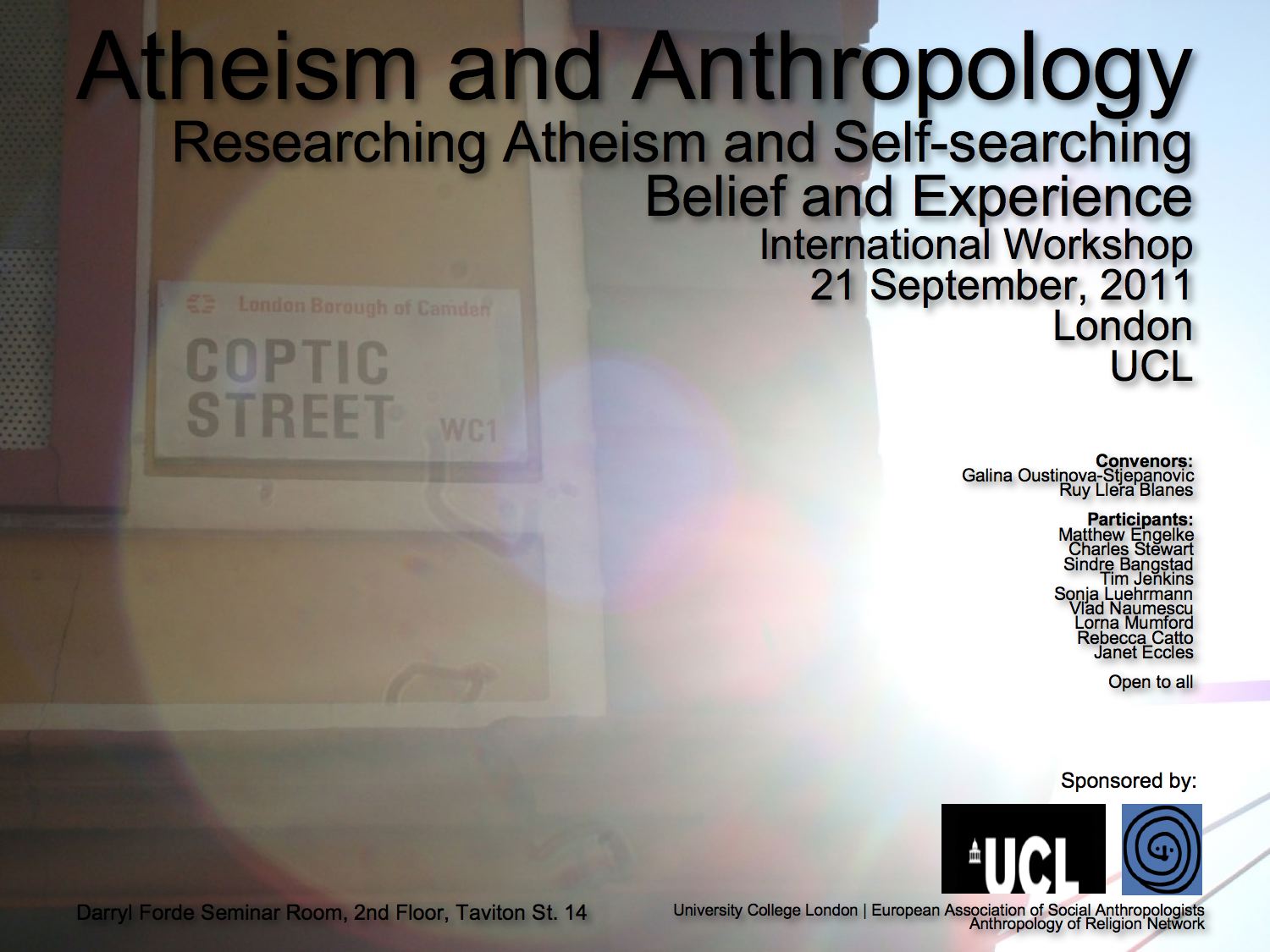
To coincide with the launching of our new website, the NSRN are proud to announce the publication of a new Events Report by Lorna Mumford, on the recent ‘Atheism and Anthropology’ Workshop in London.

Please see the details and link to the document below:

Atheism and Anthropology: Researching Atheism and Self-Searching Belief and Experience Workshop

University College, London, 21 September 2011
Report by Lorna Mumford, University College London
Published by the NSRN, 14 December 2011

New Statesman Guest Edited by Dawkins out this week

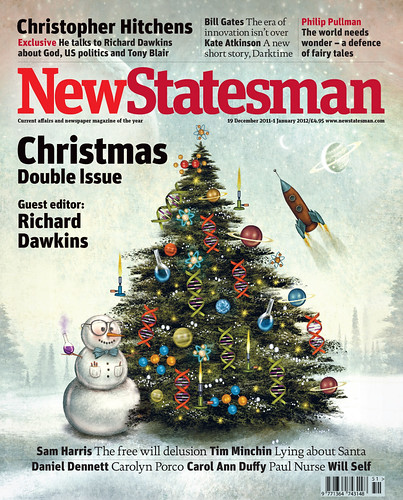
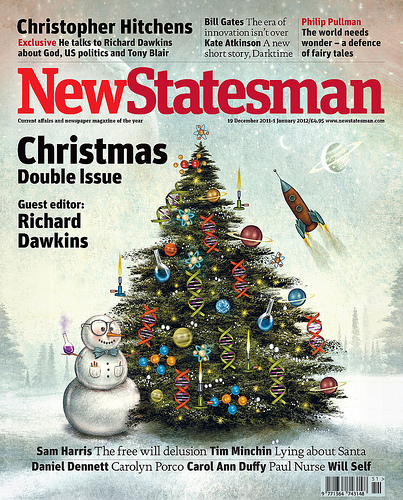
New Statesman Guest Edited by Richard Dawkins 19th Dec 2011


Richard Dawkins has taken the role of guest Editor for the 19 December 2011 to 1 January 2012 issue of the New Statesman. The issue gives space to the “four horseman” of New Atheism and includes a contribution from Sam Harris on the neuroscience of freewill, Daniel Dennett contributes a Christmas essay “The Social Cell” addressing the social ties that bind us and the remaining two “horseman” come together in a conversation between Richard Dawkins and Christopher Hitchens. Other notable inclusions include authors Phillip Pullman and Kate Atkinson, Microsoft giant Bill Gates, planetary scientist Carolyn Porco and commenter and human rights activist Maryam Mamazie.

The edition gives an interesting overview of the current issues dominating the British nonreligous/secular/religious public debate. Dawkins opens with a letter to the British Prime Minister, David Cameron, in which he declares his “cultural Anglicanism” and urges Cameron to acknowledge the British Social Attitudes survey. The survey found 50% of the population declare themselves to be of no faith and the number declaring themselves to be Church of England, Christian, at 20% which for Dawkins undermines  the privileging of religion over non religion, especially the particular privilege he sees accorded to the Anglican state church. He urges Cameron to consider the need for neutrality “in all matters pertaining to religion”.

The New Statesman site quotes Dawkins on his venture:

“To guest-edit a great magazine with the status of a national treasure is the literary equivalent of being invited to imagine your ideal dinner party – Christmas dinner, in this case – and then of actually being allowed to send out real invitations to your dream companions. Every acceptance is like a present off the Christmas tree, gratefully unwrapped and treasured.

At the same time, I couldn’t help being daunted by the New Statesman’s historic reputation for serious, well-written radical commentary, and by the need in my literary Christmas dinner to temper merriment with gravitas.

We have no reindeer, but four horsemen; no single star of wonder and no astrologers bearing gifts, but a gifted star of astronomy who knows wonder when she sees it; no kings from the east, but the modern equivalent of a king from the west; and wise men – and women – all around the table. Please join us at the feast.”

Details of his editorial and how to access the magazine can be found on the New Statesman website

Memories of Religious and Secular Ceremonies Site Launch

[Image]

The Religion and Society funded, cross-cultural project Memories of Religious and Secular Ceremonies has involved oral history research in Bulgaria, Romania and the UK.

Visit http://www.southampton.ac.uk/mrasc/ to read more about the project and its findings.

Memories of Religious and Secular Ceremonies has been led by Professor Peter Coleman, a gerontologist based at Southampton University who recently published a book on belief and ageing with Policy Press. Click here for details.