Publication: Islam and the Politics of Secularism and Varieties of Secularism in Asia

Islam and the Politics of Secularism

The Caliphate and Middle Eastern Modernization in the Early 20th Century

Nurullah Ardic

Published 16th January 2012 by Routledge – 394 pages

This book examines the process of secularization in the Middle East in the late 19th and early 20th century through an analysis of the transformation and abolition of Islamic Caliphate. Focusing on debates in both the center of the Caliphate and its periphery, the author argues that the relationship between Islam and secularism was one of accommodation, rather than simply conflict and confrontation, because Islam was the single most important source of legitimation in the modernization of the Middle East.

Through detailed analysis of both official documents and the writings of the intellectuals who contributed to reforms in the Empire, the author first examines the general secularization process in the Ottoman Empire from the late 18th century up to the end of the 1920s. He then presents an in-depth analysis of a crucial case of secularization: the demise of Islamic Caliphate. Drawing upon a wide range of secondary and primary sources on the Caliphate and the wider process of political modernization, he employs discourse analysis and comparative-historical methods to examine how the Caliphate was first transformed into a “spiritual” institution and then abolished in 1924 by Turkish secularists. Ardiç also demonstrates how the book’s argument is applicable to wider secularization and modernization processes in the Middle East.

Deriving insights from history, anthropology, Islamic law and political science, the book will engage a critical mass of scholars interested in Middle Eastern studies, political Islam, secularization and the near-global revival of religion as well as the historians of Islam and late-Ottoman Empire, and those working in the field of historical sociology and the sociology of religion as a case study.

Varieties of Secularism in Asia

Anthropological Explorations of Religion, Politics and the Spiritual

Edited by Nils Ole Bubandt, Martijn Van Beek

Published 29th September 2011 by Routledge – 261 pages
Varieties of Secularism is an ethnographically rich, theoretically well-informed, and intellectually coherent volume which builds off the work of Talal Asad, Charles Taylor, and others who have engaged the issue of secularism(s) and in socio-political life. The volume seeks to examine theories of secularism/secularity and examine concrete ethnographic cases in order to further the theoretical discussion.

Whereas Taylor’s magisterial work draws up the conditions and problems of a belief in God in Western modernity, it leaves unexplored the challenges posed by the spiritual in modernity outside of the North Atlantic rim. This anthology seeks to begin that task. It does so by suggesting that the kind of secularity described by Taylor is only one amongst others. By attending to the shifting relationship between proper religion and ‘bad faiths’; between politically valorised and embarrassing spiritual phenomena; between the new visibilities and silences of magic, ancestors, and religion in democratic politics, this book seeks to outline the particular formations of secularism that have become possible in Asia from China to Indonesia and from Bahrain to Timor-Leste.

Publication: Religion and Change in Modern Britain

Religion and Change in Modern Britain
Edited by Linda Woodhead, Rebecca Catto

Published 14th February 2012 by Routledge

This book offers a fully up-to-date and comprehensive guide to religion in Britain since 1945. A team of leading scholars provide a fresh analysis and overview, with a particular focus on diversity and change. They examine:

  • relations between religious and secular beliefs and institutions
  • the evolving role and status of the churches
  • the growth and ‘settlement’ of non-Christian religious communities
  • the spread and diversification of alternative spiritualities
  • religion in welfare, education, media, politics and law
  • theoretical perspectives on religious change

The volume presents the latest research, including results from the largest-ever research initiative on religion in Britain, the AHRC/ESRC Religion and Society Programme. Survey chapters are combined with detailed case studies to give both breadth and depth of coverage. The text is accompanied by relevant photographs and a companion website.

Forthcoming publications

Please see details below of a number of forthcoming publications in 2012

Natural Burial: Traditional-Secular Spiritualities and Funeral Innovation

Hannah Rumble and Douglas Davies

26th July 2012

“Co-authored with Prof Douglas Davies in the Dept. for Theology and Religion, University of Durham.
From the 1990s the British developed an interest in natural burial, also known as woodland, green, or eco-logical burial. This continued a stream of British interest in funeral innovation from Victorian cemetery monuments through the birth and rise of cremation to the many things done with cremated remains. The book sets natural burial in the context of creative dealing with death, grief, mourning and the celebration of life. Ideas from sociology and anthropology combine with psychological issues and theological ideas to show how human emotions take shape and help people think of their own death as well as dealing with death of those they love.

Douglas Davies and Hannah Rumble explore the variety of motivations for the appeal of natural burial, and use interviews with people using a special natural burial site created by the Church of England but open to all, to illustrate the spiritual understandings of life and death in the sacred, secular and mixed worlds of modern Britain.”

This book is the outcome of the AHRC-ESRC Collaborative doctoral award and will be published by Continuum in July 2012. This joint volume offers a spectrum of anthropological and theological interpretation of people’s choice of woodland burial while also raising numerous theoretical issues pivoting around ideas of ‘giving something back’ and ‘not making a fuss’, as well as the more anticipated issues of ecology

Making Sense of the Secular: Critical Perspectives from Europe to Asia
Edited by Ranjan Ghosh

1st October 2012

This book offers a wide range of critical perspectives on how secularism unfolds and has been made sense of across Europe and Asia. The book evaluates secularism as it exists today – its formations and discontents within contemporary discourses of power, terror, religion and cosmopolitanism – and the focus on these two continents gives critical attention to recent political and cultural developments where secularism and multiculturalism have impinged in deeply problematical ways, raising bristling ideological debates within the functioning of modern state bureaucracies.

Examining issues as controversial as the state of Islam in Europe and China’s encounters with religion, secularism, and modernization provides incisive and broader perspectives on how we negotiate secularism within the contemporary threats of terrorism and other forms of fundamentalism and state-politics. However, amidst the discussions of various versions of secularism in different countries and cultural contexts, this book also raises several other issues relevant to the antitheocratic and theocratic alike, such as: Is secularism is merely a nonreligious establishment? Is secularism a kind of cultural war? How is it related to “terror”? The book at once makes sense of secularism across cultural, religious, and national borders and puts several relevant issues on the anvil for further investigations and understanding.

Europe’s Encounter with Islam: The Secular and the Postsecular
Luca Mavelli

12 March 2012

In the last few years, the Muslim presence in Europe has been increasingly perceived as ‘problematic’. Events such as the French ban on headscarves in public schools, the publication of the so-called ‘Danish cartoons’, and the speech of Pope Benedict XVI at the University of Regensburg have hit the front pages of newspapers the world over, and prompted a number of scholarly debates on Muslims’ capacity to comply with the seemingly neutral and pluralistic rules of European secularity.

Luca Mavelli argues that this perspective has prevented an in-depth reflection on the limits of Europe’s secular tradition and its role in Europe’s conflictual encounter with Islam. Through an original reading of Michel Foucault’s spiritual notion of knowledge and an engagement with key thinkers, from Thomas Aquinas to Jurgën Habermas, Mavelli articulates a contending genealogy of European secularity. While not denying the latter’s achievements in terms of pluralism and autonomy, he suggests that Europe’s secular tradition has also contributed to forms of isolation, which translate into Europe’s incapacity to perceive its encounter with Islam as an opportunity rather than a threat.

Drawing on this theoretical perspective, Mavelli offers a contending account of some of the most important recent controversies surrounding Islam in Europe and investigates the ‘postsecular’ as a normative model to engage with the tensions at the heart of European secularity. Finally, he advances the possibility of a Europe willing to reconsider its established secular narratives which may identify in the encounter with Islam an opportunity to flourish and cultivate its democratic qualities and postnational commitments.

This work will be of great interest to students and scholars of religion and international relations, social and political theory, and Islam in Europe.

Post-Secularism, Realism and Transcendence: Explorations of the Utopian Content of the Religious Condition
Jolyon Agar

30 July 2012

This project addresses the recent rise in post-secularism in the humanities and social sciences. Post-secularism is the proposition that the secular project begun by the Enlightenment has come to an end. If we define secularism as the historical process of increasing marginalisation of the religious from contributing to debates in the public sphere and the process of public policy formation then it is in crisis. This opens up the intriguing possibility that there may be opportunities for renewed debate about the nature of our “secular age” and the role of religion in modern society. Evidence for such a renewal of the religious may be found in the alarming rise of religious fundamentalism in the late 20th and early 21st Centuries, especially in the Islamic world and the United States, the resurgence of Catholic conservatism under Pope John Paul II and Pope Benedict XVI or the increasing popularity of more esoterical quasi-religious New Ageism.

This book will be of great interest to those scholars currently working in the area of post-secularism (a very popular area of research in political philosophy); Hegelian and Marxist scholars; the Critical Realist community. It will also be of interest to undergraduates and postgraduates taking courses in Utopian Marxism, Critical Theory, Critical Realism, post-Hegelian German philosophy, philosophy of religion and the interface between political philosophy and religion.

Religious Experience: A Reader
Edited by Craig Martin, Russell T. McCutcheon
Introduction by  Leslie Dorrough Smith

Many regard religious experience as the essence of religion, arguing that narratives might be created and rituals invented but that these are always secondary to the original experience itself. However, the concept of “experience” has come under increasing fire from a range of critics and theorists. This Reader presents writings from both those who assume the existence and possible universality of religious experience and those who question the very rhetoric of “experience”.

Bringing together both classic and contemporary writings, the Reader showcases differing disciplinary approaches to the study of religious experience: philosophy, literary and cultural theory, history, psychology, anthropology; feminist theory; as well as writings from within religious studies. The essays are structured into pairs, with each essay separately introduced with information on its historical and intellectual context.

The ultimate aim of the Reader is to enable students to explore religious experience as rhetoric created to authorize social identities. The book will be an invaluable introduction to the key ideas and approaches for students of Religion, as well as Sociology and Anthropology.

CONTRIBUTORS: Robert Desjarlais, Diana Eck, William James, Craig Martin, Russell T. McCutcheon, Wayne Proudfoot, Robert Sharf, Ann Taves, Charles Taylor, Joachim Wach, Joan Wallach Scott, Raymond Williams

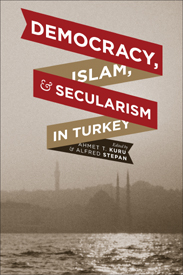
Publication:Democracy, Islam, and Secularism in Turkey

Democracy, Islam, and Secularism in Turkey
Edited by Ahmet T. Kuru and Alfred Stepan

Published by Columbia University Press, February 2012

While Turkey has grown as a world power, promoting the image of a progressive and stable nation, several choices in policy have strained its relationship with the East and the West. Providing historical, social, and religious context for this behavior, the essays in Democracy, Islam, and Secularism in Turkey examine issues relevant to Turkish debates and global concerns, from the state’s position on religion to its involvement with the European Union.

Written by experts in a range of disciplines, the chapters explore the toleration of diversity during the Ottoman Empire’s classical period; the erosion of ethno-religious heterogeneity in modern, pre-democratic times; Kemalism and its role in modernization and nation building; the changing political strategies of the military; and the effect of possible EU membership on domestic reforms. The essays also offer a cross-Continental comparison of “multiple secularisms,” as well as political parties, considering especially Turkey’s Justice and Development Party in relation to Europe’s Christian Democratic parties. Contributors tackle critical research questions, such as the legacy of the Ottoman Empire’s ethno-religious plurality and the way in which Turkey’s assertive secularism can be softened to allow greater space for religious actors. They address the military’s “guardian” role in Turkey’s secularism, the implications of recent constitutional amendments for democratization, and the consequences and benefits of Islamic activism’s presence within a democratic system. No other collection confronts Turkey’s contemporary evolution so vividly and thoroughly or offers such expert analysis of its crucial social and political systems.

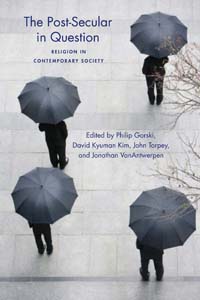
Publication: The Post-Secular in Question: Religion in Contemporary Society

Due to be published this month, The Post-Secular in Question: Religion in Contemporary Society

Edited By Philip Gorski, David Kyuman Kim, John Torpey and Jonathan Van Antwerpen

ISBN: 9780814738726

A review of the book, by  can be found on his blog, fors clavigera

More details about the book can be found on the New York University Press site

CFP: Journal for the Academic Study of Religion: Special Postgraduate Issue

Religion and Rethinking the Human

The ‘human,’ like that of ‘religion,’ is a category always under contestation. In current Euro-American scholarship and public culture, there is an acute anxiety about humans’ excessive reliance on technology, its environmental costs, and the ominous prospect of a post-human dystopia. These anxieties have been recognised, theorised, and allayed by a number of academic sub-disciplines in the humanities and social sciences. It is therefore noteworthy that the study of ‘religion,’ ultimately concerned with the consideration of one of the most enduring products of the ‘human,’ has yet to wholeheartedly embrace a deconstruction of this seemingly transparent category.

Although ‘humans’ are credited with creating ‘religion,’ ‘religion’ itself has played a central role in constructing the ‘human’ as we understand it today. This symbiotic relationship is multifaceted, multivalent, and under-theorised within much of the current field of the contemporary study of religion. In order to bridge this gap between the study of religion and the plethora of recent ‘turns’ in academic scholarship that trouble the ‘human,’ the Journal for the Academic Study of Religion (formerly the Australian Religion Studies Review) seeks papers that provide a valuable insight into this issue of endurance and relevance from a variety of interdisciplinary and methodological perspectives.

Articles may present viewpoints, arguments, and analyses on broad delineations of religion, religiosity, and any of the following, or other and divergent, topics:

  • The historical construction of the human
  • The human and the non-human, super-human, or post-human
  •  Anthropocentrism and the biopolitical processes that bring about the centrality of the human and of certain humans
  • Notions of sentience, identity, and individualism
  • Human rights, law, governance, politics, media, and relations with ‘nature,’ climate, and the environment
  • Interspecies relations, especially between the human, the animal, the plant, the microbial, and the technological
  • Human evolution and cognition
  • The politics and governance of death, dying, and decomposition

This issue of the Journal for the Academic Study of Religion is a special issue that will be edited by postgraduate students featuring contributions from national and international postgraduate students. We are hoping that this will provide students not only with an important platform from which to share their research interests and efforts, but also an invaluable opportunity for the academic community at large to sample the high quality work and the innovation of scholars at a postgraduate level. We are seeking unique essays on the subject of Religion and Rethinking the Human that showcase the original research of students, and we welcome a variety of submissions that provide a unique insight into this highly pertinent issue.

If you would like to contribute to this Special Issue, please send your abstract to the guest postgraduate editors: George Ioannides (george.ioannides@sydney.edu.au) and Venetia Robertson (venetia.robertson@sydney.edu.au) by 1 July 2012. Abstracts should be no longer than 500 words and accompanied by a brief author biographical statement. Authors will be notified by the end of July, and the deadline for submission of complete articles (6000 words) will be 1 December 2012. Papers will be published subject to peer review. This special issue of the Journal for the Academic Study of Religion will be published in December 2013.

CFP: Special Issue “Religion & Globalization”

Please note the CFP below for the special Issue “Religion & Globalization”. Areas of interest include  the re-enchantment of the world and the transient nature of religious practice. It would be interesting to see included some work on similar negotiations within secular practices and discourses or other view points on the secular.
A special issue of Religions (http://www.mdpi.com/journal/religions/)

http://www.mdpi.com/journal/religions/special_issues/religion_globalization/

Call for Papers

Whether globalization is considered as a worldwide structured system of interstate relationships (Friedmann, 1998) or as a world “in motion” (Tomlinson, 1999) crossed by human and cultural flows (Appadurai, 1998), it refers indisputably to a new set of environmental conditions for religions. Globalization is creating new dynamics of change including transnational expansions of traditions (Csordas, 2007), deterritorialized sites, cultic areas (even parishes), virtualized and networked “communities” of believers, electronic and mediatized gods (Stolow, 2010), the universalization of cosmopolitan values and the localization of universalized beliefs (Robertson, 1992). Also shifting religious geographies (for example, Christianity turning “southern” and “black”, Islam turning “Asian”, Buddhism turning “white” and “western”) have contributed to a reshaping of global geopolitics (Huntington, 1993), an “ecological” turn in religious beliefs (Taylor, 2005), a worldwide standardization of religious systems (Beyer, 1994, 1998, 1999) and re-enchantment on a global scale (Csordas, 2007). Migrations have been – and still are – major forces for the geographic redistribution of beliefs and cults, while the world is also becoming ‘proselytized’. This does not clarify the very specific modes by which each process of mobility affects the various ways different religions are acted upon by global forces in their specific contexts. Neither does it take into account the fact that global religious changes may have nothing to do with mobility (Friedmann, 1998) but rather with global systems (Beyer, 1994). A global perspective on religious changes and adaptations in the contemporary world requires a prudent examination of different case-studies as not all religions are subjected to the same forces and engaged with similar processes of changes. Indeed, the “great” historical religions do not face global changes like new expanding religious cults or sects do. Analysis must cautiously distinguish between globalizing religions in global conditions, the impact of globalization on religions, and the role of religions in the rise and the shaping of global (economic, political or ideological) forces.

This special issue aims at gathering papers in which scholars from different disciplinary backgrounds (religious studies, anthropology, sociology, political sciences, history, political economy or others) can explore, on an empirical basis and in clearly identified geographic, historical and cultural contexts, the effects of religion on globalization or of globalization on religions. Please contact Prof. Lionel Obadia, anthropologist, University Lyon 2 at: Lionel.obadia@univ-lyon2.fr

Keywords: Globalization, Global and globalizing religions, spiritual transnationalism, migration and missionary activism, mediatization of religions, religion and the Internet,  deterritorialization and new geographies of religions.

Expected deadline: September 30, 2012.

Podcast: Grace Davie on the Changing Nature of Religion

Grace Davie discusses the changing nature of religion, particularly in the UK and Europe following her keynote address to the Society for the Scientific Study of Religion in Milwaukee last October.

Listen to the podcast

“In this interview with Chris, Professor Davie discusses the place of religion in modern Europe, paying particular attention to the place of the United Kingdom within the European context. In an effort to combat the caricatures that typify media accounts of religion in the contemporary world, Davie discusses the changing nature of religion, in academia and in the public square, and considers the impact of the arrival of new cultures into Europe, whilst reflecting on secular reactions to these”