CFP: Nonreligion and the Secular: New Horizons for Multidisciplinary Research 4-6 July 2012

The call for papers for the Nonreligion and Secularity Research Network conference is here! The conference is being held at Goldsmiths University, from 4-6 July 2012

Registration details can be found here

Nonreligion and the Secular: New Horizons for Multidisciplinary Research


Conveners: Lois Lee (ll317@cam.ac.uk), Stacey Gutkowski (stacey.gutkowski@kcl.ac.uk), and Stephen Bullivant (stephen.bullivant@smuc.ac.uk)

Conference Coordinator: Katie Aston (k.aston@gold.ac.uk)

Following decades of neglect, the academic study of nonreligion has grown rapidly in the past five years. The primary aim of this conference is to bring together scholars across a range of academic disciplines (sociology, anthropology, theology, political science, psychology, history, international relations, area studies) to begin to untangle the confused and individually contested concepts of nonreligion and the secular. Is nonreligion a subcategory of the secular or vice versa? How do the two terms structure one another? What are the practical and theoretical implications of the concepts, such as they are and/or in alternative formulations? The aim of this international conference is to contribute to addressing this lacuna.  While discussions of nonreligion and the secular have been running largely in parallel, they are potentially mutually enriching topics with significant bearing outside of the academy. This conference will consolidate the achievements already made over the past five years by nonreligion scholars and forge new, multidisciplinary dialogue between these researchers and those primarily working with the concept of the secular. This conference will bring together a range of internationally renowned scholars, including keynote speakers Gracie Davie (Exeter), Callum Brown (Dundee), Monika Wohlrab-Sahr (Leipzig), and Humeira Iqtidar (King’s College London).

The conference engages with a historical moment in which forms of religion and nonreligion have increasingly asserted themselves in the public sphere, in non-Western as well as Western settings. In the case of radical Islamism and New Atheism, such assertions have had powerful, sometimes inflammatory and divisive affect. This urgent wider social and political context demonstrates the urgency of a reasoned, global, scholarly contribution, aimed at further theorising and conceptualising nonreligion and the secular, individually and in relation to each other.

 This conference will interrogate three dimensions and welcomes both empirically- and theoretically-based paper contributions which address the following:

 1) Nonreligion as a concept in its own right

What is meant by the term “nonreligion”? How does it manifest itself in the lives of individuals and in collective social activity and identity? Is it the most appropriate term to encompass a range of phenomena and where may its parameters lie? What is the relationship between nonreligion and modernity? Is nonreligion a resonant category outside of Western contexts? 

 2) The nonreligious in relation to notions of the secular

How do nonreligion and the secular mutually constitute one another? Under what historical social and political conditions did the rise of secularism and secularity facilitate the appearance of the nonreligious? Does the emergence of the nonreligious indicate a new phase of modernity?

 3) The implications of nonreligion research for pressing social and political issues associated with discussions of the secular

What bearing does nonreligiosity have on social, political and legal questions about social cohesion and multiculturalism? To what extent do the “harder” forms on nonreligion breed intolerance and fundamentalism? What are the implications of nonreligion for the possibility of democratic consensus and governance? To what extent do secular political landscapes outside of the West involve or even require the presence of nonreligious phenomena?

Publication Outcome: We are planning to publish a selection of the papers presented at the conference in an edited volume.

 The deadline for abstract submission (250 words max) is 27 April 2012. Please send your abstract together with a short biographical note to Katie Aston at k.aston@gold.ac.uk
CFP: The International Conference on Media, Religion, and Culture 8-12 July 2012

Please see details below of  The International Conference on Media, Religion, and Culture of particular interest to the network is the thread Media and The Boundaries of the Religious and the Secular


Call for papers deadline: April 15th,2012

There has been great interest to the conference and there are still requests for submitting abstracts.

Local committee decided to extend the deadline for abstract submissions until April 15, 2012.

There will be a great religious sites tour all around Turkey after the conference.

Please use nezihorhon@gmail.com for abstract submissions.


The International Conference on Media, Religion, and Culture, organized every two years by the International Society for Media, Religion, and Culture, invites papers for its July 8-12, 2012 conference to be held in Eskisehir, Turkey (outside of Istanbul), at Anadolu University.

In contemporary societies, electronic media such as smart mobile phones, satellite television, radio, and laptop computers have become ubiquitous. Although historians point out that world religions have always been mediated by culture in some way, people have incorporated these electronic media into everyday practices, and industries and state organizations have arisen to profit from those practices, in ways that are unprecedented. Today’s media can connect people and ideas with one another, but they also foster misunderstandings and reinforce societal divisions. They may provide the means for the centralization of religious authority, or the means to undermine it. Scholars of religion, as well as scholars of media and of culture, must consider how these various societal institutions of the media interact with one another and with systems of religion, governance, and cultural practices, as our societies demand better means by which to understand emergent concerns in an increasingly interconnected, globalized context.

The contemporary location of Turkey has long been the meeting place between Eastern and Western culture, religion, trade, and communication. This conference provides a crossroads for scholars, doctoral students, media professionals, and religious leaders from a variety of religious and secular traditions to meet and exchange ideas. Interdisciplinary scholarship is welcome, as is comparative work, theoretical development, and in-depth ethnographic studies that shed light on contemporary phenomena at the intersection of media, religion, and culture.

Papers, panels, workshops, and roundtable proposals could address, but should not be limited to:


* Global and Glocal Media and Religion(s)

* Mediation and Mediatization of Religion

* Media and The Boundaries of the Religious and the Secular

* Media, Power, Religion and Democracy

* Religion and Visual Expression

* Crossroads of Old/New Media and Religion

* Religion, Gender and Media

* Dialogue/Conflict: Media and Religion

* Islam and Media/ Islamic Media

* Social Media, Religion and Cultures


Presentation Formats

This year we will be accepting proposals in four formats: papers, panels, workshops and roundtables.

Panels bring together in discussion four participants or presentations representing a range of ideas and projects. Roundtables may include more individuals who comment on a common theme in briefer formats.

Panels and roundtables are scheduled for 90 minutes and should include a mix of individuals working in areas of research, theory, and practice. We also encourage the use of discussants.

Workshops provide an opportunity for hands-on exploration and/or project development. They can be organized around a core challenge that participants come together to work on or around a tool, platform, or concept. Workshops are scheduled for 90 minutes and should be highly participatory.

Submission of abstracts and online registration has started: Transformations of the Sacred in Europe and Beyond

ESA Mid-term Conference: Research Network 34 – Sociology of Religion

University of Potsdam, Germany, 3-5 September 2012
in cooperation with the German Section for the Sociology of Religon in the DGSYou will find the registration form on: http://www.uni-potsdam.de/esa-religion/abstractsandregistration.html

Plenary Speakers:

Schirin Amir-Moazami, Institute for Islamic Studies, Free University of Berlin
Hubert Knoblauch, Institute for Sociology, Technical University of Berlin
Gordon Lynch, Religious Studies School of European Culture and Languages, University of Kent

Eva-Maria Schrage, Graduate School “Religion and Politics in the Cultures of Pre-modernity and Modernity”, University of Münster

Panel: Religions on the Move/Changes in Religious Cultures
Inger Furseth, Director of the Nordic Research Program NOREL, Oslo
Dorota Hall, Ass. Professor at the Dep. of Religious Studies, Polish Academy of Sciences, Warsaw
Volkhard Krech, Director of the Käte Hamburger Kolleg Dynamics in the History of Religions and speaker of the Center for Religious Studies (CERES) at the University of Bochum
Siniša Zrinščak, Department of Social Work, University of Zagreb

New Website for SOCREL

The address remains the same – www.socrel.org.uk –  but the team have created a new look site.

All of the information relating to the upcoming annual conference in Chester can be found on the website, although some of the details from past conferences and events are still being loaded up. If you find a
problem when using part of the site, please use them.  You can also use the  annual conference to give feedback too.

If there was a way of finding information on the old site that you liked, you can still access it at – old.socrel.org.uk – but please note that these pages will no longer be kept up to date.

Event: Religious Freedom and Equality: Emerging Conflicts in North America and Europe

The Berkley Center for Religion, Peace & World Affairs are holding an event in Oxford, on 12 April 2012. The event will explore religious freedom and equality, a key area of concern for those investigating secularism and the state.

More details of the event can be found on the Berkley Center site, but below is the outline of the event.

In both Europe and North America, an increasing emphasis on equality has pitted rights claims against each other, raising profound philosophical, moral, legal, and political questions about the meaning and reach of religious liberty. The questions emerge in several areas — for example, questions of religious conscience, an all male Roman Catholic clergy, or the prospect of establishing a separate Muslim system of family law within a democratic state.

No question is more salient in the West, however, than the emerging conflict between new equal rights claims on behalf of homosexuals and existing claims of religious freedom. The conference at Magdalen College will focus on this issue as the primary exemplar of the broader conflict.

Three examples illustrate emerging conflicts surrounding the principle of equality and the rights of religious groups and individuals.

– The Catholic Archdiocese of Washington DC ceased its foster care program because DC’s same-sex marriage law would have required placement of children with same-sex couples.

– The High Court in the United Kingdom denied to a married Christian couple the right to foster children because they would not agree to teach their children that homosexuality is natural.

– In California, the federal judge who overturned a referendum defining marriage as between a man and a woman dismissed religious and moral arguments against same-sex marriage as “irrational”, and for that reason unconstitutional.

Each of these examples addresses the tension between claims of equal rights and the claims of religious freedom in various domains: the rights of religious communities to adhere to their fundamental teachings, including protecting the rights of conscience; the rights of parents to impart their religious beliefs to their children; and the liberty to advance religiously-based moral arguments as a rationale for laws.

The conference will bring together leading scholars, politicians, and religious leaders to explore how these tensions and conflicts are playing out differently on both sides of the Atlantic. It will consist of three panels – on the United States and Canada, the United Kingdom and Ireland, and continental Europe – that debate a core set of questions.

– What are the legal and moral frameworks that govern tensions between claims for homosexual equality and for religious freedom?

– How are those tensions illustrated in particular legal, political, and policy controversies?

– What is the proper balance between new claims of equality before the law, on the one hand, and existing claims for freedom of religious groups and individuals, on the other?

By exploring these complex issues in-depth and from differing perspectives the conference will contribute to scholarship and wider public debate in a critical, emerging area.

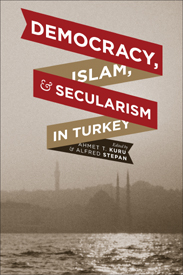
Publication:Democracy, Islam, and Secularism in Turkey

Democracy, Islam, and Secularism in Turkey
Edited by Ahmet T. Kuru and Alfred Stepan

Published by Columbia University Press, February 2012

While Turkey has grown as a world power, promoting the image of a progressive and stable nation, several choices in policy have strained its relationship with the East and the West. Providing historical, social, and religious context for this behavior, the essays in Democracy, Islam, and Secularism in Turkey examine issues relevant to Turkish debates and global concerns, from the state’s position on religion to its involvement with the European Union.

Written by experts in a range of disciplines, the chapters explore the toleration of diversity during the Ottoman Empire’s classical period; the erosion of ethno-religious heterogeneity in modern, pre-democratic times; Kemalism and its role in modernization and nation building; the changing political strategies of the military; and the effect of possible EU membership on domestic reforms. The essays also offer a cross-Continental comparison of “multiple secularisms,” as well as political parties, considering especially Turkey’s Justice and Development Party in relation to Europe’s Christian Democratic parties. Contributors tackle critical research questions, such as the legacy of the Ottoman Empire’s ethno-religious plurality and the way in which Turkey’s assertive secularism can be softened to allow greater space for religious actors. They address the military’s “guardian” role in Turkey’s secularism, the implications of recent constitutional amendments for democratization, and the consequences and benefits of Islamic activism’s presence within a democratic system. No other collection confronts Turkey’s contemporary evolution so vividly and thoroughly or offers such expert analysis of its crucial social and political systems.

CFP: Journal for the Academic Study of Religion: Special Postgraduate Issue

Religion and Rethinking the Human

The ‘human,’ like that of ‘religion,’ is a category always under contestation. In current Euro-American scholarship and public culture, there is an acute anxiety about humans’ excessive reliance on technology, its environmental costs, and the ominous prospect of a post-human dystopia. These anxieties have been recognised, theorised, and allayed by a number of academic sub-disciplines in the humanities and social sciences. It is therefore noteworthy that the study of ‘religion,’ ultimately concerned with the consideration of one of the most enduring products of the ‘human,’ has yet to wholeheartedly embrace a deconstruction of this seemingly transparent category.

Although ‘humans’ are credited with creating ‘religion,’ ‘religion’ itself has played a central role in constructing the ‘human’ as we understand it today. This symbiotic relationship is multifaceted, multivalent, and under-theorised within much of the current field of the contemporary study of religion. In order to bridge this gap between the study of religion and the plethora of recent ‘turns’ in academic scholarship that trouble the ‘human,’ the Journal for the Academic Study of Religion (formerly the Australian Religion Studies Review) seeks papers that provide a valuable insight into this issue of endurance and relevance from a variety of interdisciplinary and methodological perspectives.

Articles may present viewpoints, arguments, and analyses on broad delineations of religion, religiosity, and any of the following, or other and divergent, topics:

  • The historical construction of the human
  • The human and the non-human, super-human, or post-human
  •  Anthropocentrism and the biopolitical processes that bring about the centrality of the human and of certain humans
  • Notions of sentience, identity, and individualism
  • Human rights, law, governance, politics, media, and relations with ‘nature,’ climate, and the environment
  • Interspecies relations, especially between the human, the animal, the plant, the microbial, and the technological
  • Human evolution and cognition
  • The politics and governance of death, dying, and decomposition

This issue of the Journal for the Academic Study of Religion is a special issue that will be edited by postgraduate students featuring contributions from national and international postgraduate students. We are hoping that this will provide students not only with an important platform from which to share their research interests and efforts, but also an invaluable opportunity for the academic community at large to sample the high quality work and the innovation of scholars at a postgraduate level. We are seeking unique essays on the subject of Religion and Rethinking the Human that showcase the original research of students, and we welcome a variety of submissions that provide a unique insight into this highly pertinent issue.

If you would like to contribute to this Special Issue, please send your abstract to the guest postgraduate editors: George Ioannides (george.ioannides@sydney.edu.au) and Venetia Robertson (venetia.robertson@sydney.edu.au) by 1 July 2012. Abstracts should be no longer than 500 words and accompanied by a brief author biographical statement. Authors will be notified by the end of July, and the deadline for submission of complete articles (6000 words) will be 1 December 2012. Papers will be published subject to peer review. This special issue of the Journal for the Academic Study of Religion will be published in December 2013.

CFP: Religion on the Move 12-14 September, 2012

Migration is a key concern in secularity studies, regarding the response of non-religious groups to incoming religious practice and the apparent rise of religiosity which appears as religions change and adapt through migration.

Call for Papers: Religion on the Move

How Motion and Migration influence Religion

10th Conference of the SIEF Working Group on Ethnology of Religion

Szeged, Hungary 12-14 September, 2012

In many ways movement is an important aspect of religion and spirituality. Not only has the significance of motion within the practice of religion and rituality increased (Coleman & Eade 2004), but also, through the movement and migration of people all over the world, religions and religious practices are relocating and changing (Jenkins 2007). Movement is significant for the practice of many religions. It seems that motion has been gaining in importance and that the performative expression and execution of religious practice play a stronger part than they used to do. There might be related to the more participative role of believers in religion and rituality and the enhanced relevance of individuals ‘doing’ religion. The popularity of walking the many pilgrim ways through Europe is an example of that trend, while other expressions of movement like dancing, meditations, processions and other rituals also seem to be more in focus.

A second strand of movement is connected to migration for, by moving, people bring faiths and religious practices to other places in the world where they were not previously known or practised. Nowadays, through mass migrations, refugees, displacements because of war and other translocations, religions and beliefs can expand both spatially and quantitatively. These are processes in which the faiths which are moving are being transformed, and the religion(s) of the areas in which people and their religion are newly settled are likewise affected (examples include Islam in Europe and the new Christians from Africa in Europe). Sometimes beliefs are appropriated through tourism or by ‘spiritual seekers’; aspects of Eastern religion and esoterism have been imported to Western society. In that regard the Internet has become a migratative instrument, in its capacity of ‘posting’ religion all over the globe and into people’s homes, regardless of what religion is practised there. The extension of religion through (digital) migration has an impact on social, cultural and political contexts (Woodhead et al. 2002). The movement of religion might lead to an adaptation to new circumstances, to inculturation, but also potentially to a transformation in the religious constituents of the local culture as well. Sometimes there is openness and religion finds new host communities. Evangelical, Pentecostal, neo-Pentecostal churches have spread across the Atlantic Ocean to Europe (Coleman 2007) and so have Afro-American religions, as Candomblé, Umbanda, or Santeria cubana (Capone 2004; Saraiva 2010). Sometimes the members of the host country become involved in such new practices, but movement may also lead to segregation within host communities and contested situations.

Papers connected to these two research strands on movement and religion are welcomed; one could for example think of the following topics:

• The influence of migration on religion

• Movement as constituative element in religion and rituality

• Effects of globalisation and transnationalism on religion

• Changes in religion through digital movement, via the Internet.

• Movement and spatiality related to the practice of religion

Format: the conference takes place over two days, followed by an excursion on the third day. Paper presentations are limited to 20 minutes each, followed by ten minutes of discussion. In total 20 paper presenters will be selected. Colleagues who do not present a paper are welcome to participate in the conference and its discussions. A business meeting of the SIEF Working Group on Ethnology of Religion will be held during the conference. Organizers: the conference is organized by the Department of Ethnology and Cultural Anthropology of the University of Szeged together with the Bálint Sándor Institute for Research on  religion and the International Society for Ethnology and Folklore (SIEF).

Venue: University of Szeged and Gál Ferenc Theological College of Szeged Fee: the conference fee is 60 €, including conference materials, reception, coffee, brunch, excursion. Participants are responsible for travel and accommodation; there is no funding for expenses available.

Application: submit an abstract of your paper of maximum 300 words, together with your name, position, and institutional affiliation to Dr. István Povedák povedak@yahoo.com by March 15, 2012. The selection of the papers will be done in collaboration with the Board of the SIEF Working Group on Ethnology of Religion. The final selection will be communicated by April 1, 2012.

Contacts: povedak@yahoo.com; peter.jan.margry@meertens.knaw.nl

CFP: Exploring the Extraordinary 22-23 September, 2012

The “extraordinary” strikes as an interesting ground between organised non-religion and religion, a ground which cannot be easily claimed by either group. The extraordinary may even be an interesting phenomena for exploring the terrain between these two binary positions, allowing for nuance in the field.

CALL FOR PAPERS

Exploring the Extraordinary 4th Conference
22nd-23rd September, 2012
Holiday Inn, York

Since its inception in 2007, members of Exploring the Extraordinary have organised three successful academic conferences that have brought together researchers from a variety of different disciplines and backgrounds. The purpose of these events has been to encourage a wider dissemination of knowledge and research, and an interdisciplinary discussion of extraordinary phenomena and experience. By ‘extraordinary’ we refer to phenomena and experiences that are considered to be beyond the mundane, referring to those that have been called supernatural, paranormal, mystical, transcendent, exceptional, spiritual, magical and/or religious, as well as the relevance of such for human culture.

We are looking for submissions for our fourth conference, and would like to invite presentation proposals on topics related to the above. Please submit a 300-500 word paper abstract to Dr Madeleine Castro and Dr Hannah Gilbert (ete.network@gmail.com) by the 6th April 2012. Accepted papers should be on powerpoint, no longer than 20 minutes in length, and intended for an interdisciplinary audience. Please include contact information and a brief biographical note.

For more information, and to see past conference schedules, please visit http://etenetwork.weebly.com

Ideology and the Secular Student Conference. Monday, 12 March from 2-5pm.


The Anthropology students of Goldsmiths University College welcome you to have  a public conference being held on Monday 12 March, 2012 and Monday 19 March 2012

The panels are as follows:

12 March

Atheism, Land Reborn and Secular Missionaries

19 March

Violence, Nationalism and Empathy

The panels are a result of a new addition to the Anthropology Syllabus – Ideology and Secularism a course for 3rd Year BA students.