Publication: An ethnography of the British Humanist Association, Dr Matthew Engelke

The ESRC has produced a report and press release on Humanist Funerals,  announcing the work of Dr Matthew Engelke, which explores early outcomes from his year researching with and within the British Humanist Association.

For more details about the research please contact

Dr Mathhew Engelke
Email: m.engelke@lse.ac.uk
Telephone: 020 7995 6494 or 07800 835403
ESRC Press Office:

Danielle Moore-Chick
Email: danielle.moore-chick@esrc.ac.uk
Telephone 01793 413122
Jeanine Woolley
Email: jeanine.woolley@esrc.ac.uk
Telephone 01793 413119

NSRN Annual Conference – Schedule announced and early registration deadline extended

Please find attached below the provisional schedule for the forthcoming NSRN conference, to be held at Goldsmiths, University of London, in July.

NSRN Final Schedule

Please kindly circulate widely. 

To register please visit this link http://nsrn.net/2012/04/23/registration-now-open-for-the-nsrn-annual-conference/  we are pleased to be able to extend the period of ‘early-bird’ registration until 1 June.

Publication: Is There a Crisis of Secularism in Western Europe?

Please see below for details of an electronic advance publication of Tariq Modood’s talk at the the annual conference at Chester SocRel.  On a personal note I can attest to how thought provoking and insightful I found this lecture, Modood invites comments and it would be interesting to hear people’s thoughts via the NSRN-Discuss.

2011 Paul Hanly Furfey Lecture

Is There a Crisis of Secularism in Western Europe?

Tariq Modood
Sociology of Religion 2012

New Events Report: Non-Religiosity, Identity, and Ritual

The NSRN announces the publication of a new Events Report by Christopher R. Cotter (NSRN), Rebecca Aechtner (University of Edinburgh) and Johannes Quack (McGill University) on the “Non-Religiosity, Identity, and Ritual” Panel Session at the 2011 annual conference of the European Association for the Study of Religions (EASR), “New Movements in Religion” (September 18-22, 2011).

Please see the details and link to the document below:

Non-Religiosity, Identity, and Ritual Panel Session
Hungarian Culture Foundation, Budapest, Hungary
Report by Christopher R. Cotter (NSRN), Rebecca Aechtner (University of Edinburgh) & Johannes Quack (McGill University)
Published by the NSRN, 18 April 2012

CFP: Nonreligion and the Secular: New Horizons for Multidisciplinary Research 4-6 July 2012

The call for papers for the Nonreligion and Secularity Research Network conference is here! The conference is being held at Goldsmiths University, from 4-6 July 2012

Registration details can be found here

Nonreligion and the Secular: New Horizons for Multidisciplinary Research


Conveners: Lois Lee (ll317@cam.ac.uk), Stacey Gutkowski (stacey.gutkowski@kcl.ac.uk), and Stephen Bullivant (stephen.bullivant@smuc.ac.uk)

Conference Coordinator: Katie Aston (k.aston@gold.ac.uk)

Following decades of neglect, the academic study of nonreligion has grown rapidly in the past five years. The primary aim of this conference is to bring together scholars across a range of academic disciplines (sociology, anthropology, theology, political science, psychology, history, international relations, area studies) to begin to untangle the confused and individually contested concepts of nonreligion and the secular. Is nonreligion a subcategory of the secular or vice versa? How do the two terms structure one another? What are the practical and theoretical implications of the concepts, such as they are and/or in alternative formulations? The aim of this international conference is to contribute to addressing this lacuna.  While discussions of nonreligion and the secular have been running largely in parallel, they are potentially mutually enriching topics with significant bearing outside of the academy. This conference will consolidate the achievements already made over the past five years by nonreligion scholars and forge new, multidisciplinary dialogue between these researchers and those primarily working with the concept of the secular. This conference will bring together a range of internationally renowned scholars, including keynote speakers Gracie Davie (Exeter), Callum Brown (Dundee), Monika Wohlrab-Sahr (Leipzig), and Humeira Iqtidar (King’s College London).

The conference engages with a historical moment in which forms of religion and nonreligion have increasingly asserted themselves in the public sphere, in non-Western as well as Western settings. In the case of radical Islamism and New Atheism, such assertions have had powerful, sometimes inflammatory and divisive affect. This urgent wider social and political context demonstrates the urgency of a reasoned, global, scholarly contribution, aimed at further theorising and conceptualising nonreligion and the secular, individually and in relation to each other.

 This conference will interrogate three dimensions and welcomes both empirically- and theoretically-based paper contributions which address the following:

 1) Nonreligion as a concept in its own right

What is meant by the term “nonreligion”? How does it manifest itself in the lives of individuals and in collective social activity and identity? Is it the most appropriate term to encompass a range of phenomena and where may its parameters lie? What is the relationship between nonreligion and modernity? Is nonreligion a resonant category outside of Western contexts? 

 2) The nonreligious in relation to notions of the secular

How do nonreligion and the secular mutually constitute one another? Under what historical social and political conditions did the rise of secularism and secularity facilitate the appearance of the nonreligious? Does the emergence of the nonreligious indicate a new phase of modernity?

 3) The implications of nonreligion research for pressing social and political issues associated with discussions of the secular

What bearing does nonreligiosity have on social, political and legal questions about social cohesion and multiculturalism? To what extent do the “harder” forms on nonreligion breed intolerance and fundamentalism? What are the implications of nonreligion for the possibility of democratic consensus and governance? To what extent do secular political landscapes outside of the West involve or even require the presence of nonreligious phenomena?

Publication Outcome: We are planning to publish a selection of the papers presented at the conference in an edited volume.

 The deadline for abstract submission (250 words max) is 27 April 2012. Please send your abstract together with a short biographical note to Katie Aston at k.aston@gold.ac.uk

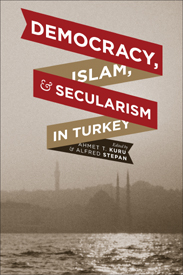
Publication:Democracy, Islam, and Secularism in Turkey

Democracy, Islam, and Secularism in Turkey
Edited by Ahmet T. Kuru and Alfred Stepan

Published by Columbia University Press, February 2012

While Turkey has grown as a world power, promoting the image of a progressive and stable nation, several choices in policy have strained its relationship with the East and the West. Providing historical, social, and religious context for this behavior, the essays in Democracy, Islam, and Secularism in Turkey examine issues relevant to Turkish debates and global concerns, from the state’s position on religion to its involvement with the European Union.

Written by experts in a range of disciplines, the chapters explore the toleration of diversity during the Ottoman Empire’s classical period; the erosion of ethno-religious heterogeneity in modern, pre-democratic times; Kemalism and its role in modernization and nation building; the changing political strategies of the military; and the effect of possible EU membership on domestic reforms. The essays also offer a cross-Continental comparison of “multiple secularisms,” as well as political parties, considering especially Turkey’s Justice and Development Party in relation to Europe’s Christian Democratic parties. Contributors tackle critical research questions, such as the legacy of the Ottoman Empire’s ethno-religious plurality and the way in which Turkey’s assertive secularism can be softened to allow greater space for religious actors. They address the military’s “guardian” role in Turkey’s secularism, the implications of recent constitutional amendments for democratization, and the consequences and benefits of Islamic activism’s presence within a democratic system. No other collection confronts Turkey’s contemporary evolution so vividly and thoroughly or offers such expert analysis of its crucial social and political systems.

Ideology and the Secular Student Conference. Monday, 12 March from 2-5pm.


The Anthropology students of Goldsmiths University College welcome you to have  a public conference being held on Monday 12 March, 2012 and Monday 19 March 2012

The panels are as follows:

12 March

Atheism, Land Reborn and Secular Missionaries

19 March

Violence, Nationalism and Empathy

The panels are a result of a new addition to the Anthropology Syllabus – Ideology and Secularism a course for 3rd Year BA students.

Event: Negotiating Religion Workshop 3: Negotiating Religion in Urban Space 7 March 2012

Part of the Negotiating Religion series, this workshop will investigate the spatial incorporation of religious communities in the city both in the form of the material urban environment, for example in the presence of religious buildings and other faith spaces, and in  everyday urban cultures, practices and politics.

Questions which will be explored in this workshop include: How are new religious buildings incorporated into contemporary urban spaces? What continuities are there with the emergence of religious architecture in earlier times? What significance do religious buildings and other markers in the urban landscape have for different religious communities? How are existing and new forms of religious spatial practice (processions, festivals, pilgrimage) incorporated into the urban environment? What kinds of transformations of urban space are produced by religious spatial practices? What role do faith groups play in the making and remaking of urban spaces?

PROGRAMME:

10.30
Registration
11am-1pm: Session 1: Negotiating Religion in Urban Space: New Faith Spaces
Speakers Professor John Eade (Roehampton University/Migration Research Unit, UCL)
Religious Place-Making and Migration across a Globalising City: Responding to Mobility in London
Ali Mangera (Mangera Yvars Architectural Practice)
Designing faith spaces in the city: The Salaam Centre, North Harrow
Dr Richard Gale (School of City and Regional Planning, Department of Cardiff)
‘…make your dwellings into places of worship’: mosque development and the politics of place and residence in the UK’
Dr Andrew Crompton (School of Architecture, University of Liverpool)
Multi-faith spaces: a universal interface to God
Chair Dr Claire Dwyer (UCL Geography and Migration Research Unit)
1-2pm
Lunch
2-3.45pm Session 2: Negotiating Faith in Urban Space: Continuity and Practice
Speakers Dr Nazneen Ahmed (Compass, University of Oxford)
Making Muslim Space on the London Docks: Lascar Seafarers’ Faith Practices, 1880-1945
Liz Hingley  (Leverhulme Artist in Residence, Migration Research Unit, UCL)
Under gods: stories from Soho Road, Birmingham
Dr Claire Dwyer (Department of Geography and Migration Research Unit, UCL)
Faith and Suburbia: secularisation, modernity and the changing geographies of religion in London’s suburbs
Dr David Garbin (CRONEM, University of Surrey)
Diaspora, suburban Christianity and the American ‘New South’: African migrant churches in Atlanta
Chair Professor John Eade (Roehampton/UCL)
3.45-4pm Break
4-6pm Panel: Negotiating Faith in Urban Space: Politics and Praxis
Panelists Dr John Zavos, (South Asian Studies, University of Manchester)
Small Acts, Big Society: Sewa and Hindu (nationalist) identity in the UK
Dr Luke Bretherton (Faith and Public Policy Forum, Kings College London)
Community Organising, Religious Pluralism and Democratic Citizenship
David Garbin (CRONEM, University of Surrey) and Enrico Masi (University of Bologna, Italy)
Soldiers of God in the Global City (Video Documentary)
6pm Reception. All welcome

Convener:
Dr Claire Dwyer (UCL Geography)

For further information on the individual sessions or the series as a whole, please contact: Dr François Guesnet or Dr Uta Staiger.


CFP: ‘Death in modern Scotland, 1855-1955: beliefs, attitudes and practices’

‘Death in modern Scotland, 1855-1955: beliefs, attitudes and practices’

New College, University of Edinburgh, Friday 1 February 2013 – Saturday 3 February, 2013.

‘There remains a huge agenda for death research, offering a unique vantage point for the study of Scottish history’ (Professor Elaine McFarland of Glasgow Metropolitan University, 2004). Since those words were written, there have been increasing signs of interest, research and publications in death studies in Scotland.

This conference invites those who are researching death from whatever disciplinary perspective to offer papers whose total range will illuminate one hundred years of death in modern Scotland. These hundred years began with the passing of the Registration Act and the Burial Grounds (Scotland) Act in 1855 and end with the opening of Daldowie Crematorium in 1955.

Plenary speakers include:

Professor Elaine McFarland, Dr Elizabeth Cumming and Professor Hilary J. Grainger.

Papers will be particularly welcome on the subjects of:

  • death, grief and mourning;
  • funeral rites and rituals; customs and costume;
  • demographic and statistical interpretations; registration of death;
  • public health and medicine;
  • death, poverty, gender and social class
  • death, urban and rural comparisons
  • burial and cremation;
  • the development of funeral directing services;
  • theology, liturgy and funeral ministry;
  • monuments and memorialisation;
  • issues of architecture and landscape design;
  • the folklore of death; ghost narratives and beliefs; spiritualism;
  • death in war-time;
  • death, grief, mourning;
  • death in literature and the arts;
  • death and Scottish law;
  • violent death; the death penalty;
  • disasters: air, rail, sea and industrial;

Established research and work-in-progress welcomed.

Abstracts of 200 words maximum may be sent to Peter C. Jupp, Braddan House, High Street, Duddington, Stamford, Lincs PE9 3QE email peterc.jupp@btinternet.com or peter.c.jupp@ed.ac.uk

A follow-up call for papers with full conference details and names of plenary speakers will be published soon.

Revd Dr Peter C. Jupp,

Honorary Fellow,

Department of Divinity,

University of Edinburgh, UK.

Update: The Social Science of Secularity – Frank L. Pasquale writes up the study of non-religion to date and predicts a “coherent and enduring field of enquiry”

There were some issues with the link for this this article, but this has now been resolved, link here

The Council for Secular Humanists has published a paper by Frank L. Pasquale, titled “The Social Science of Secularity

Following a failure of irreligious studies to get off the ground in 1971, the purposeful study of the non-religious has again attempted flight and seems to be rocketing, as a subject in its own right, as much NSRN work can attest. This is a fact championed by Pasquale who gives the NSRN a good write up as an “innovative organisation”.

Pasquale gives a useful overview of the breadth of current research and the genesis of organisations such as the NSRN and CAR (Center for Atheist Research). He pays particular attention to key areas needing serious consideration from researchers, including the thorny issue of terminology, accurate description and characterisation. Other key areas include  health, pluralisation of world-views and all “will increasingly need to direct attention to the vast and apparently growing mass of “seculous,” “religular,” or “fuzzy” types in between”.