CFP: Radical Secularization? Deadline 1 May 2012

20-22 September  2012, Universiteit Antwerpen will host a conference on secularization theory. Conference organizers are currently accepting abstracts and will do so through May 1

“This three day international conference tries to frame a status quaestionis of secularization theory in the field of contemporary philosophy. It starts off with an assessment of the classic Löwith-Blumenberg debate. This debate centers around the relationship between monotheism and Christianity on one hand, and Modernity on the other. The focus of the conference then shifts to contemporary debates, with Charles Taylor and Marcel Gauchet as exemplary protagonists. The debate will revolve around ‘transcendent’ versus ‘immanent’ readings of Christianity. On its last day, the question of religion in the public sphere comes to the fore.

Though the conference is philosophical in nature, it hopes to explore interdisciplinary crossroads with theology, sociology, and the social sciences in general.”

Religion and Belief in Higher Education, Derby 15 June 2012

Please see details below for a symposium on religion and belief in higher education, please note the inclusion of Dr Rebecca Catto and Dr Janet Eccles project findings, ‘Forming and Expressing Non-Religious Beliefs in Higher Education’.

RELIGION & BELIEF IN HIGHER EDUCATION

How are students and staff negotiating religion and belief in universities today? This symposium will bring together researchers examining the role of religion and belief in higher education and showcase a range of recent research projects. We will examine evidence from large-scale surveys and local case studies, and from projects spanning a range of faith and belief groups. Topics include multi-faith spaces on campus, non-religious students, Muslim chaplaincy and student Christianity. The symposium will bring together scholars from a range of disciplines, including sociology, religious studies, social policy, architecture, Islamic studies and theology.

SPEAKERS:

Professor Paul Weller & Nicki Moore (Derby) ‘Religion and Belief in Higher Education: Findings, Questions and Reflections from a Research Project for the Equality Challenge Unit’

Jacqueline Stevenson (Leeds Metropolitan) ‘Struggling, Striving, Strategising, Surviving: Religious students in UK higher education’

Dr Ataullah Siddiqui (Markfield Institute) ‘Bridging the Gap between the “Islamic Studies” and “Islamic Sciences”: Some Challenges’

Dr Mike Higton (Cambridge) ‘A Theology of Higher Education’

Dr Adam Dinham (Goldsmith’s) ‘An Ambiguous Role for Religion in the Universities: A Case Study in Practice’

Dr Andrew Crompton (Liverpool) ‘The Architecture of the Multifaith Space: Designing for Inclusion’

Dr Rebecca Catto & Dr Janet Eccles (Lancaster) ‘Forming and Expressing Non-Religious Beliefs in Higher Education’

Maulana Dr M. Mansur Ali (Cambridge Muslim College) ‘Muslim Chaplaincy in UK and US Higher Education: A Comparative Study’

Dr Kristin Aune (Derby) ‘Student Christianity in English Universities’

DATE: Friday 15th June 10am-4.45pm

VENUE: The Enterprise Centre, University of Derby, Bridge Street, DE1 3LA

REGISTRATION: No charge but places are limited so please register soon. Vegetarian lunch and refreshments provided.
Register by email to Frauke Uhlenbruch (f.uhlenbruch@derby.ac.uk) by Friday 18th May

Dr. Kristin Aune
Senior Lecturer in Sociology
Head of the Society, Religion & Belief Research Group
Faculty of Education, Health & Sciences
University of Derby
Kedleston Road
Derby DE22 1GB
Tel: 01332 591428

Book Launch: The Salvation of Atheists and Catholic Dogmatic Theology, 17 April

One of the directors of the NSRN, Stephen Bullivant will be launching his new book, The Salvation of Atheists and Catholic Dogmatic Theology on Tuesday 17th April 2012. Please find details below

5.30pm-7pm with a drinks reception and light refreshments
Senior Common Room, St Mary’s University College,
Waldegrave Road, Twickenham TW1 4SX

The Salvation of Atheists and Catholic Dogmatic Theology

Stephen Bullivant
(Oxford University Press, 2012)

Ethnicity and the Mixed Marriage Crisis

Katherine E. Southwood
(Oxford University Press, 2012)

Palestine Nakba: Decolonising History, Narrating the Subaltern, Reclaiming Memory

Nur Masalha
(Zen Books, 2012)

A poster for the event can be found here

Project of Religious Freedom discussion series launched on the Immanent Frame

The Luce Project of Religious Freedom is launching a discussion series on the Immanent Frame. The series, guest edited by Elizabeth Shakman Hurd and Winnifred Fallers Sullivan in conjunction with a joint research project asks the question -“what is religious freedom, and why are we talking about it now?”

Scholars contributing to the series consider the multiple histories and genealogies of religious freedom—and the multiple contexts in which those histories and genealogies are salient today. The responses start with Elizabeth Shakman Hurd’s contribution Believing in religious freedom and has continued with contributions from Saba Mahmood, Winnifred Fallers Sullivan, Peter Danchin, and Samuel Moyn.

Oxford Journal of Law and Religion – first issue just published


The Oxford Journal of Law and Religion, new to Oxford Journals in 2012, has just published its first issue! Plenty in the first issue for the scholar of secularism and the secular including Religious freedom, state and church and human rights.

The OJLR will be freely available online in 2012, so visit the table of contents for the first issue:

http://www.oxfordjournals.org/page/4452/6

Make sure to create or update your My Account profile so you don’t miss Advance Access alerts for the OJLR’s articles as they publish online ahead of print here:

http://www.oxfordjournals.org/page/4452/7

The Critical Religion Research Group Host Naomi Goldenberg April 2012

April 2012 Naomi Goldenberg visit hosted by the Critical Religion Research Group. On their website she states: 

Conceptualizing religions as vestigial states has value for clarifying matters pertaining to supposed qualitative differences between ‘religious’ and ‘secular’ law.  According to my reasoning, such a distinction is more productively thought of as occurring between two forms of ‘states’ with markedly similar processes involving contingency, debate and compromise, something I will draw out further in my forthcoming presentations.
 

Please see details below of three events with Naomi Goldenberg over April.

The Critical Religion Research Group is delighted to be hosting Naomi Goldenberg,Professor of Religious Studies (Department of Classics and Religious Studies, University of Ottawa), for a visit to the UK in April 2012.

Prof. Goldenberg will be speaking in three locations: StirlingAberdeen and London.  Details for each location are noted below, as are some notes about her current research.  The Critical Religion Research Group is also happy to facilitate media enquiries regarding Prof. Goldenberg’s visit.  Unless otherwise noted, all general enquiries should be directed to Dr Tim Fitzgerald.

In advance of her visit, Prof. Goldenberg has also written guest blog entries that discuss her work.

Stirling – Monday, 23.4.12

What’s God Got to Do With It? Contemporary Statecraft, Gender and the Category of Religion”

Room E26, Pathfoot Building, University of Stirling, at 15:00.

Aberdeen – Tuesday, 24.4.12

Prof. Goldenberg is speaking at a day workshop entitled Modernity and the Category of Religion, organised by Dr Trevor Stack of Aberdeen University’s Centre for Citizenship, Civil Society and Rule of Law.

Other speakers include Dr Stack, Dr Tamas Gyorfi, Stirling’s Dr Fitzgerald, Dr Suzanne Owen and Dr Brian Bock; Stirling’s Dr Jasper is a discussant.

Please email Louise Harkins with any queries.

London – Thursday, 26.4.12

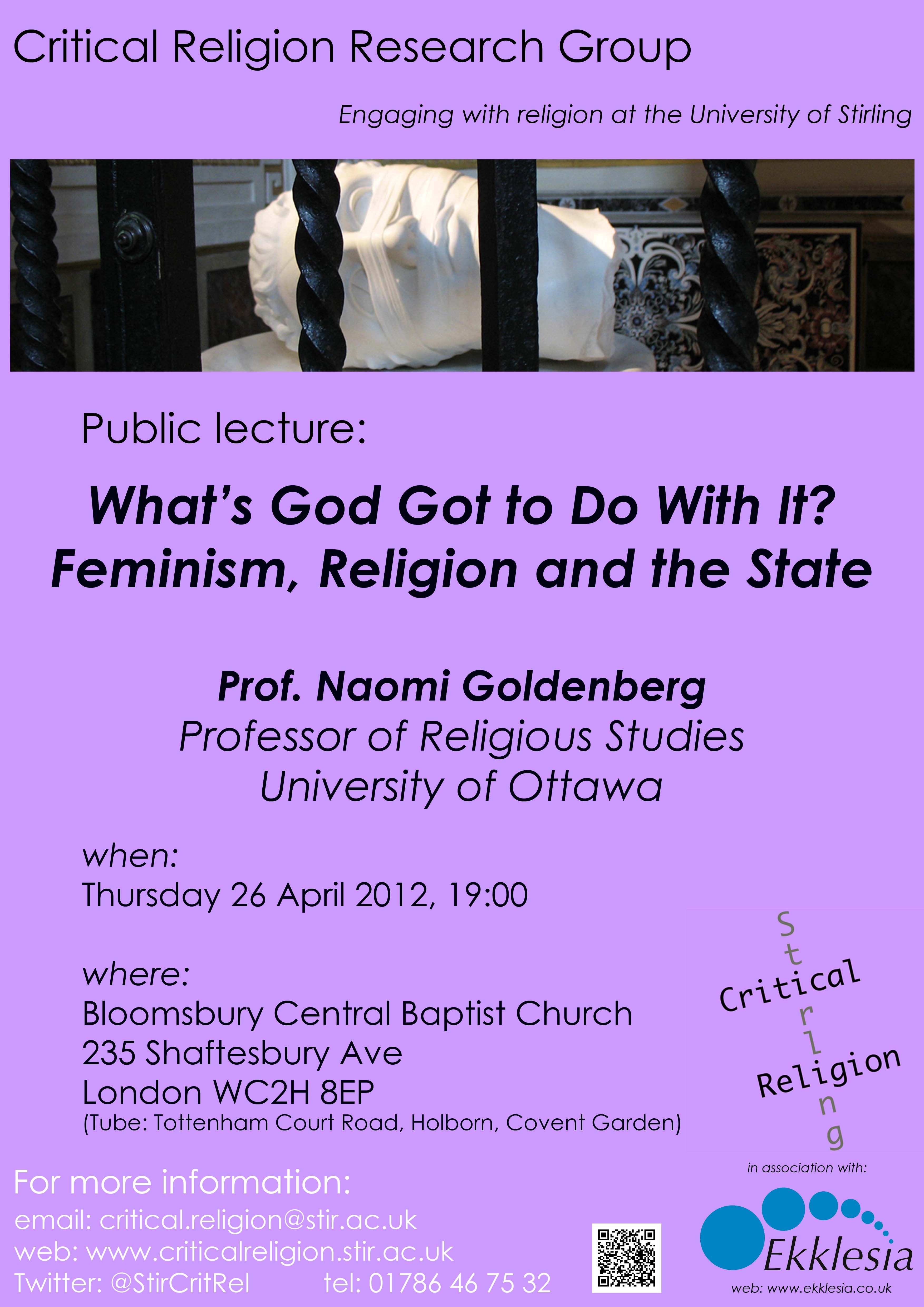
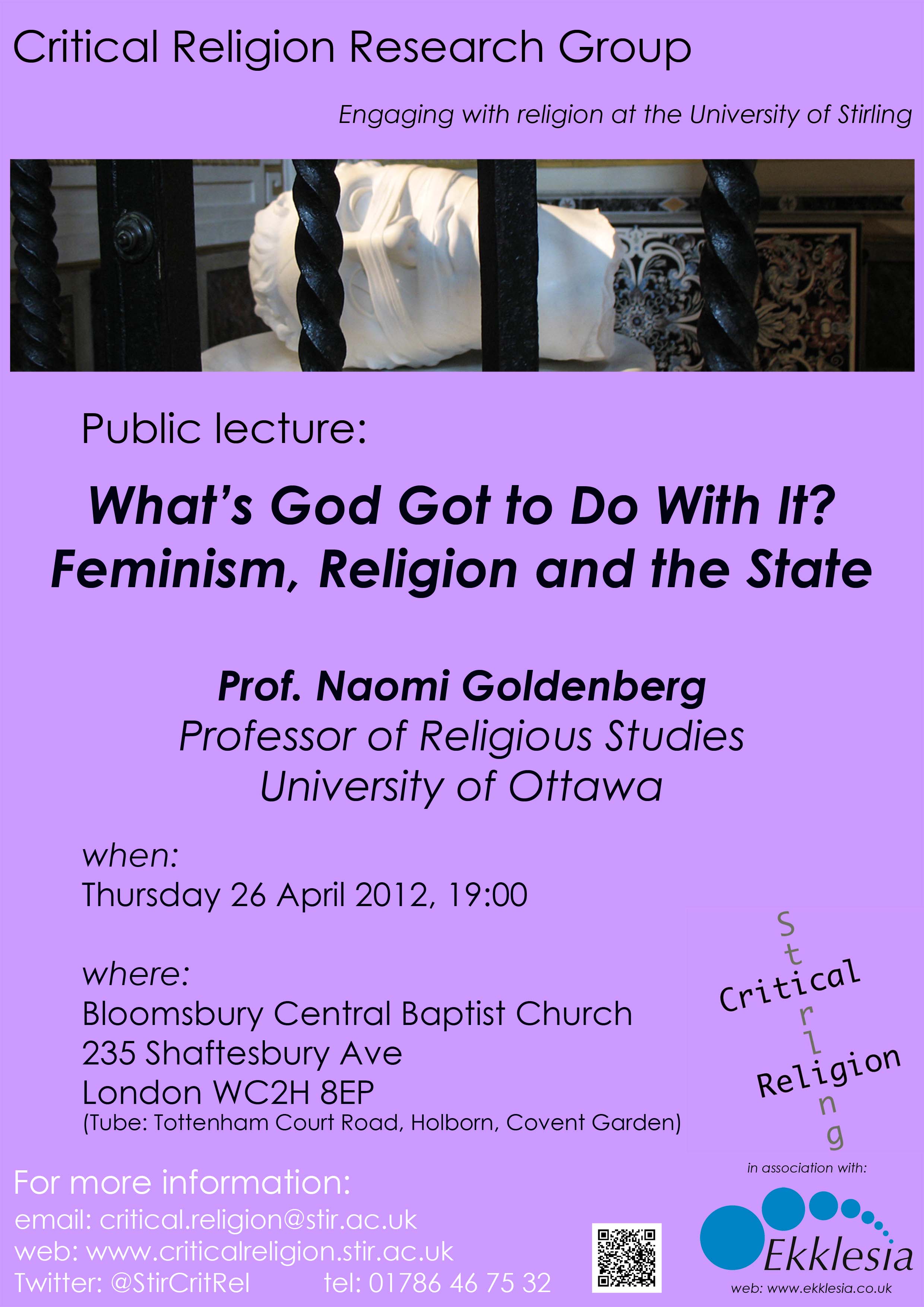
What’s God Got to Do With It? Feminism, Religion and the State”

Bloomsbury Central Baptist Church, Covent Garden, London, at 19:00.

Posters for this event can be sent on request, and are available for download here in jpg format: A3 sizeA4 size.

The London event is organised in conjunction with our partner, Ekklesia.

Theme

Prof. Goldenberg writes:

I will argue that religions function as vestigial states within contemporary nation-states.  By ‘vestigial states’ I mean sets of institutions and practices that originate in particular histories with reference to former sovereignties within present governmental jurisdictions.  Vestigial states are both tolerated and encouraged as attenuated and marginalized governments within fully functioning nation states.  However, they compete with contemporary nation states and therefore are always problematic in varying degrees – especially if a vestigial state challenges the exclusive right of the present state to control violence.  Indeed, vestigial states have a propensity to behave as once and future states.  Nevertheless, although vestigial states can contest contemporary governments, they also work to ground the powers that authorize them by recalling earlier, now mystified forms of sovereignty from which present states arise. They are thus storehouses of nostalgia for fictional, beneficent male hegemonies that present states are thought of as representing in less magical (i.e. ‘secular’) incarnations.

Because vestigial states always embody and perform patriarchal power through citing former male-dominated governments, they support the notion that the only truly legitimate political authority is male.  Although women can exercise some authority in contemporary nation states, this power is so novel that it lacks cultural roots and social gravitas.  Rights and responsibilities tend to be provisional, partial, and subject to restriction.  In order for recent, progressive feminist gains worldwide to be both secured and furthered, the role of vestigial states – i.e. religions – in the maintenance of male control of contemporary nation states must be more vigorously interrogated.

We also encourage you to read Prof. Goldenberg’s guest blog contributions.

CFP: Nonreligion and the Secular: New Horizons for Multidisciplinary Research 4-6 July 2012

The call for papers for the Nonreligion and Secularity Research Network conference is here! The conference is being held at Goldsmiths University, from 4-6 July 2012

Registration details can be found here

Nonreligion and the Secular: New Horizons for Multidisciplinary Research


Conveners: Lois Lee (ll317@cam.ac.uk), Stacey Gutkowski (stacey.gutkowski@kcl.ac.uk), and Stephen Bullivant (stephen.bullivant@smuc.ac.uk)

Conference Coordinator: Katie Aston (k.aston@gold.ac.uk)

Following decades of neglect, the academic study of nonreligion has grown rapidly in the past five years. The primary aim of this conference is to bring together scholars across a range of academic disciplines (sociology, anthropology, theology, political science, psychology, history, international relations, area studies) to begin to untangle the confused and individually contested concepts of nonreligion and the secular. Is nonreligion a subcategory of the secular or vice versa? How do the two terms structure one another? What are the practical and theoretical implications of the concepts, such as they are and/or in alternative formulations? The aim of this international conference is to contribute to addressing this lacuna.  While discussions of nonreligion and the secular have been running largely in parallel, they are potentially mutually enriching topics with significant bearing outside of the academy. This conference will consolidate the achievements already made over the past five years by nonreligion scholars and forge new, multidisciplinary dialogue between these researchers and those primarily working with the concept of the secular. This conference will bring together a range of internationally renowned scholars, including keynote speakers Gracie Davie (Exeter), Callum Brown (Dundee), Monika Wohlrab-Sahr (Leipzig), and Humeira Iqtidar (King’s College London).

The conference engages with a historical moment in which forms of religion and nonreligion have increasingly asserted themselves in the public sphere, in non-Western as well as Western settings. In the case of radical Islamism and New Atheism, such assertions have had powerful, sometimes inflammatory and divisive affect. This urgent wider social and political context demonstrates the urgency of a reasoned, global, scholarly contribution, aimed at further theorising and conceptualising nonreligion and the secular, individually and in relation to each other.

 This conference will interrogate three dimensions and welcomes both empirically- and theoretically-based paper contributions which address the following:

 1) Nonreligion as a concept in its own right

What is meant by the term “nonreligion”? How does it manifest itself in the lives of individuals and in collective social activity and identity? Is it the most appropriate term to encompass a range of phenomena and where may its parameters lie? What is the relationship between nonreligion and modernity? Is nonreligion a resonant category outside of Western contexts? 

 2) The nonreligious in relation to notions of the secular

How do nonreligion and the secular mutually constitute one another? Under what historical social and political conditions did the rise of secularism and secularity facilitate the appearance of the nonreligious? Does the emergence of the nonreligious indicate a new phase of modernity?

 3) The implications of nonreligion research for pressing social and political issues associated with discussions of the secular

What bearing does nonreligiosity have on social, political and legal questions about social cohesion and multiculturalism? To what extent do the “harder” forms on nonreligion breed intolerance and fundamentalism? What are the implications of nonreligion for the possibility of democratic consensus and governance? To what extent do secular political landscapes outside of the West involve or even require the presence of nonreligious phenomena?

Publication Outcome: We are planning to publish a selection of the papers presented at the conference in an edited volume.

 The deadline for abstract submission (250 words max) is 27 April 2012. Please send your abstract together with a short biographical note to Katie Aston at k.aston@gold.ac.uk

CFP: The International Conference on Media, Religion, and Culture 8-12 July 2012

Please see details below of  The International Conference on Media, Religion, and Culture of particular interest to the network is the thread Media and The Boundaries of the Religious and the Secular


Call for papers deadline: April 15th,2012

There has been great interest to the conference and there are still requests for submitting abstracts.

Local committee decided to extend the deadline for abstract submissions until April 15, 2012.

There will be a great religious sites tour all around Turkey after the conference.

Please use nezihorhon@gmail.com for abstract submissions.


The International Conference on Media, Religion, and Culture, organized every two years by the International Society for Media, Religion, and Culture, invites papers for its July 8-12, 2012 conference to be held in Eskisehir, Turkey (outside of Istanbul), at Anadolu University.

In contemporary societies, electronic media such as smart mobile phones, satellite television, radio, and laptop computers have become ubiquitous. Although historians point out that world religions have always been mediated by culture in some way, people have incorporated these electronic media into everyday practices, and industries and state organizations have arisen to profit from those practices, in ways that are unprecedented. Today’s media can connect people and ideas with one another, but they also foster misunderstandings and reinforce societal divisions. They may provide the means for the centralization of religious authority, or the means to undermine it. Scholars of religion, as well as scholars of media and of culture, must consider how these various societal institutions of the media interact with one another and with systems of religion, governance, and cultural practices, as our societies demand better means by which to understand emergent concerns in an increasingly interconnected, globalized context.

The contemporary location of Turkey has long been the meeting place between Eastern and Western culture, religion, trade, and communication. This conference provides a crossroads for scholars, doctoral students, media professionals, and religious leaders from a variety of religious and secular traditions to meet and exchange ideas. Interdisciplinary scholarship is welcome, as is comparative work, theoretical development, and in-depth ethnographic studies that shed light on contemporary phenomena at the intersection of media, religion, and culture.

Papers, panels, workshops, and roundtable proposals could address, but should not be limited to:


* Global and Glocal Media and Religion(s)

* Mediation and Mediatization of Religion

* Media and The Boundaries of the Religious and the Secular

* Media, Power, Religion and Democracy

* Religion and Visual Expression

* Crossroads of Old/New Media and Religion

* Religion, Gender and Media

* Dialogue/Conflict: Media and Religion

* Islam and Media/ Islamic Media

* Social Media, Religion and Cultures


Presentation Formats

This year we will be accepting proposals in four formats: papers, panels, workshops and roundtables.

Panels bring together in discussion four participants or presentations representing a range of ideas and projects. Roundtables may include more individuals who comment on a common theme in briefer formats.

Panels and roundtables are scheduled for 90 minutes and should include a mix of individuals working in areas of research, theory, and practice. We also encourage the use of discussants.

Workshops provide an opportunity for hands-on exploration and/or project development. They can be organized around a core challenge that participants come together to work on or around a tool, platform, or concept. Workshops are scheduled for 90 minutes and should be highly participatory.

Submission of abstracts and online registration has started: Transformations of the Sacred in Europe and Beyond

ESA Mid-term Conference: Research Network 34 – Sociology of Religion

University of Potsdam, Germany, 3-5 September 2012
in cooperation with the German Section for the Sociology of Religon in the DGSYou will find the registration form on: http://www.uni-potsdam.de/esa-religion/abstractsandregistration.html

Plenary Speakers:

Schirin Amir-Moazami, Institute for Islamic Studies, Free University of Berlin
Hubert Knoblauch, Institute for Sociology, Technical University of Berlin
Gordon Lynch, Religious Studies School of European Culture and Languages, University of Kent

Eva-Maria Schrage, Graduate School “Religion and Politics in the Cultures of Pre-modernity and Modernity”, University of Münster

Panel: Religions on the Move/Changes in Religious Cultures
Inger Furseth, Director of the Nordic Research Program NOREL, Oslo
Dorota Hall, Ass. Professor at the Dep. of Religious Studies, Polish Academy of Sciences, Warsaw
Volkhard Krech, Director of the Käte Hamburger Kolleg Dynamics in the History of Religions and speaker of the Center for Religious Studies (CERES) at the University of Bochum
Siniša Zrinščak, Department of Social Work, University of Zagreb

New Website for SOCREL

The address remains the same – www.socrel.org.uk –  but the team have created a new look site.

All of the information relating to the upcoming annual conference in Chester can be found on the website, although some of the details from past conferences and events are still being loaded up. If you find a
problem when using part of the site, please use them.  You can also use the  annual conference to give feedback too.

If there was a way of finding information on the old site that you liked, you can still access it at – old.socrel.org.uk – but please note that these pages will no longer be kept up to date.