A little slow in publishing this but still worth a read.
New Statesman‘s Jonathan Derbyshire interviews Charles Taylor on his new book Secularism and Freedom of Conscience

A little slow in publishing this but still worth a read.
New Statesman‘s Jonathan Derbyshire interviews Charles Taylor on his new book Secularism and Freedom of Conscience
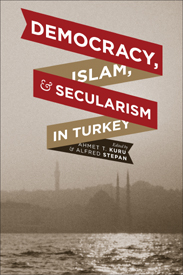
Democracy, Islam, and Secularism in Turkey
Edited by Ahmet T. Kuru and Alfred Stepan
Published by Columbia University Press, February 2012
While Turkey has grown as a world power, promoting the image of a progressive and stable nation, several choices in policy have strained its relationship with the East and the West. Providing historical, social, and religious context for this behavior, the essays in Democracy, Islam, and Secularism in Turkey examine issues relevant to Turkish debates and global concerns, from the state’s position on religion to its involvement with the European Union.
Written by experts in a range of disciplines, the chapters explore the toleration of diversity during the Ottoman Empire’s classical period; the erosion of ethno-religious heterogeneity in modern, pre-democratic times; Kemalism and its role in modernization and nation building; the changing political strategies of the military; and the effect of possible EU membership on domestic reforms. The essays also offer a cross-Continental comparison of “multiple secularisms,” as well as political parties, considering especially Turkey’s Justice and Development Party in relation to Europe’s Christian Democratic parties. Contributors tackle critical research questions, such as the legacy of the Ottoman Empire’s ethno-religious plurality and the way in which Turkey’s assertive secularism can be softened to allow greater space for religious actors. They address the military’s “guardian” role in Turkey’s secularism, the implications of recent constitutional amendments for democratization, and the consequences and benefits of Islamic activism’s presence within a democratic system. No other collection confronts Turkey’s contemporary evolution so vividly and thoroughly or offers such expert analysis of its crucial social and political systems.
Advertisement for the post of Postgraduate Part-time Research Assistants
The Department of Law is seeking to employ two suitably qualified Postgraduate Research Assistants to work within the research project RELIGARE. These are EU grant funded positions. The project researches the area of: ‘Religious Diversity and Secular Models in Europe – Innovative Approaches to Law and Policy’.
Candidates will be required to undertake research in collaboration with and under the supervision of the Principal Investigator, Dr Prakash Shah, in order to realise the objectives and development of the research programme. Duties will involve writing case notes, assisting in the organisation of project meetings, attending project meetings, coordinating volunteers’ activities, and writing and editing research papers and reports. Good academic and legal writing skills are necessary.
These are part-time, fixed term posts available for 6 months. The posts are to commence mid March 2012 or as soon as possible thereafter. Remuneration will be made on an hourly basis and will be in the range of £15.43 – £16.27 per hour depending on the tasks allocated and experience of the employee. Benefits include 30 days annual leave (pro-rata) and defined benefit pension scheme.
Candidates must be able to demonstrate their eligibility to work in the UK in accordance with the Immigration, Asylum and Nationality Act 2006. Where required, this may include entry clearance or continued leave to remain under the Points Based Immigration Scheme.
Informal enquiries should be addressed to please contact Dr Prakash Shah (prakash.shah@qmul.ac.uk).
Details about the department and further particulars are available from: www.laws.qmul.ac.uk
Further details and an application form can be found at: http://webapps.qmul.ac.uk/hr/vacancies/jobs.php?id=2882
Completed application forms, quoting 12012/NL, should be returned to law-recruitment@qmul.ac.uk. Applications must be made on the official College application form and must include the applicant’s CV and the names of three referees.
The closing date for applications is 4th March 2012 at 17:00 hrs BST and interviews will be held shortly thereafter.
(26 August – 2 September 2012, Antwerp, Belgium)
We would like to draw your attention to the call for applications for the 2012 UCSIA summer school on “Religion, Culture and Society”. This summer school is a one-week course taking place from Sunday 26 August until Sunday 2 September (dates of arrival and departure). This year the programme will focus on the topic of Secularism(s) and Religion in Society.
Topic:
It is evident that religion, culture and society are strongly interwoven and are crucial for understanding the contemporary world. With globalization touching all aspects of our lives, religion(s) and culture(s) have to understand their position in this complex globalizing process. It is the aim of the interdisciplinary UCSIA summer school to better understand the dynamic interplay between the macro- and micro-social developments concerning religion that take place in much of the contemporary world.
Guest lecturers are Rajeev Bhargava (Centre for the Study of Developing Societies, Delhi), Peggy Levitt (Wellesley College), Robert W. Hefner (Boston University) and John Hutchinson (London School of Economics).
Practical details:
Participation and stay for young scholars and researchers are free of charge. Participants should pay for their own travel expenses to Antwerp.
You can submit your application via the electronic submission on the summer school website. The completed file as well as all other required application documents must be submitted to the UCSIA Selection Committee not later than Sunday 15 April 2012.
For further information regarding the programme and application procedure, please have a look at their website.
Please help us to distribute this call for application among PhD students and postdoctoral scholars who might be interested in applying for this summer school.
For all further information, do not hesitate to contact UCSIA on the address below.
Sara Mels
Project coordinator
UCSIA vzw
Prinsstraat 14
B-2000 Antwerp
Belgium
Tel. +32 (0)3 265 45 99
Fax +32 (0)3 707 09 31
e-mail: sara.mels@ua.ac.be
This CFP is the result of a discussion a few of us have been having about putting together an exploratory session at this year’s AAR, in the hope that we can create a group within the AAR yearly program to deal with irreligion/nonreligion and secularism topics going forward.
Exploratory session, American Academy of Religion annual meeting, Chicago, IL on Nov 17-20.
Society is always in flux, a fact that could hardly be missed in 2011, the year of the protester. As such, social change has become a hot topic in a variety of academic disciplines. Those dealing with religion are asking questions about how religious belief systems envision utopia, how religious institutions promote or stifle transformations of society, and how social change in turn transforms religion; but what about irreligious institutions, nontheistic belief systems and secularism? How do they relate to and interact with social change? This panel was born out of the belief that it is also important to investigate the relationship between social change and “the secular.” Paper topics may include but are not limited to nontheistic moral philosophies and worldviews, irreligious communities, institutions and individuals, or secularism as ideology and practice. We hope to get proposals from a wide array of disciplinary perspectives and papers will be selected based on thematic relevance and methodological diversity. If you are interested in participating please send an abstract of no more than 500 words to smithp@bu.edu by the end of the day, Feburary 13, 2012.
Please note that this panel is also part of an effort to create an “Irreligion and Secularism” unit within the American Academy of Religion annual meeting program and is therefore being pitched to the AAR as an exploratory session. This means that once your paper is selected the panel still requires approval from the AAR program committee before it gets accepted for this year’s annual meeting.
For further details please contact, Per Smith: smithp@bu.edu
Following the recent update on our bibliography, please find details of a further special series of essays on Secularism from the November issue of Cultural Anthropology which will be included shortly. The essays focus on theories of Secularism and possibilities for its practical application within the field of Anthropology, using the work of Asad and Connolley as a theoretical frame.
SECULARISM
Introduction
Charles Hirschkind and Matthew Scherer
Cultural Anthropology November 2011, Vol. 26, No. 4: 620.
Landmarks in the Critical Study of Secularism
Matthew Scherer
Cultural Anthropology November 2011, Vol. 26, No. 4: 621-632.
Is There a Secular Body?
Charles Hirschkind
Cultural Anthropology November 2011, Vol. 26, No. 4: 633-647.
Some Theses on Secularism
William E. Connolley
Cultural Anthropology November 2011, Vol. 26, No. 4: 648-656.
Thinking About the Secular Body, Pain, and Liberal Politics
Talal Asad
Cultural Anthropology November 2011, Vol. 26, No. 4: 657-675.
Now that things are slowly getting back to normal after the holiday season, we thought some extra reading might be in order.
The following items have been added to the NSRN’s bibliography today, and are mostly the result of suggestions from visitors to the website. A huge thanks to everyone who suggested items – please keep them coming.
The complete bibliography can be viewed in a list organised by author surname or publication date.
—————–
The Orfalea Center for Global & International Studies, Santa Barbara
presents
Rethinking Secularism – A Seminar Discussion
Friday, November 18, 2011 – 12:00 noon, Orfalea Center seminar room – 1005 Robertson Gym
With:
Craig Calhoun, President, Social Science Research Council, and Prof of Sociology, NYU
Jonathan Van Antwerpen, Editor-in-Chief, The Immanent Frame, SSRC online magazine
Mark Juergensmeyer, Director, Orfalea Center for Global and International Studies
Comments by:
Benjamin (Jerry) Cohen, UCSB Political Science
Wade Clark Roof, UCSB Religious Studies
Giles Gunn, UCSB Global & International Studies
The speakers will discuss the background and content of the multi-year project of the Social Science Research Council on the crisis of secularism that resulted in their recently published, co-edited volume Rethinking Secularism (2011 Oxford UP). The project (and the volume) involved an interdisciplinary group of leading theorists and scholars, including the philosopher Charles Taylor, the literary theorist Talal Asad, the political scientist Peter Katzenstein, the sociologist Jose Casanova, and many more. The project focused on the central issues of how ”the secular” emerged historically, how it is now constituted and understood in different ways around the global, and how it has presented an analytic challenge for the social sciences, the humanities, and international affairs.
 NSRN Online