
Again, for the keen eyed this is a little slow in being posted on here, but still worth sharing. The ImmanentFrame have posted an except from Charles Taylor’s chapter in the edited volume Rethinking Secularism (Oxford University Press, 2011).
publication
Publication: New Statesman’s Jonathan Derbyshire interviews Charles Taylor on his new book Secularism and Freedom of Conscience
A little slow in publishing this but still worth a read.
New Statesman‘s Jonathan Derbyshire interviews Charles Taylor on his new book Secularism and Freedom of Conscience
Publication:Democracy, Islam, and Secularism in Turkey
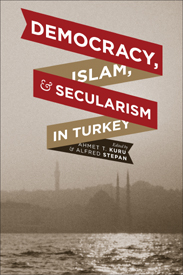
Democracy, Islam, and Secularism in Turkey
Edited by Ahmet T. Kuru and Alfred Stepan
Published by Columbia University Press, February 2012
While Turkey has grown as a world power, promoting the image of a progressive and stable nation, several choices in policy have strained its relationship with the East and the West. Providing historical, social, and religious context for this behavior, the essays in Democracy, Islam, and Secularism in Turkey examine issues relevant to Turkish debates and global concerns, from the state’s position on religion to its involvement with the European Union.
Written by experts in a range of disciplines, the chapters explore the toleration of diversity during the Ottoman Empire’s classical period; the erosion of ethno-religious heterogeneity in modern, pre-democratic times; Kemalism and its role in modernization and nation building; the changing political strategies of the military; and the effect of possible EU membership on domestic reforms. The essays also offer a cross-Continental comparison of “multiple secularisms,” as well as political parties, considering especially Turkey’s Justice and Development Party in relation to Europe’s Christian Democratic parties. Contributors tackle critical research questions, such as the legacy of the Ottoman Empire’s ethno-religious plurality and the way in which Turkey’s assertive secularism can be softened to allow greater space for religious actors. They address the military’s “guardian” role in Turkey’s secularism, the implications of recent constitutional amendments for democratization, and the consequences and benefits of Islamic activism’s presence within a democratic system. No other collection confronts Turkey’s contemporary evolution so vividly and thoroughly or offers such expert analysis of its crucial social and political systems.
Publication: The Post-Secular in Question: Religion in Contemporary Society
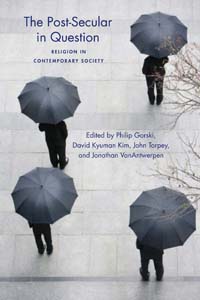
Due to be published this month, The Post-Secular in Question: Religion in Contemporary Society
Edited By Philip Gorski, David Kyuman Kim, John Torpey and Jonathan Van Antwerpen
ISBN: 9780814738726
A review of the book, by James K.A. Smith can be found on his blog, fors clavigera
More details about the book can be found on the New York University Press site
CFP: Special Issue “Religion & Globalization”
Please note the CFP below for the special Issue “Religion & Globalization”. Areas of interest include the re-enchantment of the world and the transient nature of religious practice. It would be interesting to see included some work on similar negotiations within secular practices and discourses or other view points on the secular.
A special issue of Religions (http://www.mdpi.com/journal/religions/)
http://www.mdpi.com/journal/religions/special_issues/religion_globalization/
Call for Papers
Whether globalization is considered as a worldwide structured system of interstate relationships (Friedmann, 1998) or as a world “in motion” (Tomlinson, 1999) crossed by human and cultural flows (Appadurai, 1998), it refers indisputably to a new set of environmental conditions for religions. Globalization is creating new dynamics of change including transnational expansions of traditions (Csordas, 2007), deterritorialized sites, cultic areas (even parishes), virtualized and networked “communities” of believers, electronic and mediatized gods (Stolow, 2010), the universalization of cosmopolitan values and the localization of universalized beliefs (Robertson, 1992). Also shifting religious geographies (for example, Christianity turning “southern” and “black”, Islam turning “Asian”, Buddhism turning “white” and “western”) have contributed to a reshaping of global geopolitics (Huntington, 1993), an “ecological” turn in religious beliefs (Taylor, 2005), a worldwide standardization of religious systems (Beyer, 1994, 1998, 1999) and re-enchantment on a global scale (Csordas, 2007). Migrations have been – and still are – major forces for the geographic redistribution of beliefs and cults, while the world is also becoming ‘proselytized’. This does not clarify the very specific modes by which each process of mobility affects the various ways different religions are acted upon by global forces in their specific contexts. Neither does it take into account the fact that global religious changes may have nothing to do with mobility (Friedmann, 1998) but rather with global systems (Beyer, 1994). A global perspective on religious changes and adaptations in the contemporary world requires a prudent examination of different case-studies as not all religions are subjected to the same forces and engaged with similar processes of changes. Indeed, the “great” historical religions do not face global changes like new expanding religious cults or sects do. Analysis must cautiously distinguish between globalizing religions in global conditions, the impact of globalization on religions, and the role of religions in the rise and the shaping of global (economic, political or ideological) forces.
This special issue aims at gathering papers in which scholars from different disciplinary backgrounds (religious studies, anthropology, sociology, political sciences, history, political economy or others) can explore, on an empirical basis and in clearly identified geographic, historical and cultural contexts, the effects of religion on globalization or of globalization on religions. Please contact Prof. Lionel Obadia, anthropologist, University Lyon 2 at: Lionel.obadia@univ-lyon2.fr
Keywords: Globalization, Global and globalizing religions, spiritual transnationalism, migration and missionary activism, mediatization of religions, religion and the Internet, deterritorialization and new geographies of religions.
Expected deadline: September 30, 2012.
 NSRN Online