PhD position in nonreligion

Three full-time four-year paid PhD positions are available at the School of Theology and Religious Studies, University of Tartu. The positions are fully funded and successful candidates will be hired as Junior Research Fellows for the duration of their PhD studies.

There are no predetermined research areas or focuses, the candidate has to propose one’s own topic – and projects on nonreligion are very welcome. For that, contact dr Atko Remmel: atko.remmel@ut.ee.

NB! Application deadline is very soon, May 15. For more information see https://usuteaduskond.ut.ee/en/news/open-call-three-full-time-paid-phd-positions-theology-and-religious-studies.

NSRN Annual Lecture 2025

You are cordially invited to the NSRN Annual Lecture 2025, which will be given by Anna Strhan and Rachael Shillitoe. The title of the lecture is Growing Up Godless: Childhood and the Formation of Non-Religion.

How are children’s non-belief and non-religion formed in everyday life? While previous studies have shown that what happens during childhood is crucial in driving the growth of non-religious populations, we know little about the experiences of the growing numbers of children for whom being non-religious is the “new normal” or about how their non-religion and non-belief are formed in everyday life. Drawing on rich ethnographic fieldwork and in-depth interviews with children, their parents, and teachers across different parts of England, this lecture addresses this scholarly gap, examining the formation of children’s non-religious identities and perspectives and how these relate to shifting moral landscapes.

The lecture will take place via Zoom on May 22, 2025, 9.30 am PDT / 12.30 pm EDT / 5.30 pm BST / 6.30 pm CEDT.

Registration is open at: https://ut-ee.zoom.us/meeting/register/riF2v789QDGz_i_3JK1_Zw.

NSRN 2025 conference CfP – Extended

Nonreligion and Secularity Research Network Conference

8-10 September 2025

Institute of Ethnology and Social Anthropology at the Slovak Academy of Sciences, Comenius University in Bratislava, Slovakia

Scholarly discussions on nonreligion often begin by noting that nonreligion and its related phenomena are primarily studied within Western, particularly Anglophone contexts, with recent efforts to expand global perspectives. However, these broad categorizations – “Western,” “Anglophone,” or “global North or South” – oversimplify the notable diversity of nonreligion within those demarcations. Various phenomena that are considered nonreligious emerge from complex intersections of national histories, political contexts, and religious influences – or the absence thereof – while simultaneously being shaped by global media and generational dynamics.

The Nonreligion and Secularity Research Network (NSRN) invites paper and session proposals for its 2025 conference, Nonreligion and Secularity at Cultural Crossroads. We aim to explore how secularity and nonreligion function and are manifested in various contexts, social and cultural interconnections, and power relations. Potential topics include, but are not limited to:

  • Theoretical and methodological challenges of studying nonreligion and secularity – (alternative) conceptualizations of nonreligion; liminalities and ambiguous forms of nonreligion; nonreligion and language
  • Nonreligion among minority and majority populations – how its reach affects the perceived boundaries of nonreligion and its “important others”
  • Virtual secularities and nonreligion – how nonreligion is shaped within social networks on the internet
  • Secularity and state – different aspects of the position of non-religion in different states; regional and global forms and manifestations of nonreligion
  • Nonreligion and values – nonreligion in changing cultural landscapes and how the cultural context influences what is considered nonreligion
  • Nonreligion and demographics – the aspects of age, gender, and generations, socialization into nonreligion

We welcome scholars at any career stage (we especially encourage PhD-students) from sociology, anthropology, religious studies, demography, and other fields to apply and bring interdisciplinary approaches and methodologies.

The 2025 NSRN conference will take place as a face-to-face conference that will be held in partnership with the Institute of Ethnology and Social Anthropology at the Slovak Academy of Sciences, Bratislava, Slovakia, and Comenius University in Bratislava.

We expect the participants who present their papers, to join us in person in Bratislava, Slovakia from 8-10 September 2025. However, there will be an opportunity to listen to the presentations and ask questions via Zoom throughout the conference. There will be no fee to attend the 2025 NSRN conference either in person or virtually.

Instructions for submitting session and paper proposals:

Each individual may only present one paper at the 2025 conference, on top of being a co-author on other papers, chairing/organizing a session, and/or being part of an author-meets-critics session. Each session will be allocated a 1h30min time slot during the conference.

To submit a paper proposal:

  • Title of the paper
  • Abstract of the paper (max. 150 words)
  • First and last name, institutional affiliation, title/position, and contact e-mail address of the primary author
  • First and last name(s), institutional affiliation(s), title(s)/position(s), and contact e-mail address(es) of the co-author(s) (if applicable)

To submit a session proposal (with 3-4 papers and a chair):

  • Title of the session
  • Abstract of the session (max. 150 words)
  • First and last name(s), institutional affiliation(s), title(s)/position(s), and contact e-mail address(es) of the session chair and organizer
  • Titles of each of the (3-4) papers
  • Abstracts of each of the (3-4) papers (150 words max. each)
  • First and last names, institutional affiliations, titles/positions, and contact e-mail addresses for each paper’s primary author and co-author(s)

To submit an author-meets-critics session:

  • Book title, publication year, and press
  • Book abstract (150 words max.)
  • First and last name, institutional affiliation, title/position, and contact e-mail address of the session organizer
  • First and last name(s), institutional affiliation(s), title(s)/position(s), and contact

e-mail address(es) of the book’s author(s)

  • First and last names, institutional affiliations, titles/positions, and contact e-mail addresses for each of the (2-4) critics

All paper and session proposals must be e-mailed to nsrnconference2025@gmail.com by the end of the day on 31 March 2025. Notifications of acceptance will be e-mailed to conference participants by April 15, 2025. Preliminary program will be sent out by the end of May 2025, registration date is June 30, 2025 at the latest.

For any questions, please contact us by e-mail at nsrnconference2025@gmail.com.

NSRN 2025 Conference – CfP

Nonreligion and Secularity Research Network Conference

8-10 September 2025

Institute of Ethnology and Social Anthropology at the Slovak Academy of Sciences, Comenius University in Bratislava, Slovakia

Scholarly discussions on nonreligion often begin by noting that nonreligion and its related phenomena are primarily studied within Western, particularly Anglophone contexts, with recent efforts to expand global perspectives. However, these broad categorizations – “Western,” “Anglophone,” or “global North or South” – oversimplify the notable diversity of nonreligion within those demarcations. Various phenomena that are considered nonreligious emerge from complex intersections of national histories, political contexts, and religious influences – or the absence thereof – while simultaneously being shaped by global media and generational dynamics.

The Nonreligion and Secularity Research Network (NSRN) invites paper and session proposals for its 2025 conference, Nonreligion and Secularity at Cultural Crossroads. We aim to explore how secularity and nonreligion function and are manifested in various contexts, social and cultural interconnections, and power relations. Potential topics include, but are not limited to:

  • Theoretical and methodological challenges of studying nonreligion and secularity – (alternative) conceptualizations of nonreligion; liminalities and ambiguous forms of nonreligion; nonreligion and language
  • Nonreligion among minority and majority populations – how its reach affects the perceived boundaries of nonreligion and its “important others”
  • Virtual secularities and nonreligion – how nonreligion is shaped within social networks on the internet
  • Secularity and state – different aspects of the position of non-religion in different states; regional and global forms and manifestations of nonreligion
  • Nonreligion and values – nonreligion in changing cultural landscapes and how the cultural context influences what is considered nonreligion
  • Nonreligion and demographics – the aspects of age, gender, and generations, socialization into nonreligion

We welcome scholars at any career stage (we especially encourage PhD-students) from sociology, anthropology, religious studies, demography, and other fields to apply and bring interdisciplinary approaches and methodologies.

The 2025 NSRN conference will take place as a face-to-face conference that will be held in partnership with the Institute of Ethnology and Social Anthropology at the Slovak Academy of Sciences, Bratislava, Slovakia, and Comenius University in Bratislava.

We expect the participants who present their papers, to join us in person in Bratislava, Slovakia from 8-10 September 2025. However, there will be an opportunity to listen to the presentations and ask questions via Zoom throughout the conference. There will be no fee to attend the 2025 NSRN conference either in person or virtually.

Instructions for submitting session and paper proposals:

Each individual may only present one paper at the 2025 conference, on top of being a co-author on other papers, chairing/organizing a session, and/or being part of an author-meets-critics session. Each session will be allocated a 1h30min time slot during the conference.

To submit a paper proposal:

  • Title of the paper
  • Abstract of the paper (max. 150 words)
  • First and last name, institutional affiliation, title/position, and contact e-mail address of the primary author
  • First and last name(s), institutional affiliation(s), title(s)/position(s), and contact e-mail address(es) of the co-author(s) (if applicable)

To submit a session proposal (with 3-4 papers and a chair):

  • Title of the session
  • Abstract of the session (max. 150 words)
  • First and last name(s), institutional affiliation(s), title(s)/position(s), and contact e-mail address(es) of the session chair and organizer
  • Titles of each of the (3-4) papers
  • Abstracts of each of the (3-4) papers (150 words max. each)
  • First and last names, institutional affiliations, titles/positions, and contact e-mail addresses for each paper’s primary author and co-author(s)

To submit an author-meets-critics session:

  • Book title, publication year, and press
  • Book abstract (150 words max.)
  • First and last name, institutional affiliation, title/position, and contact e-mail address of the session organizer
  • First and last name(s), institutional affiliation(s), title(s)/position(s), and contact

e-mail address(es) of the book’s author(s)

  • First and last names, institutional affiliations, titles/positions, and contact e-mail addresses for each of the (2-4) critics

All paper and session proposals must be e-mailed to nsrnconference2025@gmail.com by the end of the day on March 14, 2025. Notifications of acceptance will be e-mailed to conference participants by April 15, 2025. Preliminary program will be sent out by the end of May 2025, registration date is June 30, 2025 at the latest.

For any questions, please contact us by e-mail at nsrnconference2025@gmail.com.

NSRN 2024 Annual Lecture

The NSRN 2024 Annual Lecture will be taking place virtually on May 8, 2024. Dr. Donovan Schaefer (University of Pennsylvania) will be sharing his presentation, titled “The Re-Disenchantment of the World: Thinking, Feeling, and Secularity” while NSRN President Atko Remmel will moderate a Q & A period following the presentation. Please see the poster below for further information, including the time of the presentation based on your location. Anyone interested in attending can register through this link: https://forms.gle/7oLmvMwStTAvwt7m6


For an abstract of the lecture, see below!

Charles Taylor once wrote that “everyone can agree that one of the big differences between us and our ancestors of 500 years ago is that they lived in an ‘enchanted’ world and we do not.” But what does “disenchantment” really mean? And why do we so often insist that we are disenchanted? By re-evaluating the relationship between thinking and feeling, this talk opens the door to a new view of disenchantment—neither embracing Taylor’s story of decline nor dismissing disenchantment as mere “myth.” Rather than the eradication of feeling, disenchantment is a rearrangement of the way modernity feels. This calls on us to rethink how disenchantment fits in to theories of secularization.


NSRN Annual Lecture (2023)

Beyond Doubt: The Secularization of Society

In this webinar, Isabella Kasselstrand, Phil Zuckerman, and Ryan T. Cragun will discuss their new book, Beyond Doubt: The Secularization of Society (NYU Press, 2023). The webinar will take place on Zoom at noon EDT on September 19th, 2023. The event is jointly organized by the NSRN and the Nonreligion in a Complex Future (NCF) project.

The Zoom webinar will be free to register and attend, and open to all. All attendees must register beforehand. To register, please click here.

To view the poster click here.

Nonreligion and Secularity Research Network Conference (2023)

Towards Substantive Understandings of Nonreligion and Secularity

University of Ottawa, Canada, 6-9 June, 2023

The 2023 NSRN conference will be delivered using a hybrid virtual and in-person format. For those who can travel, we strongly recommend you join us in person at the conference venue at the University of Ottawa in Ottawa, Canada from 6-9 June 2023. However, for those who cannot join in person, there will be at least one hybrid session room (out of two session rooms in total) throughout the days of the conference where participants can present virtually, listen to other virtual and in-person presentations
and ask their questions. There will be no fee to attend the 2023 NSRN conference either in person or virtually.

Deadline for session and paper proposals: 16 December 2022

NSRN Annual Lecture (2022)

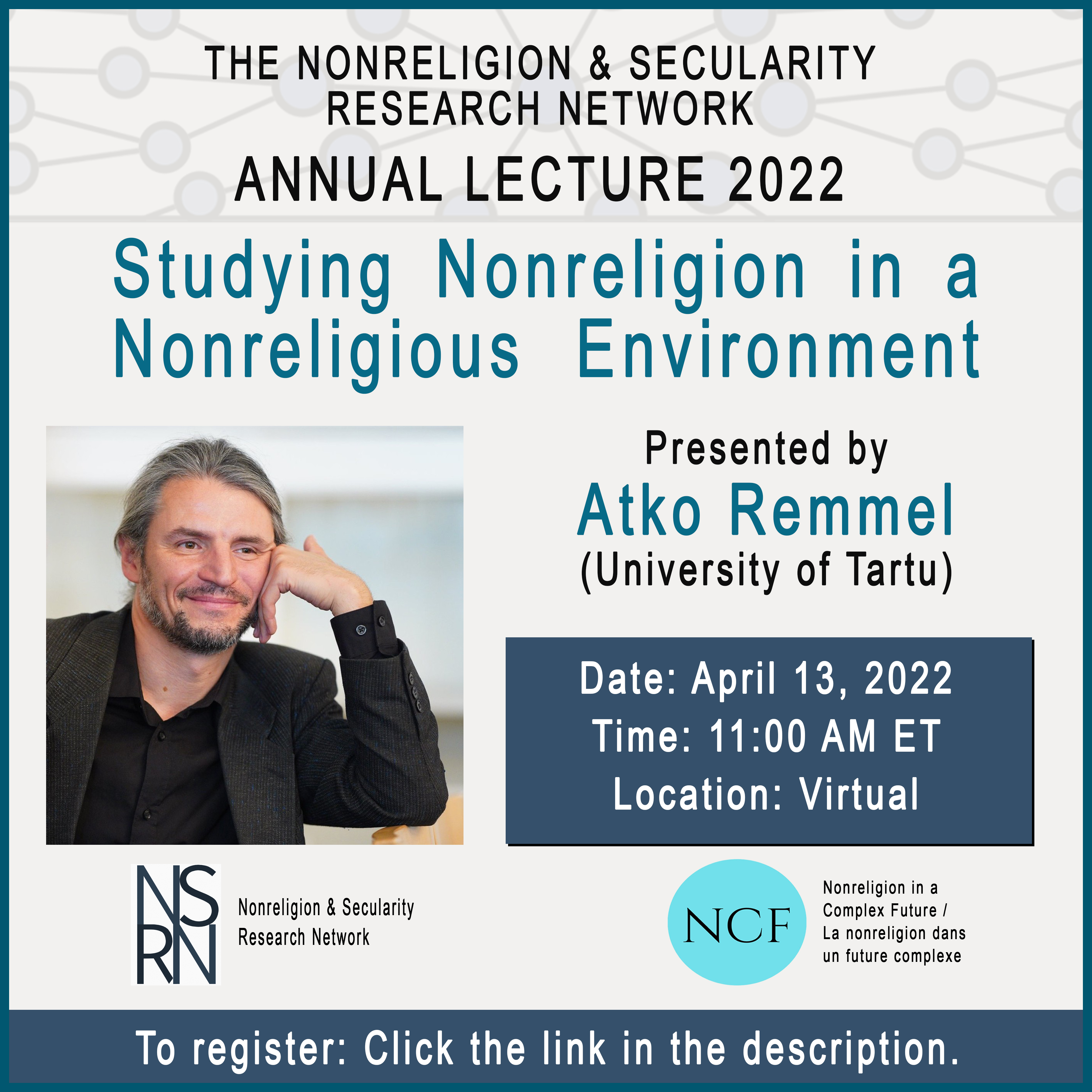
In this virtual lecture, presented by the Nonreligion and Secularity Research Network in partnership with the Nonreligion in a Complex Future Project, Atko Remmel (University of Tartu) discusses his findings on nonreligion in Estonia, often considered one of the least religious countries in Europe. The lecture touches on the impact of Soviet “forced secularization” on the situation today, the intersections of nonreligion, nationalism and environment(alism), the perceptions of (non)religion among the different generations of the nonreligious, and finally, what all of this tells us about the study of (non)religion in such a context.

Date: April 13, 2022

Time: 11:00 am – 12:00 pm (Montreal, Canada)

Location: Virtual – Zoom

To view the recording of the lecture click here.

NSRN Annual Lecture (2020)

The NSRN is pleased to announce that the 2020 Annual Lecture, titled “Going Godless: Black Feminism, Humanism, and Anti-Racism”, will be given by Dr. Sikivu Hutchinson on 10 December, 2020 (13:00 – 14:00 EST) as a free online event open to all. Please see the attached poster here for more information.

To attend, please RSVP with Vanessa Turyatunga at vturyatu@uottawa.ca

Going Godless: Black Feminism, Humanism, and Anti-Racism
According to a 2012 Washington Post/Kaiser Family Foundation Survey, 87% of African American women are religious, making African American women among the most religious demographic groups in the U.S. Although Black women have long been stereotyped as the “backbone” of the Black Church, some Black women non-theists and humanists are bucking these traditions to challenge organized religion. Historically, Black women have relied on churches and faith-based institutions as vehicles for political organizing, cultural identity, and community solidarity. It is for this reason, as well as the slave-era stigma associated with Black female sexuality, that being a Black female humanist and atheist is even more taboo than being a Black male atheist. Dehumanized as either hyper-sexual Jezebels or asexual Aunt Jemimas, Black women have been constructed as less moral, less human, less chaste, and less civilized than respectable white Christian women. “Going Godless” will examine this history vis-à-vis the emergence of Black feminist humanist perspectives in the American secular humanist and atheist movements. For example, how have Black women humanists and atheists drawn on the feminist/womanist legacy of writers and thinkers like Zora Neale Hurston, Lorraine Hansberry, Alice Walker, and Nella Larsen? How are they challenging the traditional church/state separation agenda of the mainstream atheist/humanist movements? And what intersectional issues inform a Black feminist humanist political agenda as racial, gender, and socioeconomic inequality intensifies in the U.S.?

A recording of the lecture is available here: https://www.youtube.com/watch?v=MYnmD4F-Nxo

Nonreligion and Secularity Research Network Conference Call for Papers (2021)

Nonreligion and Secularity Research Network Conference – 16-18 June, 2021

The growing number of nonreligious individuals poses new challenges for societies experiencing simultaneous intensification of religious diversity and renewed presence of religion in the public sphere. The impact of this shift is profound, contributing to social anxiety and divisions as societies become both more and less religious. These tensions are likely to deepen as the nonreligious play a more significant political role. Consequently, we need a better understanding of the moral and social dimensions of nonreligion and secularity, the socio-cultural circumstances of their emergence, and how nonreligion, secularity, spirituality and religion are negotiated simultaneously in social institutions such as in health, the law, education, the economy, politics, the environment, culture, recreation and leisure, as well as migration. Given that the nonreligious populations of many countries are growing rapidly, understanding the implications of this shift is key to addressing the pressing issue of how complex diversities can coexist in positive ways.

The Nonreligion and Secularity Research Network (NSRN) invites both paper and session proposals for its 2021 conference titled Nonreligion in a Complex Future. The 2021 NSRN conference will be held in partnership with the Nonreligion in a Complex Future (NCF) project, based at the University of Ottawa (Canada) and led by Professor Lori Beaman.

Given the ongoing travel and gathering restrictions related to COVID-19, the 2021 NSRN conference will be delivered using a virtual format. This format has the benefits of potentially allowing for more international attendees, no monetary costs for attendees and participants (the virtual NSRN 2021 conference will be free to attend and participate in!), lower health risks, and a positive impact on the environment as no travel is required. Reasonable daily time slots will be found for conference presenters from all global time zones.

Please see the attached Call for Papers here for more information and instructions on how to submit paper and session proposals.

All paper and session proposals must be e-mailed to nsrnconference2021@gmail.com by the end of the day on Monday the 1st of February 2021. For any questions, please contact the programme chair Dr. Sarah Wilkins-Laflamme by e-mail at sarah.wilkinslaflamme@uwaterloo.ca

Call for Papers: https://thensrn.org/wp-content/uploads/2020/10/nsrn-2021-conference-call-for-papers.pdf