CFP: EASR 2016 Conference

EASR 2016 Conference

Relocating Religion

Helsinki 28 June – 1 July 2016

Annual conference of the EASR

Special conference of the IAHR

Welcome to the annual conference of the European Association for the Study of Religions (EASR) that will be held from 28 June – 1 July 2016, at the University of Helsinki, Finland. The theme of the conference is Relocating religion.

Religion has always been a moving concept. Throughout history, it has changed place, shape, function and content; conceptions of religion have been dependent on theoretical or political interests and strategies. Religion can be framed as a means of identity-work, world-building and well-being, but it can also be perceived as a consumer good or a security threat. Due to the open, fragile, and inherently negotiable nature of the category of ‘religion’, rigid definitions produce simplistic and distorted representations of the complexities involved in the formation of religious phenomena. At the same time, attempts to define and redefine religion in various contexts are themselves an important topic of research. All of this requires interdisciplinary scholarly imagination and critical new approaches.

In recent scholarship, religious change has been conceptualized from a variety of theoretical perspectives. When focusing on the modern period, some scholars speak about the vitalization of religions, secularization and post-secularity, while others refer to re-sacralization and re-enchantment. Concurrently, the need for more knowledge and understanding not only of religion, but also of secularization, secular positions and non-religion has been underlined. Many of these perspectives highlight the significance of religious change as a cultural and social phenomenon. Such perspectives are, however, equally applicable to the study of religious transformations in other contexts than the modern period. The conference will offer the opportunity to explore changes and continuities in the forms, practices and implications of religion at all levels of societies and cultures, in the past as well as in the present.

Language of the conference is English.

The keynote speakers are:

Giovanni Filoramo, University of Turin
Anne-Marie Korte, University of Utrecht
James R. Lewis, University of Tromsø
Linda Woodhead, University of Lancaster

CALL FOR PAPERS

Call for session proposals:

1 September to 30 October 2015

We invite proposals for closed sessions (with a fixed chair and speakers) and open sessions (with a chair and a theme).

Notification of acceptance: 15 November 2016 at the latest

Call for individual papers:

15 November to 31 December 2015

Notification of acceptance: 15 February 2016 at the latest

Registration15 February to 1 May 2016

Organizers: The conference will be organized by the Study of Religions at the University of Helsinki in collaboration with the Finnish Society for the Study of Religion, Comparative Religion at the Åbo Akademi University and the Donner Institute, Turku.

Welcome: On behalf of the organizing committee, cordially welcome to Helsinki,

Tuula Sakaranaho, President of the conference

Heidi Rautalahti, Conference secretary

For further information, please, contact: http://blogs.helsinki.fi/easr-2016/

Publication of special journal issue on “Atheism, Secularity, and Science.”

Announcing the publication of “Atheism, Secularity, and Science,” a special issue of the journal Science, Religion & Culture, guest edited by John R. Shook, Ralph W. Hood Jr., and Thomas J. Coleman III. The journal issue contains theoretical and empirical articles covering a wide range of topics related to atheism and secularity. It begins with an introduction by the editors discussing key areas in the field, within which they situate this issue’s articles on topics such as definitions and discourse, measurement, mental wellbeing, organized nonbelief and humanism, growth of the “nones,” secularity of academics, hypothetical god image, and deconversion narratives in Rabbis. The issue concludes with three book reviews on The Problem of Animal Pain, The New Atheist Novel, and Living the Secular Life.

Science, Religion & Culture is an open access peer reviewed journal and the special issue, “Atheism, Secularity, and Science” can be viewed here: http://smithandfranklin.com/journal-details/Science-Religion-and-Culture/9/archive/2015/June

New Books in NSRN Book Series

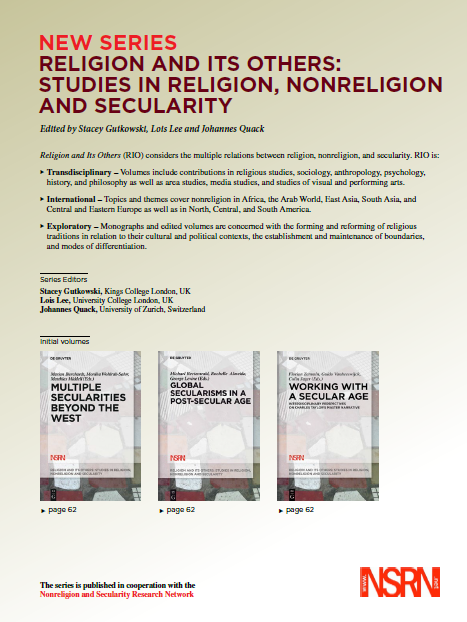
The NSRN and De Gruyter are pleased to announce the first three publications in their book seriesReligion and its Others: Studies in Religion, Nonreligion, and Secularity:

For more on the series, see here: http://nsrn.net/book-series/

Download Flyer

NSRN Series 2

Nordic Conference for the Sociology of Religion 2016

Nordic Conference for the Sociology of Religion 2016 | 17. – 19.8. 2016 Helsinki, Finland

We are pleased to invite you to the 23rd Nordic conference for the Sociology of Religion. The conference will be held on the 17th–19th of August in 2016 at the University of Helsinki, Finland.

The theme of the conference is: Wellbeing, leadership and the lifespan – Current trends in the sociology of religion

The subjective turn has made the individual the centre of attention in debates on current religious and spiritual change. The customisation of religious belief, ritual and thought often centres around individual wellbeing. At the same time, religious organisations are redrafting their management and leadership strategies and have shifted their attention from classic teaching and worship to new forms of individualised and experience-centred formats. Individuals and their lifespan have increasingly become the centre of focus in religion. These changes also tend to raise tensions in religious organisations, and the polarisation between extremes seems to be increasing. The changes are linked to changes in society at large, including demographic changes, generational changes, changes in the role of the media and changes in the role of religious authority. Religion is increasingly a matter of personal choice and is given no automatic authority at any level.

The 23rd Nordic Conference for the Sociology of Religion seeks more understanding, both theoretically and empirically, on the changes in the religious field and their meaning for the individual, for religious and secular organisations, and for society at large. Contributions addressing these developments and changes at different levels and broadening the understanding of the role of religion in society today are warmly welcome. Other current topics within the sociology of religion will also be discussed. We encourage proposals for both sessions and individual papers.

  • The dead line for session proposals is Nov 31, 2015.
  • The dead line for paper proposals is March 15, 2016.

The confirmed keynote speakers are:

Nancy Ammerman, Boston University
Jörg Stolz, University of Lausanne
Coutney Bender, Columbia University
Anne Birgitta Pessi, University of Helsinki
Language of the conference is English.

For further information, please contact the organisers:

Kati Niemelä, University of Helsinki, kati.niemela@helsinki.fi

Jenni Spännäri, University of Helsinki, jenni.spannari@helsinki.fi

CFP: Rethinking Boundaries in the Study of Religion and Politics

Postgraduate Conference: Rethinking Boundaries in the Study of Religion and Politics

11-12 September 2015

University of Aberdeen

Submission Deadline: 19 June 2015

A common approach to the study of religion and politics frames the inquiry using boundaries. Such boundaries include religion/secular, private/public, belief/practice and theism/atheism, to name just a few. It may be argued that these categorisations are analytically useful in understanding social phenomena because, for example, what is ‘religious’ should be analysed in relation to what is ‘secular.’ Another approach may instead point to the problem with the construction of such binaries in that empirically these distinctions become blurred, so that framing an action, for example as ‘public’ or ‘private’, does not reflect the diversity of human experience. Continue reading

Call for papers: Special Issue of Secularism & Nonreligion: Intersectionality and Power

The NSRN co-sponsored Journal Secularism & Nonreligion is seeking submissions for a special issue on “Intersectionality and Power”, Guest Editors: Penny Edgell, Evan Stewart, and Jacqui Frost, University of Minnesota.

The deadline for submission has been extended to 18 September 2015.

See here for more information.

https://s3-eu-west-1.amazonaws.com/ubiquity-partner-network/snr/S%26N+Intersectionality+and+Power+CFP.pdf

CFP: Life Here and Hereafter: Beliefs and Practices – Vilnius Lithuania

3rd International Scientific Conference of the Lithuanian Society for the Study of Religions

LIFE HERE AND HEREAFTER: BELIEFS AND PRACTICES

Vilnius, Lithuania
23-24 October, 2015

With Vilnius University and Vytautas Magnus University

Call for Papers

Life here and hereafter is considered to be one of the core concerns of an individual throughout the history of humanity. Quest for the meaning of life, role of death, possibilities of life after death are challenged with a broad scope of perceptions, reflections and expressions among various spiritual and religious traditions, emerging spiritualities, groups and individuals.

This conference addresses the topic of life here and hereafter and focuses on beliefs and practices of diverse origins, their formation, spread and expressions. It also focuses on the past and current representations of the phenomenon in specific regions and worldwide, discussing its diverse manifestations and changes concerning institutional and individual religiosities on (trans)national and (trans)regional levels.

The conference welcomes both empirical and theoretical contributions from various disciplines, as well as interdisciplinary approaches towards beliefs and practices within the domain of life here and hereafter. Of particular interest are those that combine perspectives and methods drawn from all social sciences and humanities on historical, present, and newly emerging approaches towards conceptions, manifestations and representations, as well as research methods, issues and problems, and new directions in studies of this phenomenon.

The 3rd Conference of the Lithuanian Society for the Study of Religions Life Here and Hereafter: Beliefs and Practices will be held on October 23-24, 2015 at Vilnius University, Vilnius. We welcome scholars from religious studies, sociology, anthropology, philosophy, psychology, political science, and other disciplines to contribute to historical and contemporary studies of the role and manifestations of the phenomenon of life here and hereafter, in this way enriching its academic understandings. We expect individual paper proposals as well as panel proposals with three to four presentations.

We invite papers and panels including, but not limited to the following topics:

  • Methodological implications, challenges and issues;
  • Life here and hereafter and their socio-cultural representations;
  • Death and dying related beliefs and practices;
  • Divinations, predictions and prophecies;
  • The role of individuals and institutions in practices related to beliefs in life here and hereafter;
  • Life here, hereafter and cultural memory;
  • Life here and hereafter: religious and secular approaches;
  • Life, dying and afterlife in traditional religious groups and churches in the past and in the 21st century;
  • Life here and hereafter within contemporary spirituality, individual religiosity, combined forms of organized and individual religions;
  • Institutional arrangements, development and changes of beliefs and practices within the domain of life here and hereafter;
  • Afterlife and social imagination;
  • Life here and hereafter in the public sphere;
  • Life here and hereafter in the popular culture.

Please submit a 250-300 words abstract of your presentation accompanied by a short CV by e-mail to: religiousstudieslt@gmail.com by June 15, 2015. If you are interested in another topic related to the study of life here and hereafter, we encourage you to organize a session/panel. In this case, please submit a 200-300 words proposal by July 15, 2013 to the same email address.

Key dates

  • Submission of paper and session/panel proposals – June 15, 2015.
  • The authors of accepted proposals will be notified by July 15, 2015.
  • Notification of acceptance and opening of the registration – July 15, 2015.
  • The final date of the registration for the conference –September 15, 2015.
  • Final program – September 20, 2015

Fees

Conference fee (50 Euro) may be paid by bank transfer or in cash (not by card) at the registration desk.

The costs of travel and lodging should be covered by the participants.

Special events

Participants of the conference will be offered excursion in Vilnius city.

Organisers: dr. Eglė Aleknaitė (Vytautas Magnus University), assoc. prof. Milda Ališauskienė (Vytautas Magnus University), prof. Audrius Beinorius (Vilnius University), assoc. prof. Aušra Pažėraitė (Vilnius University), dr. Rasa Pranskevičiūtė (Vytautas Magnus University), prof. Edgūnas Račius (Vytautas Magnus University), assoc. prof. Annika Hvithamar (Copenhagen University).

Any conference related queries are to be sent to the conference email address.

CFP: International Conference on Religion and Spirituality in Society

Sixth International Conference on Religion and Spirituality in Society

23-24 May 2016

The Catholic University of America


Washington D.C., USA

Current Submission Deadline*:
 18 March 2015

PLEASE NOTE: The Fifth International Conference on Religion and Spirituality in Society is taking place at the University of California at Berkley, 16-17 April 2015. Proposals are still being accepted for a short time. Click here for more details.

Continue reading

CFP: Pilgrimage to the Heart of the Sacred The Sacred Journeys: Pilgrimage and Beyond Project

Call for Presentations

The Sacred Journeys: Pilgrimage and Beyond Project: 2nd Global Meeting

Friday 3rd July – Sunday 5th July 2015
Mansfield College, Oxford, United Kingdom


Call for Presentations:
Pilgrimage is a cross-cultural phenomenon that facilitates interaction between and among diverse peoples from countless cultures and walks of life. In the 2nd Global Conference, we will continue to explore the many personal, interpersonal, intercultural, and international dimensions of this profound phenomenon.

Among the key issues that emerged from Sacred Journeys I: Pilgrimage and Beyond, were:

1. Definition of Pilgrimage:
‘Travel for transformation’ embraces the sacred journey as a potential turning point in one’s life. Witness the avalanche of books by pilgrims who have experienced the Camino, or those who have been influenced by the transformation of others, like Malcolm X.  After his experience of the Hajj pilgrimage, the activist was stirred to reevaluate his lifelong journey in search of justice and reconciliation as well as his thinking regarding race relations in the United States. Questions arise as to how and when a journey becomes ‘sacred’ and how and when pilgrimage devolves into a mere tourist endeavor.  Does tourism merely observe the authentic in others, whereas pilgrimage seeks it for oneself?

2. Reinforcing the Vision of the Ultimate Unity of Humanity:
Pilgrimage scholar George Greenia’s insight that ‘pilgrimages generate the least violent mass public gatherings [that] humankind has designed for itself’ inspires the question: In what ways can the concept of the sacred journey lend itself to envisioning a world united in difference?  We can reflect, for instance, on the sacred journey to Adam’s Peak in Sri Lanka, a site of interfaith and intercultural pilgrimage interpreted differently by various pilgrim sects. For Buddhists, a sacred footprint in a rock formation is said to belong to Buddha, whereas for Hindus, it is deemed to be Shiva’s footprint, and for Muslims and Christians, it is thought to be Adam’s. This pilgrimage site provides a powerful example of interfaith cooperation.

3. Pilgrimage and Globalization:
The global playing field is leveling and technology is impacting pilgrims in innumerable ways. In Mecca, for instance, telephone ‘apps’ assist Hajj pilgrims searching for animals for sacrifice; in Lourdes, another ‘app’ provides details on miraculous healings, proudly declaring, ‘A miracle could happen’ during the pilgrim’s visit. Infrastructural and support services are also improving, and jour­neys once thought to be too diffi­cult or challenging, such as that to Amarnath in India, are now within reach of vast numbers of pilgrims. Will modern conveniences alter traditional experiences, create entirely new ones, or both?

4. Modernization and the Global Trend Towards the Dissolution of Traditional Ways:
Pilgrims cling to what they ascertain as familiar and reaffirm what they believe to be ‘true’ at local levels. There may be a growing awareness that ‘the world is one’ and that we must work together to deal with our common ecological, political, and security problems, but in the interest of cultural survival, primordial standard-bearers like nation, tribe, and race have been reified and re-energized; for instance, journeys of all persuasions are now being undertaken along ancient pathways that have been rediscovered and/or redeveloped. What kinds of trends along these lines might we forecast for the future?

5. Secular Pilgrimage:
Major secular pilgrimage sites, such as to Abbey Road in London, or to Elvis Presley’s home ‘Graceland’, or Jim Morrison’s (The Doors) grave site in Paris, attract astonishing numbers of ‘pilgrims’. What are the similarities and differences between sacred and secular pilgrimages? More and more we are living in a ‘global village’ and the ‘pilgrimage in my front room’ phenomenon is facilitated by video and satellite links. These changes raise the question: must pilgrimages, whether sacred or secular, always involve a physical journey ‘in league’ with others? Virtual or alternative pilgrimages are important topics for consideration; so, too, are related online experiences that recreate the pilgrimage or tourism experience in a virtual world.

In light of our broad exploration, and these new directions, we would also welcome proposals that might take into consideration the following:

* New definitions of sacred and secular pilgrimage, and the question of authenticity.
* How historical perspectives on the meaning(s) of pilgrimages and motives for travel are changing over time.
* The metaphor of ‘the journey’ as explored by writers, artists, performers and singers, including humanists, agnostics, atheists and musicians.
* The notion of journeying toward ‘salvation’.
* Pilgrimage and ‘miracles’ and the related topic of thanksgiving.
* The post-pilgrimage experience (which can be non-religious and/or secular, involving, for instance devotional exercises, meditation practices, mental journeys, etc).
* ‘Dark’ pilgrimages to sites of remembrance and commemoration (i.e., the Hiroshima Peace Museum, the Irish National Famine Museum, Rwanda genocide memorials, etc.).

The Steering Group welcomes the submission of proposals for short workshops, practitioner-based activities, performances, and pre-formed panels. We particularly welcome short film screenings; photographic essays; installations; interactive talks and alternative presentation styles that encourage engagement.

What to Send:
Proposals will also be considered on any related theme. 300 word proposals should be submitted by Friday 13th March 2015. If a proposal is accepted for the conference, a full draft paper of no more than 3000 words should be submitted by Friday 22nd May 2015. Proposals should be submitted simultaneously to both Organising Chairs; proposals may be in Word or RTF formats with the following information and in this order:

a) author(s), b) affiliation as you would like it to appear in programme, c) email address, d) title of proposal, e) body of proposal, f) up to 10 keywords.
E-mails should be entitled: Sacred Journeys 2 Proposal Submission.

All abstracts will be at least double blind peer reviewed. Please use plain text (Times Roman 12) and abstain from using footnotes and any special formatting, characters or emphasis (such as bold, italics or underline). We acknowledge receipt and answer to all proposals submitted. If you do not receive a reply from us in a week you should assume we did not receive your proposal; it might be lost in cyberspace! We suggest, then, to look for an alternative electronic route or resend.

Organising Chairs:
Ian McIntosh: imcintos@iupui.edu
Eileen Moore Quinn: quinne@cofc.edu
Rob Fisher: sj2@inter-disciplinary.net

The conference is part of the Persons series of ongoing research and publications projects conferences, run within the Probing the Boundaries domain which aims to bring together people from different areas and interests to share ideas and explore innovative and challenging routes of intellectual and academic exploration. All proposals accepted for and presented at the conference must be in English and will be eligible for publication in an ISBN eBook.  Selected proposals may be developed for publication in a themed hard copy volume(s). All publications from the conference will require editors, to be chosen from interested delegates from the conference.

Inter-Disciplinary.Net believes it is a mark of personal courtesy and professional respect to your colleagues that all delegates should attend for the full duration of the meeting. If you are unable to make this commitment, please do not submit an abstract for presentation.

Please note: Inter-Disciplinary.Net is a not-for-profit network and we are not in a position to be able to assist with conference travel or subsistence.

289 new additions to our bibliography of relevant publications

After a long hiatus, 289 new items have been added to the NSRN bibliography. These new items can be viewed here:

http://nsrn.net/bibliography/bibliography-additions/

The bibliography can also be viewed in a list organised by author surname or publication date.

As ever, the bibliography is a collaborative enterprise and we cannot claim that it is comprehensive of all relevant NSRN related publications. If you spot any gaps, at any point, you can let us know via this comment form on the website and we will add the publication at our next update.