[Event Report] SocRel 2016 – Construction and Disruption


The 2016 Sociology of Religion Study Group (SocRel) conference was hosted by Lancaster alisonUniversity, 12th-14th of July. The conference theme of ‘Construction and Disruption: The Power of Religion in the Public Sphere’ offered a wide range of entry points for considering the visibility and role of religion in contemporary society. Papers explored religion in relation to such public realms as education, culture, state and gender and conflict. Of particular interest to me is how different constructions of the concept of religion impact on the concomitant question of what then constitutes non-religion, and how the concepts interact. The papers outlined below offered opportunities to reflect on this.

Religion, the Public Sphere and Law: Construction, Disruption and Reconstitution

Lori Beaman’s keynote set the tone by considering interactions between the law and the concept of religion. Her examination of legal cases explored how the concept of religion is constructed by different people in different contexts, and how distance between state and religion is legally constructed. Beaman’s interest is less in answering the vexed question of what is and what is not religious than in the complexities that are revealed when the question is debated within particular contexts.

She considered three cases in detail: The first, from the USA, involved a school district sued for allowing students to be taught yoga in what was argued to be a breach of the US Constitutional requirement forbidding the establishment of religion. The second, brought by a French citizen to the European Court of Human Rights (ECHR), involved a niqab-wearing woman challenging the 2010 ban on wearing, in public places, garments that cover the face. She argued that the ban breached several articles of the European Declaration on Human Rights including article 9 (freedom of thought, conscience and religion), and article 10 (protecting freedom of expression). The third case was Canadian, and centred on the question of whether opening municipal council meeting with public prayer is an inappropriate interference with the freedom of practice and conscience of attendees.

Each case demonstrates how a given phenomenon can be constructed as religious in nature by some, and as non-religious, cultural or secular by others without any material change in the circumstances under consideration. Although each occurred in different social, cultural and legal contexts, Beaman argued convincingly for a shared relevance located in an examination of the ways in which the different courts involved constructed and transformed the concepts of religion and culture. These processes resulted in yoga being legally determined as non-religious in nature, because its practice is mainstream in contemporary America. Quebec’s court of appeal accepted the same type of reasoning, judging that the use of public prayer reflected a shared cultural heritage rather than an explicitly religious practice (the Supreme Court later over-turned this ruling). While the ECHR concluded that the need to live together in a social/cultural context which understands facial visibility as an aid to social interaction outweighs the individual’s right to express themselves by covering their face. Each decision thus demonstrates the complexity and contested nature of concepts of religious and non-religious, and problematizes the idea of an absolute division between the two concepts.

Existential Cultures in Steiner Schools

Katie Aston and Dan Whisker reported on the initial stages of their research into interactions of non-religious parents and faith schools. The work to date had all taken place in Steiner schools, which base their ethos on Anthroposophy (a spiritual philosophy with roots in theosophy) . Steiner schools engage in ritual as a school community but actively avoid teaching doctrine. Education is individually focussed, with the intention of nurturing the spirit of the child. The schools are non-competitive and emphasise play as a means of learning.

The research involves surveys and interviews with parents, children and teachers. From this data Aston and Whisker identified that none of the parents with whom they spoke were either anthroposophists, or affiliated to any other religious tradition. All identified as either non-religious or spiritual. Most had also been dissatisfied with their own mainstream schooling, and this contributed to their approval of Steiner educational values and their choice of schools for their children.

Aston and Whisker have identified several preliminary avenues of analysis regarding the value of faith schools to non-religious parents. These include the development of existential cultures, processes of sacralising childhood, and distinctions between verbalised meaning and shared experience. For me this offer a chance to explore the practical distinctions between concepts of religion, non-religion and spirituality for self-described non-religious parents, actively seeking education with a spiritual component for their children and choosing a religious school to provide this. The conceptual constructions at play here suggest the complexity and ambiguity of these terms and the ways they interact in a real-world context.

Pluralist Publics and the Scientific Study of Non-Religion

This panel began with an outline of the multi-disciplinary ‘Understanding Unbelief’ project and the sociological shifts underlying academic interest in non-religion before considering some current approaches in the field.

One area being developed by Lois Lee is the emergence of ‘unbelief’ as an analytic term. She represented this as a deliberate shift away from a sole focus on the issue of deity. The term thus has several aspects – relative, indicating unbelief in specific theological claims; positive, relating to alternative existential/metaphysical beliefs; and negative, describing a general absence of metaphysical beliefs. Areas of interest include the distinct cognitive and social phenomena captured by the term, and ways in which ‘unbeliefs’ manifest in/from people’s lives. For me this shift challenges the idea of religion and non-religion as binary, suggesting perhaps either term can be applicable to a given example via the same constructive processes that Beaman’s legal cases employed.

These examples are drawn from rich and diverse range of papers, many of which touched upon non-religion and secularity in similar ways. There are many opportunities to develop the field further in relation to the academic, cultural and personal conceptual constructions of its critical terms , as well as the multivalent complexity of the religious/non-religious spectrum.


Alison Robertson is in the final stages of her PhD with the Open University. Her thesis is
on BDSM as a lived practice of religioning and her research interests include religion and spirituality in relation to self-inflicted pain, trauma and well-being, personalised religious practices, paganisms any other area where the boundaries between what is and is not deemed ‘religion’ become fuzzy. Alison has recently taken over as the Post-Graduate and Early-Careers Liaison Office for the Sociology of Religion (SocRel) research group.

 

[Book Review] American Secularism: Cultural Contours of Nonreligious Belief Systems

In this post, Benjamin Beit-Hallahmi reviews Joseph Baker’s and Buster Smith’s latest book American Secularism: Cultural Contours of Nonreligious Belief Systems (New York University Press 2015).


Americans have never ceased to amaze foreign observers with their high level of belief in souls,benny-bh spirits, and gods. Pew Research Centre (2014) found that nearly 9 in 10 (89%) Americans believe in ‘God or a universal spirit.’ Nevertheless, over the past few decades a significant rise in the proportion of Americans who were investing less and less in religious affiliation and beliefs has been noted. Kosmin and Keysar (2011) showed that the proportion of unaffiliated Americans has been growing since 1990. A few have even embraced the clearly unpopular labels of atheists or agnostics, despite Smith’s (2015:229) acknowledgment of the stigmatized and deviant status of atheism in America.

What the book is really about is secularity, the state of being secular, because ‘secularism’ usually refers to a vision of a world less affected by religion, and the authors indeed use the term secularity a few times. So the book is about secular Americans, from the unaffiliated to the atheists.

What is the theoretical framework? Baker and Smith state: “instead of a binary distinction, religiosity and secularity should be understood as poles of a continuum, ranging from thorough irreligion to zealotry” (p.  6). Moreover, “We consider theistic dis- or nonbelief to be the most salient marker of one’s secular identity. That is, self-identifying  as someone who does not believe in god is a more prominent marker of identity than saying one is not affiliated with an organized religion” (p. 16).

There is indeed a clear behavioral dividing line between spirit world adherents and non-adherents, and research indicates that the one question “Do you believe in God?” does a good job in separating two distinct populations.

I find myself really puzzled by another statement:  “Although criticism of religion is central to understanding secularism, restricting secularity today to opposition to religion denies secularists’ potential for edifying and positive values, furthering the polemical claim that to be secular is necessarily to be immoral” (p. 6). First, the rejection of belief in spirits is not criticism, but a total disengagement. Baker and Smith later report that 63% of atheists in one sample were uninterested in religion (p. 100). Second, the reference to “edifying and positive values” sounds like apologetics. The findings reported in the book demonstrate that the less religious and the irreligious are likely to be more politically progressive, but that will not persuade those who think they are immoral.

Is there a unique American secularization? The authors describe American freethought, starting in the eighteenth century, and offer a chronology of the ups and downs of religiosity in the United States, leading to the Great Abdicating after 1990. They connect the Great Abdicating to the 1960s counterculture and changes in the US family, together with political polarization and the “Culture Wars”. They do report a correlation between growing political polarization and the percentage of the unaffiliated in the population, as well as the tendency for the unaffiliated to vote Democrat in presidential elections (p. 79).

In their historical survey, they neglect the struggles over the secularization of public space and public education. Until 1934, playing baseball on Sunday was a major issue, and the elimination of Sunday blue laws is still continuing. Another aspect of the Culture Wars was the secularization of education, starting  already in the nineteenth century with  elite academic institutions  (White, 1896), and  then affecting all universities, colleges, and public schools in a trickle down process  (Hofstadter, 1963). Does anybody remember that until 1960, the American Baptist Convention considered The University of Chicago an affiliated institution?

It should be emphasized, something that the authors do not do, that after 1960 public education was completely secularized through legal rulings. Engel v. Vitale (1962), which disallowed prayers, and  Abington School District v. Schempp (1963), which disallowed Bible reading, could be compared in their impact to the 1954 Brown decision, related to the same social and historical forces. Similarly, recent challenges to the teaching of evolution followed the great historical loss by the Religious Right over religious activities in the schools. McLean v. Arkansas Board of Education (1982), Edwards v. Aguillard (1987), and Kitzmiller, et al.  v. Dover School District, et al. (2005) became milestones in public secularization. Legal rulings do not change public opinion in many cases, but these symbolic (and concrete) victories added to the growing confidence of secular Americans.

Despite American exceptionalism, Baker and Smith show that the United States fits the worldwide correlation (p.74) between secularity and the Human Development Index (p. 203). What happens in North America is part of a global trend. The political context of secularity, which is discussed at length in the book, is also not unique to the United States.

The authors doubt the universality of sex differences in secularity, and  state  that “among Western populations, women are disproportionately prone to religiosity, in spite of the patriarchal power structure of most organized religions” (p. 141). However, a recent Pew report compared men and women on religiosity around the world, with data collected in 192 countries. It included 631 comparisons. There were 393 with no significant differences, 238 significant differences with women scoring higher, and just 4 with men scoring higher (Pew, 2016). So women’s higher religiosity may not be just a Western phenomenon, and the same goes for women’s lower secularity.

The book offers a wealth of writing genres, unlike a typical sociology text. It presents survey data together with vignettes and case studies, such as that of  Lester Young Ward, one of the pioneers of US sociology (pp. 26-34), and quotations from W.E.B. Du Bois and Langston Hughes. There are also interviews, one with David Tamayo, Leader of Hispanic American Freethinkers (pp. 126-131), and then two interviews with secularists who tried to get elected to political office, which is next to impossible in the United States. My only complaint is that the book has 47 pages of detailed footnotes. The academic convention which expects the reader to tolerate this division of attention is unrealistic. Most of the material in the footnotes is interesting and important, and should be included in the main text.


References

Hofstadter, R. (1963). Anti-Intellectualism in American Life. New York: Knopf.

Kosmin, B.A.  & Keysar, A.  (2011).  AMERICAN NONES: THE PROFILE OF THE NO RELIGION POPULATION. (with Ryan Cragun and Juhem Navarro-Rivera). http://commons.trincoll.edu/aris/files/2011/08/NONES_08.pdf

Pew Research Center (2014). Importance of Religion and Religious Beliefs. Pew Research Centre, November 2015. http://www.pewforum.org/2015/11/03/chapter-1-importance-of-religion-and-religious-beliefs/#belief-in-god

Pew Research  Center (2016). The Gender Gap in Religion Around  the World.  PEW RESEARCH CENTER, March 2016. http://www.pewforum.org/2016/03/22/the-gender-gap-in-religion-around-the-world/

Smith, J (2010). Becoming an Atheist in America: Constructing Identity and Meaning from the Rejection of Theism. Sociology of Religion. 72 (2) 215-237.

White, A. D. (1896/1993). A history of the Warfare of Science with Theology in Christendom. Buffalo, NY: Prometheus Books.


Benjamin Beit-Hallahmi earned a Ph.D.  (clinical psychology and personality)  from Michigan State University in 1970. Since then, he has been the author, co-author, editor, or co-editor of  22 books and more than 300 reviews, articles, and book chapters, focusing on personality development, history of psychology, the psychology of religion, and politics. Among his best known works are Psychological Perspectives on Religion and Religiosity  (2015), Psychoanalysis and Theism (2010), The Psychology of Religious Belief, Experience, and Behaviour (with Michael Argyle, 1997), and Despair and Deliverance (1992).

[Blog Series] What’s in a name? …


In this blog post Lois Lee and Stephen Bullivant address the need for a common set of accessible and rigorous terms for the study and wider discussion of atheism, nonreligion, secularity et al.. They explain how their new project, The Oxford Dictionary of Atheism, will address this need and introduce a glossary of key terms excerpted from the Dictionary that are already available for use.


As aPROFILE NEW SMALLlois-small1n emerging field of enquiry, a fully developed and centralised body of conceptual and methodological work is not yet available to support new research. However, today, the issue is not the same as it was for researchers a decade ago – pioneering new empirical projects and trying to get to grips with long taken-for-granted concepts like ‘atheism’ and ‘irreligion’ in order to do so. For new scholars, the challenge is accessing all that these earlier scholars have learned – and ensuring that they don’t have to repeat the same conceptual explorations, or wander up the blind alleys that others have already realised are dead-ends.

Today, the issue is much more about having a centralised body of work to turn to, a point of access to a resource setting out, simply and clearly, what others have already learned. To date, there has been a lack of standardization, not only across disciplines but within them, leading either to uncertainty about a concept’s meaning or crossed-wires. What is more, lacking a centralised conceptual resource limits scholars opportunities to scrutinise and develop core concepts in light of new knowledge, to build more nuanced models, and to triangulate and accumulate knowledge.

Simply put, it would make a lot of people’s lives (not least our own!) a great deal easier if there are a more standardized set of rigorous, well-understood (and thus easily understandable), and useful core terms and concepts for our nascent field. That doesn’t, in itself, mean that all scholars must always use terms in precisely the same ways, especially given the diversity of disciplines which intersect in ‘nonreligious/secular studies’, and given the fact that certain terms fit less comfortably when applied in, say, non-western religious contexts. But even then, having a more standardized set of terminology against which to define a different sense of particular term for a particular purpose would itself be beneficial.

It is with this in mind that we offer the following three-point plan for researchers and students attempting to traverse this terrain:

  1. Firstly, a simple point but an important one: it is helpful just to be aware that single terms are used to mean a variety of different things. What is more, the differences are often very subtle, making them all the harder to detect and more pernicious as a consequence.

For example, for British sociologist, Linda Woodhead, ‘secular’ tends to mean something like a committed and confirmed Dawkinsian Atheist with anti-theist leanings; it means something similar for US sociologist Christel Manning. Yet for the British sociologists Steve Bruce and David Voas, these same phenomenon are precisely and significantly non-secular: instead, strong ‘atheist’ identities and movements is, for them, a sign that religion is thriving, whilst the ‘secular’ entails something much more like indifference to religion. As Bruce writes in 2002’s God is Dead:

In so far as I can imagine an endpoint [to European secularization], it would not be conscious irreligion; you have to care too much about religion to be irreligious. It would be widespread indifference… (p. 42)

  1. Secondly, and related to the first, there is significant international variation in how terms are understood. Inconsistent use of terms would be a lot more obvious if it was about individual variety, but actually there are local norms that mean that some understandings are taken-for-granted and assumed to be universal. For example, using ‘secular’ to mean impassioned and committed non-theists is more common in US (where authors talk about a ‘secular movement’ for example), whilst the ‘past caring’ sense of the ‘secular’ is more common in UK, though the term ‘secularist‘ is sometimes used in these settings to indicate those of strong non-theist conviction.

The effect is not a blanket one. Consider that Woodhead is from the UK and Manning from the US but use the term ‘secular’ in the same, US-favoured way. This means that we can’t say, ‘secular means x in place A and means y in place B’ – nothing so neat and tidy as that. Rather, writers need to be explicit about the senses that they use terms in, and not assume that others are using them in the same way.

  1. Finally, even if there is no consistent pattern between ‘signifieds’ and ‘signifiers’, the number of similar-sounding signifiers – ‘secular’, ‘atheist’, ‘nonreligious’ – does in fact represent a real variety of signifieds. We do not have a profusion of terms for the same things. Rather, there are subtly different phenomenon, the disentangling of which is in fact significant for understanding the field, and will help us navigate its heterogeneity. These distinctions matter, and are essential if we are to chart the complexities of the groups and phenomena that this multitude of similar-sounding terms are seeking to describe.

For all of these reasons, we were delighted to be invited by Oxford University Press to write The Oxford Dictionary of Atheism, to form part of their online Quick Reference suite, the ODA (as all the coolest cats will no doubt be calling it) is intended to,

  • document key understandings of terms;
  • point to multiple, often contradictory senses of terms (several of which are not yet documented in the OED itself); and,
  • to provide a centralized, standardized reference point to help researchers make decisions about terminology in their projects.

It also allows us to offer entries on new terms frequently encountered in this field (‘Flying Spaghetti Monster’, ‘Atheism +’, even ‘nonreligion’ itself) for which one would struggle to find clearly, concisely, and handily defined and explained anywhere else.

The ODA itself is due to go live later on in this year, but we’re able – and proud – to share a select set of terms on the Understanding Unbelief website, as part of a dedicated Glossary. We hope that these will be of wide interest and use, including but not limited.


Lois Lee is Research Associate at the Institute of Advanced Studies, UCL, PI on the Scientific Study of Nonreligious Belief project (John Templeton Foundation) and Nonreligion and Secularity Research Network co-director. Recent publications include Recognizing the Non-Religious: Reimagining the Secular (OUP, 2015) and Negotiating Religion: Cross-Disciplinary Approaches (Routledge, in press).

Stephen Bullivant is a Senior Lecturer at St Mary’s University, Twickenham. Among other books, he co-edited The Oxford Handbook of Atheism (OUP, 2013; with M. Ruse) and Secularity and Non-Religion (Routledge, 2013; with L. Lee and E. Arweck), and is currently writing The Oxford Dictionary of Atheism (OUP) with Lois Lee.

[CFP] SocRel Response Day 2016

SocRel Response Day 2016: Connecting for Change: emerging research and policy on religion and belief in the public sphere

Friday 21st October, 10 a.m. -4 p.m.

BSA Meeting Room, Imperial Wharf, London

Keynote Speaker: Professor Tariq Modood (University of Bristol)

The public sphere has been both prominent and turbulent in recent times, and in common with other interests and disciplines, the study of religion and belief has been exploring the questions which are raised. From the role of faith in public life, to media representations, legal cases and controversies, and the future of school RE, a plethora of research and reports has been underway which connect religion and belief with policy and practice. This event will present key examples, with an emphasis on sociology of religion, including as it connects with other disciplines, and with policy and practice.

The goal is to explore the connections between religion and belief research, policy and the public sphere through presentations, questions and discussions. We invite proposals for papers and/or (small) panels of 40 minutes (including time for questions), which present research which has connected with – or is planned to – any aspect of policy or practice (such as education, health, housing, welfare, law, employment, politics, government and others).

Registration now open: http://portal.britsoc.co.uk/public/event/eventBooking.aspx?id=EVT10587

Key Dates:

  • Abstract submission closes: 9th September 2016
  • Decision notification: 13th September 2016
  • Registration closes: 7th October 2016

To deliver a paper, please send an abstract of no more than 250 words, alongside a biographical note of no more than 50 words. To deliver a panel, please send an abstract of no more than 500 words alongside a biographical note of no more than 50 words for each contributor. Please send abstracts to Professor Adam Dinham at a.dinham@gold.ac.uk by Friday 9th September 2016.

Costs: £36.00 for BSA members; £41 for Socrel members; £46.00 for non-members; £15 for BSA Concessionary members; £20.00 for Socrel Concessionary members; £25.00 for non-members concessionary.

Should you have any queries about the day, please do not hesitate to contact the event organizers, Professor Adam Dinham a.dinham@gold.ac.uk or Rachael Shillitoe r.shillitoe@worc.ac.uk. For further details, visit the SocRel website www.socrel.org.uk.  For further details about the BSA visit www.britsoc.co.uk

[Blog Series] Using Neuromodulation to Change Belief – and Unbelief

Valerie van Mulukom introduces cognitive research exploring how religious beliefs can be modulated. She shows how reframing such research as stimulating of ‘unbelief’ open new avenues for new ways of exploring the nature of unbelief and its similarities and dissimilarities to religious and spiritual beliefs.

Recent technological advances have made it possible to influence brain processes through Valerie van Mulukom_005 - storneuromodulation. This is a technology which influences neurons in the brain through either focused magnetic fields (such as in transcranial magnetic stimulation, or TMS for short) or a weak electrical current emitted by electrodes placed on the skull (transcranial direct current stimulation, or tDCS for short). TMS can induce or impede action potentials in neurons, thus stimulating or inhibiting brain regions, while tDCS modulates the neuronal excitability of the target area – this can be positive, when the neuronal excitability is increased, or negative, when the neuronal excitability is decreased.[i]

There are early records of using electricity to influence brain activity: in the 11th Century, a physician called Ibn-Sidah suggested that a live electric catfish could be used for the treatment of epilepsy.[ii] The use of electrical currents for neurostimulation as we know it now did not occur until the turn of the century, however. While most of these early neurostimulation studies focused on the motor cortex, research has since then expanded to questioning whether we can also modulate higher cognitive processes such as beliefs.

There are only a handful of studies where neuromodulation was used to try modifying belief. A number of these concern general mechanisms of belief, such as a study by Takeo Tsujii and colleagues.[iii] They demonstrated that stimulating the inferior frontal cortex through TMS affects the belief-bias effect, which occurs when people reject valid arguments with unbelievable conclusions and endorse invalid arguments with believable conclusions. Consider the example: ‘No mammals are birds. All pigeons are mammals. Therefore, no pigeons are birds’. While the beliefs represented are incongruent with beliefs about the world, the reasoning in this example is actually correct (‘No B are Z. All P are B. Therefore, no P are Z.’). In their study, Tsuji and colleagues found that stimulation of the right inferior frontal gyrus  enhanced the belief-bias effect, whereas stimulation of the left inferior frontal gyrus eliminated the belief-bias effect.

Elsewhere, Colin Holbrook and colleagues from the University of California used neuromodulation methods in a study on explicit religious belief assessed through the Supernatural Belief Scale.[iv] They used a TMS technique called theta-burst stimulation to decrease religious beliefs following a reminder of death.[v] Typically, a mortality reminder or a similar threat increases conviction in religious beliefs; however, when activity in the posterior medial frontal cortex was decreased through TMS, this resulted in decreased conviction in religious beliefs, in particular for positive religious beliefs (such as God, angels, Heaven, as opposed to the Devil, demons, etc.). The posterior medial frontal cortex was targeted as it has previously been implicated in shifts in ideological commitment or abstract beliefs following threats, functions which in this study were impeded by inhibitory TMS.

Two other studies by Crescentini and colleagues suggest that neuromodulation can be used to either increase or decrease religious belief. In the first study, activity in the inferior parietal lobe (IPL) was inhibited through TMS, after which the participants’ religious and spiritual beliefs were measured through an implicit association test (see Blog article by Järnefelt on implicit measures).[vi] They found that the temporary inhibition of the IPL increased implicit religious and spiritual beliefs. They chose this region of the brain because previous research noted its involvement with the awareness of the self and body in space, including the sense of self-transcendence, which many psychologists and neuroscientists claim to be an important mechanism underlying religious and spiritual beliefs.

In the second study, they used theta-burst stimulation TMS, but contrary to the previous findings, when activity in the IPL was inhibited, participants’ religious and spiritual beliefs were unchanged. However, when excitability of the IPL was increased, this decreased implicit religious and spiritual beliefs. While the differences in findings between these two studies need be explained (possibly through the differences in neuromodulation methodology), together these initial findings suggest that religious beliefs, at least when measured implicitly, can be modified to some extent by either inhibiting or exciting a region of the brain.

Together these studies suggest that neuromodulation can induce changes in beliefs. The majority of the studies used TMS, and in particular inhibitory TMS. A number of questions remain, and they point to questions of significance for the study of ‘unbelieving’ as well as religious and spiritual forms of believing: How long lasting and powerful are the effects of neuromodulation on belief, and what does this tell us about the stability of belief and unbelief between contexts and over time? Can neuromodulation turn an atheist into a devout believer – or a religious individual into an ardent atheist? Or do articulate forms of ‘positive atheism’ also provide opportunities for self-transcendence so that some forms of unbelief behave similarly to religious and spiritual belief? What brain regions need to be targeted to achieve these changes, and what does this tell us about the nature of belief and unbelief? Can tDCS, a more affordable method of neuromodulation, induce the same effects as TMS in studies on belief?

This is a promising new brave world of research in the science of belief and unbelief. We look forward to what further insights it will bring on the nature, mechanisms and modification of both.


[i] Some of the other main differences between these techniques are that TMS produces more discomfort than tDCS, which makes it harder to create appropriate control trials. Moreover, TMS is expensive, whereas tDCS can be administered with less sophisticated devices, which are more affordable and readily accessible (some can be purchased online for less than 300 USD).

[ii] Kellaway, P. (1946). The part played by electric fish in the early history of bioelectricity and electrotherapy. Bulletin of the History of Medicine, 20, 112-137; cited in Brunoni, A. R., Nitsche, M. A., Bolognini, N., Bikson, M., Wagner, T., Merabet, L., … & Ferrucci, R. (2012). Clinical research with transcranial direct current stimulation (tDCS): challenges and future directions. Brain stimulation, 5(3), 175-195..

[iii] Tsujii, T., Sakatani, K., Masuda, S., Akiyama, T., & Watanabe, S. (2011). Evaluating the roles of the inferior frontal gyrus and superior parietal lobule in deductive reasoning: an rTMS study. Neuroimage, 58(2), 640-646.

[iv] Jong, J., Halberstadt, J., Bluemke, M. (2013). Foxhole atheism, revisited: the effects of mortality salience on explicit and implicit religious belief. Journal of Experimental Social Psychology, 48, 983–989.

[v] Holbrook, C., Izuma, K., Deblieck, C., Fessler, D. M., & Iacoboni, M. (2016). Neuromodulation of group prejudice and religious belief. Social cognitive and affective neuroscience, 11(3), 387-394.

[vi] Crescentini, C., Aglioti, S. M., Fabbro, F., & Urgesi, C. (2014). Virtual lesions of the inferior parietal cortex induce fast changes of implicit religiousness/spirituality. Cortex, 54, 1-15; Crescentini, C., Di Bucchianico, M., Fabbro, F., & Urgesi, C. (2015). Excitatory stimulation of the right inferior parietal cortex lessens implicit religiousness/spirituality. Neuropsychologia, 70, 71-79.


Dr Valerie van Mulukom received her PhD in Psychology from the University of Auckland, New Zealand. Her PhD focused on the cognitive neuroscience of memory and imagination, research which she has since applied to religion and belief. More specifically, she did research on memory and religious rituals as a postdoctoral researcher at Aarhus University, Denmark, and research on memory and group bonding as a postdoctoral researcher at the University of Oxford, England. Currently, she is a research associate at the Brain, Belief and Behaviour group at Coventry University, where she focuses primarily on (un)belief and imagination. She is also interested in creativity and narratives, and plans to extend her work in those directions in the future as well.

[Blog Series] Honest Answers to Awkward Questions

In this installment of the SSNB/NSRN Methods Blog series, psychologist Will Gervais introduces us to the unmatched count technique for survey research.  This technique is designed to allow survey takers to give more honest answers to awkward questions (e.g. Do you believe in God?) and to allow researchers to make more accurate population level estimates of socially sensitive phenomena (e.g.  the prevalence of atheism). 

You’re sitting at home one night watching Rick and Morty or House of Cards, or whatever you’re into. GervaisThe phone rings. Someone wants to ask you some questions for a survey. As a benevolent human being, you agree to participate. The nice person on the other end of the line asks you a series of questions: age, gender, ethnicity, voting preferences. And then…

“Do you believe in God?”

You give an answer and move on. Eventually, the survey ends. You go back to watching interdimensional travel or political machinations or whatever.

The people on the other end of the line compile and aggregate your answers with the answers from many others, probably at least a thousand and balanced across demographic categories to be nationally representative. Then a report comes out claiming that 10-11% of people in the US don’t believe in God (Gallup, 2016). You’re one data point in there, somewhere.

So far, so good.  Or is it? I would argue that your answer to that question might not accurately tell us whether you believe in God, and, consequently, those national percentages might not be accurate.

Let’s say you said “No, I don’t believe in God.” Given the significant stigma against religious disbelief in the US, I would be inclined to say you probably don’t believe in God. But if you answered that you do believe in God, I can make at least two distinct inferences from your statement:

  1. You believe in God.
  2. You actually don’t believe in God but aren’t comfortable telling a stranger that you don’t believe in God.

In other words, nationally representative telephone polls are probably biased when it comes to socially sensitive questions, including belief in God. Answers reflect both actual beliefs and also tendencies to consciously or unconsciously give the “right” (nice, friendly, socially acceptable) answer.

This sounds straightforward, but scientists like myself and many others who are trying to understand how religious beliefs evolved, are culturally transmitted, and affect people’s lives are in a pickle. Nationally representative polls ostensibly give us the best evidence out there about what people do and don’t believe. But we (should) also know that self-reports need to be taken with a grain of salt. Psychologists, sociologists, and others have grappled with this problem for decades (e.g. Roese & Jamieson 1993).

One school of thought says that we should turn away from self-reports and try to develop implicit measures of cognition that can tell us a lot about people’s underlying psychological tendencies,  which presumably affect explicit beliefs at some point (see Järnefelt’s previous post).

Another school of thought says that we can still ask people about their beliefs, but we should do so in a way that gives people an “out,” by which they can tell us about their beliefs in an indirect way, with pressures to appear socially desirable somewhat mitigated. There are a number of these methodological tools out there, and my current favorite is the unmatched count technique (Raghavarao & Federer 1979; Coutts & Jann 2011). It’s a way to (hopefully) get less biased population estimates of the prevalence of things that people don’t want to tell strangers over the phone.

The technique goes like this. You randomly split your sample into two groups. Let’s call them the Baseline Group and the Experimental Group. You give the folks in each group a list of statements and you ask them to tell you how many of them are true statements about them. Nobody has to tell you which statements are true about them, just how many in total. Most of the statements are the same across groups, but the Experimental Group gets a bonus statement, which is your key item of interest. Like so:

Baseline Experimental
How many of the following statements are true for you? How many of the following statements are true for you?
1. I own a unicycle 1. I own a unicycle
2. I have been to Delaware 2. I have been to Delaware
3. I brush my teeth regularly 3. I brush my teeth regularly
4. I like the beach 4. I like the beach
5. I have a university degree 5. I have a university degree
6. BONUS STATEMENT
Answer: 1  2  3  4  5 Answer: 1  2  3  4  5  6

Because the first five options are identical, any difference in average scores between the two groups should reflect the proportion of people in the experimental condition for whom the BONUS STATEMENT is true. For example, if the bonus statement was “I have walked on the moon,” we would expect that the averages in the two groups would be identical. After all, nobody in our sample (presumably) has walked on the moon. If the bonus statement was “I was born on Earth,” we would expect the average Experimental score to be 1 point higher than the average Baseline score, as presumably everyone in our sample was born on Earth.

The benefits of the technique shine through when you include a socially sensitive item as the bonus statement.  If the bonus statement is “I have smoked crack cocaine” and the Experimental score is .14 higher than the Baseline average, we can indirectly infer that 14% of people in our sample have smoked crack cocaine. That’s why adding that particular bonus statement led to a score .14 higher on average. Crucially, not a single participant in this study has to tell us that they have smoked crack, and we can’t “out” any crack users. We just make indirect population level inferences.

In terms of belief in God, picture the following example:

Baseline Experimental
How many of the following statements are true for you? How many of the following statements are true for you?
1. I own a unicycle 1. I own a unicycle
2. I have been to Delaware 2. I have been to Delaware
3. I brush my teeth regularly 3. I brush my teeth regularly
4. I like the beach 4. I like the beach
5. I have a university degree 5. I have a university degree
6. I do not believe in God
Answer: 1  2  3  4  5 Answer: 1  2  3  4  5  6

If we observe a difference between the average scores of both groups, this can tell us indirectly what proportion of our sample doesn’t believe in God. And—unlike with the telephone poll—not a single person has to out themselves as an atheist to a stranger over the phone.

So, what does this method tell us about belief in God and how can it help our scholarship? Maxine Najle and I have data from a nationally representative sample of people in the US. The paper is still in the sausage-making factory that is academic publishing, and we are collecting additional data to double check our results, so we unfortunately can’t release the full results just yet. But don’t be all that surprised to see a new paper claiming that Gallup telephone polls might be underestimating the number of atheists in the USA by tens of millions.

While obtaining more accurate population-level estimates of the prevalence of atheism is beneficial to a range of scholarly endeavors, it is of paramount importance for the testing and development of existing and emerging theories of religion (Boyer 2001; Norenzayan 2014; Norris & Inglehart 2004), as they make different predictions about how prevalent atheism should be and in which environments it should flourish. The unmatched count technique can be a very useful addition to our methodological toolkit for addressing such questions.


References

Boyer, P. (2001).  Religion Explained:  The Evolutionary Origins of Religious Thought. New York: Basic Books.

Coutts, E., & Jann, B. (2011). Sensitive questions in online surveys: Experimental results for the randomized response technique (RRT) and the unmatched count technique (UCT). Sociological Methods & Research, 40(1), 169-193.

Gallup. (2016). Religion. Retrieved from http://www.gallup.com/poll/1690/Religion.aspx

Norenzayan, A. (2013) Big Gods: How Religion Transformed Cooperation and Conflict.  Princeton: Princeton University Press.

Norris, P. & Inglehart, R. (2004). Sacred and Secular: Religion and Politics Worldwide.  Cambridge: Cambridge University Press.

Raghavarao, D., & Federer, W. T. (1979). Block total response as an alternative to the randomized response method in surveys. Journal of the Royal Statistical Society. Series B (Methodological), 40-45.

Roese, N. J., & Jamieson, D. W. (1993). Twenty years of bogus pipeline research: a critical review and meta-analysis. Psychological Bulletin, 114(2), 363.


Will Gervais (Assistant Professor, University of Kentucky) is an evolutionary and cultural psychologist who is interested in why people believe what they believe about the world. His research focuses on the cognitive, evolutionary, and cultural forces that facilitate supernatural beliefs—and how these beliefs, in turn, affect cognition, evolution, and culture. Specifically, a lot of Will’s research focuses on atheists: who are they, why are they atheists, how many of them are there, and how do people view them? A comprehensive understanding of human nature needs to account for religion, and a mature science of religion needs to account for religious disbelief.

[Blog Series] Creating Data about Nonreligious Belief

Abby Day is a leading sociologist of ‘belief’. Here, she sets out what working with ‘belief’ as a significant category of self-understanding can achieve, for religious ‘unbelievers’ as much as for ‘believers’. She encourages the use of analytical tools that respond to the complexity and multidimensionality of belief, and introduces her own seven-point method as one such approach.AbbyDayweb


‘What do you believe in?’ This was the opening question in my interviews research on belief, and it provoked a variety of responses – some perplexed, some religious, some not sure and some, defiantly, nonreligious.[i] Although my intention when creating those interviews was not to test Lois Lee’s definition of ‘nonreligion’ as being a state in relation to or with religion[ii] (she had not yet completed her research at that stage) it is, in retrospect, a question that could serve well in that endeavour. In this blog I will outline two main methodological issues that are raised when researching belief, and how nonreligion may spill out of the data being created.


Data are mute


One of the most common mistakes researchers in human sciences make, using qualitative, quantitative or mixed methods, is to state that ‘the data’ are saying something. Data say nothing. The researcher says it all through the subjective experience of conducting research; and all research in human sciences[iii] is subjective from the moment the research question is formed, through the research design, to the questions being asked and the conclusions drawn. I often wonder why, if 15-year-old kids can understand this, more mature researchers sometimes do not. I’m thinking here of ‘Jordan’ whose answer to my question ‘what do you believe in?’ drew us in conversation to his startling statement that he was a Christian, but believed in nothing. I was only surprised because my Christian-centric idea about belief carried with it all the heavy baggage of creeds, tenets, and words that seemed to define it.

People like Needham (1972) and Ruel (1982) already understood the Christian, unstable and non-generalizable roots to such notions of ‘belief’,[iv] and their solution was to avoid using the term altogether. In many ways, however, this response is to throw out the proverbial bathwater, since a conversation about ‘belief’ can bring up all the interesting, unstable and sometimes Christian-centric ideas that can richly inform our exploration.[v] From our conversations, I argued that Jordan was saying he was Christian because he was wanting to identify with his English culture, which for him (and for many others, I was to find) was constituted partly by a dominant Christian history. The data never ‘said’ that; I needed to, as Malinowski puts it, be an ethnographer who ‘has to construct the picture of the big institution, very much as the physicist constructs his [sic] theory from the experimental data, which always have been within reach of everybody, but needed a consistent interpretation’.[vi] My interpretation helped me revisit, redefine and nuance the notion of ‘belief’.

Most large surveys measure ‘beliefs’ without the surveyor having the possibility of engaging in such a conversation. This demonstrates that the survey designers assume the term is sufficiently stable and means the same thing to everyone for their methodology to be instructive. And so, for example, they ask people if they believe in life after death, assuming a sort of religious interpretation of heaven or hell. If people say ‘yes’, the surveyors may claim that the ‘data’ show a religious orientation without realising that the question itself is immersed in subjective ideas about what constitutes religion. Most people probably do believe in something like life after death, but they may not couch it in such religious terms. What they believe in, my qualitative studies suggest, is often related to the idea or experience of a spirit world, rather than a notion of an afterlife grounded in the theistic traditions that so often govern our thinking. That is why it is perfectly reasonable for an atheist to believe in life after death.

Nonreligious identification does not necessarily (or even frequently, perhaps) imply a state of materialism; it implies only a state of being other than religious (by somebody’s measure), just as atheism is not necessarily a state of being unspiritual, but a state of being other than theistic. Many nonreligious and nontheistic people in my study believed in ghosts, the continuing presence of deceased relatives, aliens and all sorts of interesting ‘other worldly’ entities and states. Many had even sensed such entities, leading me to create an idea of the sensuous social supernatural. Such categories cut across pre-conceived notions of ‘belief’ and ‘unbelief’, and allow us to build more complicated, and less binary models for understanding believing and believers as part of people’s lived lives.

Methodologically, realising that data don’t ‘speak’ – or, at least, that they are part of a broader conversation in which the researcher has played a determining role – is important because it creates a constant state of tension, uncertainty and, ideally, reflexivity in the researcher. For the study of nonreligious belief, this realisation can also free researchers from the strictures of preconceived concepts of what ‘unbelief’ entails, whilst still allowing us to work with those concepts constructively instead of discarding them altogether.


Beliefs are the stories we tell


One of the most productive ways of working with a more complicated notion of ‘belief’ is to explore what people tell us about believing. People have beliefs because those beliefs say something about them. In many places in the world, ‘believing in’ something or someone is a critical part of their identity. For example, when we want to express our love or support for someone, we tell them ‘I believe in you’. When we want to make a stand for values that orient, or we would like to think orient, our behaviour, we say ‘I believe in that [social justice, fairness, equality and so on]’. That beliefs are not usually seen as ‘facts’ to be proven is their purpose and strength. That is why it is so important for some religious people to depart from belief, to say that they do not believe in God, but know or experience God.

If beliefs are wrapped up in identity, then the only way we will get at them is to prompt people to tell us about themselves, to tell us stories. These ‘belief narratives’, as I like to call them, are stories that are sometimes clear and sometimes messy, and they can provide insights into at least seven aspects of what people believe in:

  • the content of their beliefs,
  • how they practise them,
  • where they got them from,
  • how salient they are to them,
  • what the function is for them,
  • when they exist for them,
  • and where.

Provoking these kind of multi-dimensional stories can lead us into a better understanding of the substance and contours of religion and nonreligion. It is how I discovered that people who said they were not religious in our interview could also be the same people that ticked the ‘Christian’ box on the national census. I created a category of nonreligious Christians who were, in three of the seven aspects (content, practice, source) I analysed above, nonreligious. The only time Christianity arose was when it had a certain salience and functioned to claim a kind of identity that was performed in the time and place of filling out a national census form. Keeping with Lee’s definition, the identity of nonreligion was only sparked when explicitly linked to a religious category by an instrument that forced a choice. That had all sorts of ramifications – some theoretical, some ethical, and some practical.[vii]

Researching such matters may be, at least at first, a little messy, but such are the matters themselves. Analytical tools that aim to disaggregate different elements of believing and to understand their complicated relations to religion, nonreligion and areligion, too, are necessary to grapple with this messiness. Messiness is not the same as meaninglessness. To many people, when they matter they really matter, mess and all.


Dr. Abby Day (Abby.day at gold.ac.uk) is Reader in Race, Faith and Culture in the Department of Sociology, Goldsmiths, University of London, where her teaching, research, writing and supervisions cover sociology of religion, media and religion, and critical criminology. Past Chair of the Sociology of Religion Study group in the British Sociological Association, her work focuses on improving the academic and public understanding of complex religious and non-religious identities, from ‘Christmas Christians’ to ‘Friday Muslims’. These manifestations are often tied to national, ethnic, gendered and historical identities.


[i] Abby Day, 2013 [2011]: Believing in Belonging: Belief and Social Identity in the Modern World. Oxford: Oxford University Press.

[ii] Lois Lee, 2015. Recognizing The Non-Religious : Reimagining The Secular. Oxford: Oxford University Press, 2015.

[iii] This frequently also applies to natural science, as Latour argued (1993. We have Never Been Modern. Cambridge, MA: Harvard University Press), but I am restricting my argument here to human sciences.

[iv] Rodney Needham, 1972. Belief, Language and Experience. Chicago: Chicago University Press; Malcolm Ruel, 1982. “Christians as Believers.” In Religious Organization and Religious Experience, ed. J. Davis, 9–32. ASA Monograph 21. London and New York: Academic Press.

[v] Day, 2013 [2011], Believing in Belonging.

[vi] Bronislaw Malinowski, 1961 [1922] Argonauts of the Western Pacific. New York: E.P. Dutton: 93.

[vii] Abby Day and Lois Lee, 2014 ‘Making Sense of Surveys and Censuses: Issues in Religious Self-Identification: Introduction,’ Religion, 44:3, 345-356.


[Blog Series] You Get What You Ask For: The Importance of Question Wording in Surveys

In the latest instalment of the NSRN/SSNB Methods series, sociologist Ryan T. Cragun considers bad, better and best ways of asking interview questions about religious affiliation and belief.

Ryan - publicity photo - upper body

There isn’t a perfect way to ask people about their religious (non)affiliation or their (non)belief in a god or higher power. But there are wrong ways, and there are better ways. In this blog post, I don’t suggest that there is one right way to ask about these issues, but want to raise the issue of variations in question wording so those studying the nonreligious and nonbelievers are aware of the ramifications that result from subtle differences in methodology.

How Not To Ask Questions


One of the most instructive ways to think about good questions about nonreligious identity, non-affiliation and non-theism is to understand bad questions – or how not to ask about these things. Everyone is susceptible: the following example comes from WIN/Gallup International, which bills itself as ‘the world’s leading association in market research and polling’.[i] But even these ‘leading’ market researchers and pollsters make some of the most fundamental errors in researching and reporting nonreligion.[ii]

Here is how WIN/Gallup International asks about religious affiliation:

Irrespective of whether you attend a place of worship or not would you say you are: a. a religious person, b. not a religious person, c. a convinced atheist, d. do not know/no response.

The problems with this question are legion, but they illustrate some commonplace issues in survey research in this field.

Firstly, the researchers fail to realize that there is a difference between ‘believing’ and ‘belonging’. Religious affiliation (or ‘belonging’) has to do with an individual’s sense of connectedness or alignment with a religious (or nonreligious) tradition. Belief in a god or higher power can be and often is correlated with religious affiliation, but it is not a religious affiliation. Belonging (e.g. are you a religious person) and believing (e.g. are you a convinced atheist) are confused here.

Related to this, the question also falls foul of warnings against double-barrelled questions, or questions that ask about two separate and distinct issues simultaneously; these are strongly discouraged by principles of good survey design.[iii] Another example of a double-barrelled question would be something like, ‘Please choose yes or no for the following question, ‘Are you a Christian and a good person?’ The respondent could be a Christian and a bad person. Ze[iv] could be a good person and not a Christian. But ze could also be both or neither. The problem is that this is really two separate questions.  WIN/Gallup’s question is double-barrelled as it asks about both believing and belonging. It only adds insult to injury that the question is only double-barrelled for those who do not believe, because belief or ‘convinced theism’ is not an option  – something that is methodologically dubious, and likely to have the effect of minimizing the number of people who indicate they are atheist and/or nonreligious.

The question also violates the principle of exclusivity, that is, that each respondent should only fit into one category; respondents cannot choose ‘not a religious person’ and ‘a convinced atheist’, even though most atheists are also not religious. The effect of this is, again, to reduce the number of people in the nonreligious and atheist categories. The question also violates the principle of inclusivity, that is, that there should be a category for everyone. What if a respondent is an agnostic who visits random religious organizations, but only on holidays? Where would that person fit?  Or what about the increasingly common, ‘spiritual but not religious’?  Where do they fit?

Finally, the question also uses a modifier on ‘atheist’ that reduces the odds of people choosing that option, but there is not a comparable modifier for being a religious person (e.g., ‘a convinced religious person’).

In short, this question is a model case of how not to ask questions about religious believing and belonging. It does everything wrong.

How to Ask Better Questions


So that’s how not to ask questions. How can we do better? For one, a general takeaway from the WIN/Gallup question is that researchers (and others) can build specific arguments about trends in believing and belonging (not to mention behaving) by choosing carefully how they word the questions they ask.

The details of the wording matter too. The following survey questions, all from major US surveys, illustrate this, since each asks questions about religious affiliation and belief in a higher power or god in different ways, and each gets slightly different results.

Since 1972, the General Social Survey (GSS) has asked participants the following question to capture their religious affiliation:

What is your religious preference? Is it Protestant, Catholic, Jewish, some other religion, or no religion?

Pew’s question (specifically from 2014) is slightly different:

What is your present religion, if any? Are you protestant, Roman Catholic, Mormon, Orthodox such as Greek or Russian Orthodox, Jewish, Muslim, Buddhist, Hindu, atheist, agnostic, something else, or nothing in particular?’[v]

Finally, Gallup also uses different wording:

What is your religious preference – Protestant, Roman Catholic, Jewish, another religion, or no religion?[vi]

The resulting portraits of religion affiliation in the US for 2014 are shown in Figure 1.

Figure 1

While there are differences, most are not that large. Gallup appears to be under-representing the nonreligious, estimating that group at just 16%, while the other two surveys estimate they are above 20% of the population, a difference of potentially tens of millions of Americans. The other sizable difference is the varied percentage of Protestants in the three samples, though most of this difference is accounted for in the percentage of Christians in Gallup. Data from years prior to 2014 (and since) suggest that either the way Gallup asks about religious affiliation or Gallup’s sampling methodology is resulting in lower estimates of the percentage of nonreligious Americans than is the case in the other two surveys. Of note, all of these surveys now include the option of ‘nonreligious’ or the less preferable ‘nothing in particular’.[vii]  This was not always the case.  As late as 2005, Gallup did not include this option and in surveys prior to the change, their estimate of the percentage of the US population that was nonreligious was proportionately even lower compared to the GSS and other national surveys than it is now. More accurate estimates of the nonreligious appear to require the inclusion of this option in the question.

There are bigger differences when it comes to belief in a god or higher power. The GSS presents respondents with a variety of response options and asks them:

Please look at this card and tell me which statement comes closest to expressing what you believe about God.

  • I don’t believe in God,
  • I don’t know whether there is a God and I don’t believe there is any way to find out
  • I don’t believe in a personal God, but I do believe in a Higher Power of some kind
  • I find myself believing in God some of the time, but not at others
  • While I have doubts, I feel that I do believe in God
  • I know God really exists and I have no doubts about it

Pew and Gallup take a different approach on this topic. Gallup uses a single question (though with a variant for one half of the respondents):

Do you believe in God? OR Do you believe in God or a universal spirit?[viii]

Pew uses a Yes/No question initially:

Do you believe in God or a universal spirit?

It then follows up to clarify, asking participants:

How certain are you about this belief? Are you absolutely certain, fairly certain, not too certain, or not at all certain?

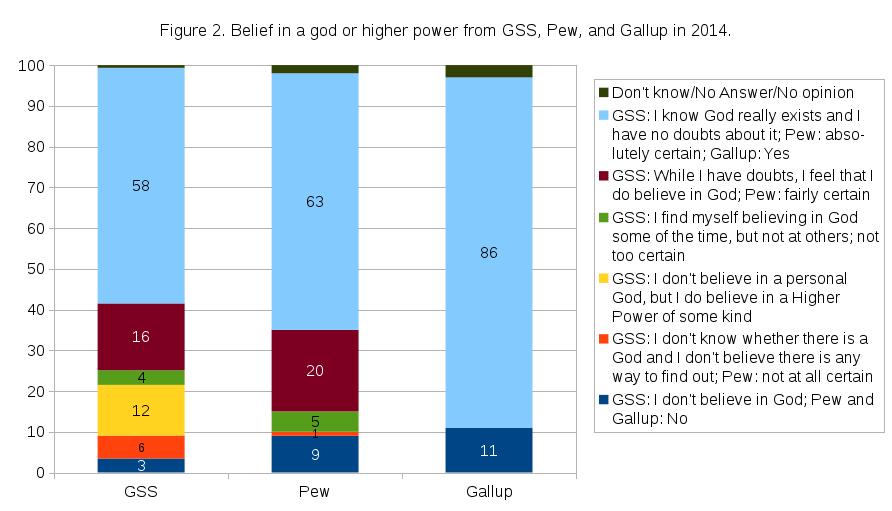
I show the results in Figure 2 below, having done my best to overlay Pew’s and Gallup’s response options with those of the GSS.

Figure 2

As Figure 2 indicates, how you ask the question matters a great deal. If you ask only a yes/no question, like Gallup does, it appears as though 86% of Americans believe in a god or higher power. That is a full 20% higher than what Pew and the GSS estimate.

Even Pew, with its two part approach, reduces the possible response options as it groups belief in a ‘God’ with belief in ‘a universal spirit’— not a small oversight, as the GSS estimates that 12% of adults in the US believe not in a personal God but in a Higher Power of some kind.

The dichotomous response options in Pew and Gallup also hide a considerable amount of nuance that is revealed in the GSS around agnosticism. The GSS estimates that 6% of Americans are agnostics; technically, Gallup and Pew do not capture agnostics, though I grouped Pew respondents who indicated their certainty of belief in a god or universal spirit as ‘not at all certain’. It’s not a perfect match, but that is precisely the point – Gallup and Pew are not actually capturing agnosticism in a clear way.

In general, comparing these instruments shows that overly general questions can be misleading. Detail from the GSS suggests that Gallup’s simple ‘yes/no’ question actually inflates the number of people who believe in a god or higher power by forcing those who doubt to opt into belief, and forcing those who truly aren’t sure if they believe to indicate they do not.

If, instead, a survey researcher wants to illustrate the nuance that exists in belief in gods or supernatural powers, they should opt for questions with multiple response options. It might even be helpful to add even more options within the ‘I know God exists’ category, such as ‘I believe in God, but no longer think God is active in the world,’ ‘I believe in a god, but it’s complicated,’ ‘I believe in many gods,’ etc.[ix]

This blog has focused on a limited set of US-based surveys, but similar effects have been found elsewhere.[x] What this work shows is that scholars interested in studying nonreligious and nonbelieving individuals need to recognize that how questions are framed will influence the results they get. There are many ways to ask about religious belonging and believing, and most of these aren’t intrinsically wrong or right – so long as the data are analysed and interpreted in a way that is sensitive to what the question is doing. On the other hand, some questions are very, very wrong, and scholars should be at pains to avoid them.


Ryan Cragun is an associate professor of sociology at The University of Tampa. His research focuses on Mormonism and the nonreligious and has been published in numerous professional journals.  He is also the author of several books.


[i]           http://www.wingia.com/en/news/losing_our_religion_two_thirds_of_people_still_claim_to_be_religious/290/

[ii]           Of note, the same question wording is used in the World Values Survey.  For an extended discussion of how question wording can affect perceived levels of religiosity in a population, see: Bruce, Steve. 2002. God Is Dead: Secularization in the West. London: Blackwell Publishers.

[iii]          Converse, Jean M. 1986. Survey Questions: Handcrafting the Standardized Questionnaire. Beverly Hills: Sage Publications.

[iv]          ‘Ze’ is a gender neutral pronoun, along with ‘zer,’ which is the possessive version of the same.

[v]           Note that Pew conflates belonging (religious affiliation) with belief as well, as they include atheist and agnostic among the options, even though those are not religious affiliations.

[vi]          Note that Gallup’s question has changed substantially over time; they added ‘no religion’ as an option in the question starting in 2006. See: http://www.gallup.com/poll/1690/religion.aspx

[vii]         Phrasing nonreligion as “nothing in particular” makes it seem as though this is just a casual and fleeting identity that is of little importance.  While that may certainly be true for some, for others, exiting religion is a monumental struggle (see: Cottee, Simon. 2015. The Apostates: When Muslims Leave Islam. London: Hurst.).

[viii]         http://www.gallup.com/poll/1690/religion.aspx

[ix]          Lois Lee recommends similar ways of extending survey options in her excellent article from 2014: Lee, Lois. 2014. “Secular or Nonreligious? Investigating and Interpreting Generic ‘not Religious’ Categories and Populations.” Religion 44(3):466–82.

[x]           On discrepancies between census and other survey data in the UK, see Voas, David and Abby Day. 2007. Secularity in Great Britain. In B. A. Kosmin and A. Keysar (eds). Secularism and Secularity: Contemporary International Perspectives. Hartford, CA: ISSSC, 95–110, and Day, Abby. 2011. Believing in Belonging: Belief and Social Identity in the Modern World. Oxford: Oxford University Press. 2011; for a detailed analysis of the effects of question wording, also in the UK case, see Field, Clive. 2014. Measuring religious affiliation in Great Britain: the 2011 census in historical and methodological context. Religion 44 (3): 357–82. DOI:10.1080/0048721X.2014.903643, and other contributions to Day, Abby and Lois Lee. 2014. Making Sense of Surveys and Censuses: Issues in Religious  Self-Identification. Religion 44 (3): 345–56. For discussion of the World Values Survey, see Egbert Ribberink, Peter Achterberg, and Dick Houtman’s earlier contribution to this blog series, Measuring Atheism: Differentiating Non-religiosity and Anti-religiosity.

NSRN/SSNB Methods blog series: May Round-Up


We are now one month into the methods blog series – a collaboration between the Scientific Study of Nonreligious Belief (SSNB) project* and the Nonreligion and Secularity Research Network (NSRN). Over the next two months, we are looking forward to contributions from leading researchers working across the social sciences, including Abby Day, Ryan Cragun, Ann Taves, Phil Zuckerman and many more besides. Meanwhile, here’s a reminder of the blogs published in May:


* The Scientific Study of Nonreligious Belief (SSNB) project focuses on the beliefs and meaning systems of nonreligious people. These ‘nonreligious beliefs’ include the religious, religious-like, and religion-related ideas and convictions of nonaffiliates and atheists, and a wide array of specific beliefs, such as those about God(s) and supernatural agents, the nature and meaning of life, and the moral status of religious traditions. The full project website is under construction; its launch will be announced on the NSRN website. The SSNB project is funded by the John Templeton Foundation, in collaboration with UCL, St Mary’s University Twickenham, Queen’s University Belfast, Coventry University and the Nonreligion and Secularity Research Network (NSRN).

[Blog Series] Not for Girls? Gender and Researching Nonreligion

In the latest contribution to the SSNB/NSRN Methods Blog, Marta Trzebiatowska explores how we need to structure our methodologies to take account of gender – and how our methodologies may themselves be structured by gender.
Marta


A study of the intersection of gender and atheism (or nonreligion, secularity and similar, frequently related phenomena) poses complex methodological challenges. From the very outset – the point of research design – we need to decide on the issue to be explained. Take, for example, the striking gender imbalance in the atheist movement – one of the most prominent gender issues in the field. Why so few women? Journalists and bloggers have offered several explanations, the most common of which is the rampant misogyny that pervades atheist organisations (e.g. Marcotte, 2014). In responding to the accusation of sexism among New Atheists, one of its leading lights, Sam Harris, has argued that women simply dislike the movement’s critical posture, which ‘is to some degree intrinsically male and more attractive to guys than to women’. He further proposes that the‘atheist variable’ lacks ‘this nurturing, coherence-building extra estrogen vibe’ that appeals to women.[i] Clearly, Harris views women as fundamentally different from men. Needless to say, his argument can be viewed as reductionist and divisive. It paints women as uncritical, a soft glue which binds communities, driven by a predominantly female hormone. Needless to say, Harris felt the need to defend himself on his blog, saying that he is ‘not the sexist pig you’re looking for’.

But if we ignore the inflammatory rhetoric, Harris’s basic message merits some attention. Studies have shown that statistically (or as Harris puts it ‘as an aggregate’) women tend to be attracted to particular social activities, while men prefer others (e.g. Craig and Liberti, 2007). This is nothing to do with hormonal differences, but a lot to do with gendered socialisation, and what we could call ‘the feedback loop’. Individuals are generally more likely to choose activities and groups they feel an affinity with; for example, walking into a room filled with people very different from us does not encourage most of us to remain. In other words, if an atheist setting is a priori defined as male, complete with the characteristics and types of behaviour we as a culture associate with masculinity, then women, regardless of their personality and convictions, are less likely to feel they belong. This in turn reduces their participation and strengthens the purportedly masculine flavour of the setting. So Harris has a point in that women’s atheism can differ from that of men’s, in this social sense at least. This difference is what often makes everyday female atheism, and non-belief more generally, invisible.

Another possible explanation for the gender imbalance among the nonreligious is linked to commonly held misconceptions about nonreligion and atheism. If statistically women are more religious (and spiritual) than men, the assumed lack of beliefs and rituals associated with nonreligion can be off-putting.[ii] As one of my female (and nonreligious) undergraduate students said: ‘it’s so sad that [atheists] don’t believe in anything’. These are possibilities we can explore scientifically.

But certainly the initial gendering of the field matters too, and maybe even more than women’s inherent preferences. The more we can understand about the highly gendered construction and promotion of nonreligious discourses and activities, the clearer the reasons for women’s reluctance to get involved. Gender is not the property of individuals. We ‘do’ gender, and more often than not we do it as difference, thus a lot of the time individuals perform gender in ways that create and reinforce inequalities. This in turn means that women, more often than men, enter social situations in which they feel judged and restricted because of their female status. If an atheist space (real and virtual) is defined as masculine by the sheer fact that more men are present, a certain version of hegemonic masculinity, and by extension symbolic violence, is enacted on those who do not fit the model.

It may then be the case that women do not differ from men in their initial attraction to atheist activities, but the gap widens as a result of women’s direct experience of the atheist milieu. The initial gendering of the atheist movement, through the high profiles of its male figures and marginalisation of their female counterparts, sets the tone for the subsequent patterns of participation. In powerful illustration of this, we might note that Jennifer Hecht, Susan Jacoby, or Greta Christina – all significant figures in the Atheist movement – do not receive a fraction of media exposure that Dawkins, Harris, or Hitchens have enjoyed. The process is part of ‘gender priming’, a psychological term referring to ‘the power of environments to signal to people whether or not they should enter a domain’ (Cheryan et al. 2009: 1058). Harris identifies the problem, then, but he is wrong to blame it on the shortage of estrogen. The atheist setting is continuously presented as stereotypically male, and thus becomes inhospitable to women.

This point can be extended to those of us who study nonreligion. Our research methodologies themselves are highly gendered. We focus on the immediately visible public expressions of atheism (e.g. New Atheism), not on the mundane and largely private actions, many of which are difficult to categorise and quantify. For example, a woman who teaches her children to say ‘LOL’ instead of ‘oh my God’ clearly practises a form of non-theism in her objection to cultural Christianity, but cannot be placed in a neatly pre-defined category, nor identified through studies of organised nonreligion. Her experience is therefore invisible when compared to a male member of an atheist movement.

The focus on atheism in studies of nonreligion is also inevitably gendered because the term ‘atheist’ tends to appeal more to men than to women who prefer ‘agnostic’ or ‘not religious’ (Schnell, 2015). In many ways, despite the strong feminist influence on social science methodologies, traditional notions of rationality and empiricism continue to define scholars’ approach to nonreligion. It can mean that researchers adjust their lens to the existing parameters and consequently block out phenomena that do not fit in.

This is why methodology and methods both matter enormously because they inevitably shape the findings and the eventual conclusions of our study. For many years sociologists of religion focused on the problem of leadership and gender in religious institutions but ignored the experiences of ordinary women who, by that point, constituted the majority of Christian churchgoers. This was a serious omission which negatively affected our understanding of gender and religiosity.

A similar mistake is being reproduced in the study of nonreligion. Obviously, female atheists who are vocal, active, and visible in the organised movement are worth studying (see Schwartz, 2013). We can learn a lot about the systemic barriers to women’s participation, as well as the dynamics of the interaction which set the tone in a way that may be hinder women’s activism. However, just like in the study of religion, we need to pay more attention to what goes on under the radar. There are plenty of female ‘nones’ out there who do not join a movement, or share their views on a public online or off-line platform – whether because they don’t want to or because they are prevented from doing so if they do. And yet their convictions inform their daily lives in ways we are only just beginning to realise, and to understand. We know that women ‘do’ religion differently than men, so why wouldn’t the same rule apply to nonreligion?


References

Cheryan, S. VC Plaut, P.G. Davies, and C.M. Steele. 2009. Ambient Belonging: How Stereotypical Cues Impact Gender Participation in Computer Science, Journal of Personality & Social Psychology, no. 97: 1045-1060.

Craig, M.L. and R. Liberti. 2007. “‘Cause That’s What Girls Do”: the Making of a Feminized Gym. Gender & Society, vol. 21, no. 5: 676-699.  

Marcotte, A. 2014. Atheism’s Shocking Woman Problem: What’s Behind the Misogyny of Richard Dawkins and Sam Harris? Salon, Oct 3.

Schnell, T. 2015. Dimensions of Secularity (DoS): An Open Inventory to Measure Facets of Secular Identities. The International Journal for the Psychology of Religion, 25:4, 272-292.

Schwartz, Laura. 2013. Infidel Feminism: Secularism, Religion and Women’s Emancipation, England 1830-1914. Manchester: Manchester University Press.


[i] See https://www.samharris.org/blog/item/im-not-the-sexist-pig-youre-looking-for

[ii] See http://www.pewresearch.org/fact-tank/2016/03/23/qa-why-are-women-generally-more-religious-than-men/