New ‘NSRN in the News’ Page

Just in time for the NSRN Conference, Lorna Mumford – one of the new members of the NSRN Online Team – has added a new page to the website which provides links to press articles relating to the NSRN or the work of network members. It is available here: http://nsrn.net/news/nsrn-in-the-news-2/

We hope that you enjoy have the opportunity to check out the latest ‘splashes’ that the NSRN has been making in the popular press, and that you will join us in thanking Lorna very much for her hard work.

Podcast with Tariq Modood on the Crisis of European Secularism

The Religious Studies Project have published a half hour podcast with Professor Tariq Modood on the Crisis of European Secularism, recorded at this year’s SOCREL Conference in Chester:

http://www.religiousstudiesproject.com/2012/05/28/podcast-tariq-modood-on-the-crisis-of-european-secularism/

You can download this interview on iTunes.

Tariq Modood is Professor of Sociology, Politics and Public Policy at the University of Bristol. He is founding Director of the University Research Centre for the Study of Ethnicity and Citizenship, and co-founding editor of the international journal, Ethnicities. As a regular contributor to the media and policy debates in Britain, he was awarded a MBE for services to social sciences and ethnic relations in 2001 and elected a member of the Academy of Social Sciences in 2004. He also served on the Commission on the Future of Multi-Ethnic Britain, the IPPR Commission on National Security and on the National Equality Panel, which reported to the UK Deputy Prime Minister in 2010.

His recent publications include Multicultural Politics: Racism, Ethnicity and Muslims in Britain (Edinburgh University Press, 2005), Multiculturalism: A Civic Idea (Polity, 2007) and Still Not Easy Being British: Struggles for a Multicultural Citizenship (Trentham Books, 2010); and as co-editor, Secularism, Religion and Multicultural Citizenship (Cambridge University Press, 2009).

Is There a Crisis of Secularism in Western Europe?, which expands considerably upon the issues in this interview, is now available at http://www.bris.ac.uk/ethnicity/news/2012/36.html.

NSRN subscribers might also be interested in Linda Woodhead’s podcast on the Secularisation Thesis, and Bjoern Mastiaux’s essay on the same topic.

Westminster Faith Debates

A series of debates on religion in public life, running from February to May 2012 at RUSI, 61 Whitehall, SW1A 2ET, Wednesdays fortnightly, 5.30-7pm.

Between 2007-2012 £12m was invested by two research councils, the AHRC and ESRC, in the largest-ever funded research programme on ‘Religion and Society’. In this series leading academics will present findings arising from that research, for response by public figures. Together they will open up debate about the place of religion in public life today.

The series is organised by the Rt Hon Charles Clarke, Professor Linda Woodhead and Dr Rebecca Catto, in co-operation with Theos.

1. Religious Identity in ‘Superdiverse’ Societies – 8th Feb

  • Trevor Phillips, Dominic Grieve, Kim Knott, Therese O’Toole

2. What’s the Place of Faith in Schools? – 22nd Feb

  • Richard Dawkins, John Pritchard, Jim Conroy, Robert Jackson

3. What have we Learned about Radicalisation? – 7th March

  • Mehdi Hasan, Ed Husain, Mark Sedgwick, Marat Shterin, Mat Francis

4. What role for Religious Organisations in an era of Shrinking Welfare? – 21st March

  •  David Blunkett, Peter Smith, Adam Dinham, Sarah Johnsen

5. What Limits to Religious Freedom? – 18th April

  • Lisa Appignanesi, Maleiha Malik, Peter Jones

6. What are the main Trends in Religion and Values in Britain? – 2nd May

  • Aaqil Ahmed, Cole Moreton, Linda Woodhead, Grace Davie

Please email p.ainsworth@lancaster.ac.uk to register for the debates you would like to attend, and visit http://www.religionandsociety.org.uk/faith_debates for further details.

50 New Additions to the NSRN Bibliography

Now that things are slowly getting back to normal after the holiday season, we thought some extra reading might be in order.

The following items have been added to the NSRN’s bibliography today, and are mostly the result of suggestions from visitors to the website. A huge thanks to everyone who suggested items – please keep them coming.

The complete bibliography can  be viewed in a list organised by author surname or publication date.

—————–

  • Alicino, F. 2011. “The Collaborations-Relations Between Western (Secular) Law and Religious Nomoi Groups in Today’s Multicultural Context : The Cases of France and Canada.” Transition Studies Review 18 (2): 430-444.
  • Aston, Katie. 2011. Atheism Explained by Jonathan Lanman (NSRN Annual Lecture 2011). NSRN Events Report series [online]. NSRN, October 25. http://nsrn.net/events/events-reports.
  • Baker, Joseph O’Brian, and Buster Smith. 2009. “The Nones: Social Characteristics of the Religiously Unaffiliated.” Social Forces 87 (3): 1251-1263.
  • Bradley, Arthur, and Andrew Tate. 2010. The new atheist novel: fiction, philosophy and polemic after 9/11. Continuum International Publishing Group, April 11.
  • Bullivant, Stephen, and Lois Lee. 2012. “Interdisciplinary Studies of Non-religion and Secularity: The State of the Union.” Journal of Contemporary Religion 27 (1).
  • Caplow, T. 1998. “The Case of the Phantom Episcopalians.” American Sociological Review 63 (1): 112-113.
  • Chatterjee, Nandini. 2011. The Making of Indian Secularism: Empire, Law and Christianity, 1830-1960. Palgrave Macmillan, March 1.
  • Cragun, Ryan, Barry A. Kosmin, Ariela Keysar, Joseph H. Hammer, and Michael Nielsen. 2012. “On the Receiving End: Discrimination Toward the Non-Religious in the United States.” Journal of Contemporary Religion 27 (1).
  • Demerath, N. J., III, and Victor Thiessen. 1966. “On Spitting Against the Wind: Organizational Precariousness and American Irreligion.” American Journal of Sociology 71 (6): 674-687.
  • Ellison, Christopher G., and Darren E. Sherkat. 1995. “The ‘Semi -Involuntary Institution’ Revisited: Regional Differences in Church Participation Among Black Americans.” Social Forces 74.
  • Festinger, L. 1956. When Prophecy Fails. Minneapolis: University of Minnesota Press.
  • Gorski, Philip S., and Ateş Altinordu. 2008. “After Secularization?” Annual Review of Sociology 34 (1): 55-85.
  • Gutkowski, Stacey. 2012. “The British Secular habitus and the War on Terror.” Journal of Contemporary Religion 27 (1).
  • Hadaway, C. Kirk, and Wade Clark Roof. 1979. “Those Who Stay Religious ‘Nones’ and Those Who Don’t: A Research Note.” Journal for the Scientific Study of Religion 18 (2): 194-200.
  • Hadaway, C.K., and P.L. Marler. 1993. “All in the Family: Religious Mobility in America.” Review of Religious Research 35 (2): 97-116.
  • Hadaway, C.K., P.L. Marler, and M. Chaves. 1998. “Overreporting Church Attendance in America: Evidence That Demands the Same Verdict.” American Sociological Review 63 (1): 122-130.
  • Hout, Michael, and Andrew Greeley. 1998. “What Church Officials’ Reports Don’t Show: Another Look at Church Attendance Data.” American Sociological Review 63 (1): 113-119.
  • Hunter, Laura A. 2010. “Explaining Atheism: Testing the Secondary Compensator Model and Proposing an Alternative.” Interdisciplinary Journal of Research on Religion 6.
  • Knott, Kim. 2010. “Theoretical and Methodological Resources for Breaking OPen the Secular and Exploring the Boundary between Religion and Non-religion.” Historia Religionum 2: 115-133.
  • Kraut, Benny. 1979. From Reform Judaism to Ethical Culture: The Religious Evolution of Felix Adler. New York: Hebrew Union College Press.
  • Lanman, Jonathan. 2011. “Thou Shalt Believe -: Or Not.” New Scientist.
  • ———. 2012. “The Importance of Religious Displays for Belief Acquisition and Secularization.” Journal of Contemporary Religion 27 (1).
  • Lee, Lois. 2012. “Research Note: Talking about a Revolution: Terminology for the New Field of Non-religion Studies.” Journal of Contemporary Religion 27 (1).
  • Lerner, Berel Dov. 1995. “Understanding a (Secular) Primitive Society.” Religious Studies 31: 303-309.
  • Lowis, M.J., A.J. Jewell, M.I. Jackson, and R. Merchant. 2011. “Religious and Secular Coping Methods Used by Older Adults : An Empirical Investigation.” Journal of Religion, Spirituality and Aging 23 (4): 279-303.
  • Luehrmann, S. 2011. Secularism Soviet Style: Teaching Atheism and Religion in a Volga Republic. Indiana: Indiana University Press.
  • MacKillop, I.D. 1986. The British Ethical Societies. Cambridge: Cambridge University Press.
  • Merino, Stephen M. 2012. “Irreligious Socialization? The Adult Religious Preferences of Individuals Raised with No Religion PDF Stephen M. Merino.” Secularism and Nonreligion 1: 1-16.
  • Mumford, Lorna. 2011. Atheism and Anthropology: Researching Atheism and Self-Searching Belief and Experience Workshop. NSRN Events Report series [online]. NSRN, December. http://www.nsrn.net/events/events-reports.
  • Orsi, R. 2005. Between heaven and earth: the religious worlds people make and the scholars who study them. Princeton, NJ and Oxford: Oxford University Press.
  • Parmeggiani, F. 2011. “Speaking of God : The Post-Secular Challenge for Italian Feminist Thought and Practices.” Annali D Italianistica 29: 417-430.
  • Presser, S., and M. Chaves. 2007. “Is Religious Service Attendance Declining?” Journal for the Scientific Study of Religion 46 (3): 417-423.
  • Quack, Johannes. 2012. “Organised Atheism in India: An Overview.” Journal of Contemporary Religion 27 (1).
  • Radest, Howard B. 1969. Toward Common Ground: The Story of the Ethical Societies in the United States. New York: Frederick Unger Publishing Co.
  • ———. 1990. The Devil and Secular Humanism: The Children of the Enlightenment. Westport, CT: Praeger.
  • Roof, W.C., and W. McKinney. 1987. American Mainline Religion: Its Changing Shape and Future. New Brunswick, NJ: Rutgers University Press.
  • Sandomirsky, S., and J. Wilson. 1990. “Processes of Disaffiliation: Religious Mobility among Men and Women.” Social Forces 68: 1211-1229.
  • Schwadel, P. 2010. “Period and Cohort Effects on Religious Nonaffiliation and Religious Disaffiliation: A Research Note.” Journal for the Scientific Study of Religion 49 (2): 311-319.
  • Stark, Rodney, Eva Hamberg, and Allen S. Miller. 2005. “Exploring Spirituality and Unchurched Religions in America, Sweden, and Japan.” Journal of Contemporary Religion 20 (1): 3-23.
  • Stolzenberg, R.M., M. Blair-Loy, and L.J. Waite. 1994. “Stolzenberg, R. M., Blair-Loy, M., & Waite, L. J. (1994). Religious Participation in Early Adulthood: Age and Family Life Cycle Effects on Church Membership. American Sociological Review, 60, 84-103.” American Sociological Review 60: 84-103.
  • Tamney, Joseph B., Shawn Powell, and Stephen Johnson. 1989. “Innovation Theory and Religious Nones.” Journal for the Scientific Study of Religion 28 (2): 216-229.
  • Taylor, Charles. 1998. Modes of Secularism. In Secularism and its Critics: Themes in Politics, ed. Rajeev Bhargava, 32-53. New Delhi: Oxford University Press.
  • Vargas, N. 2011. “Retrospective Accounts of Religious Disaffiliation in the United States: Stressors, Skepticism, and Political Factors.” Sociology of Religion (October 11). doi:10.1093/socrel/srr044. http://secularismandnonreligion.org/index.php/snr/article/view/5.
  • Veevers, J.E., and D.F. Cousineau. 1980. “The Heathen Canadians: Demographic Correlates of Nonbelief.” The Pacific Sociological Review 23 (2): 199-216.
  • Voas, David, and Siobhan McAndrew. 2012. “Three Puzzles of Non-religion in Britain.” Journal of Contemporary Religion 27 (1).
  • Welch, Michael R. 1978a. “Religious Non-Affiliates and Worldly Success.” Journal for the Scientific Study of Religion 17 (1): 59-61.
  • ———. 1978b. “The Unchurched: Black Religious Non-Affiliates.” Journal for the Scientific Study of Religion 17 (3): 289-293.
  • Wilson, J., and Darren E. Sherkat. 1994. “Returning to the Fold.” Journal for the Scientific Study of Religion 33: 148-161.
  • Zuckerman, Phil. 2009. “Why are Danes and Swedes so Irreligious?” Nordic Journal of Religion and Society 22 (1).
  • ———. 2011. Faith No More: Why People Reject Religion. New York: Oxford University Press.

‘Atheism and Non-religion’ Panel at SOCREL 2012

The draft programme for the 2012 Sociology of Religion Study Group of the British Sociological Association (SOCREL) – Religion and (In)Equalities – has recently been announced, and is available here.

The conference dates are 28-30 March 2012 at the University of Chester, UK. The entire programme looks thoroughly stimulating, and contains a number of papers which should be of interest to NSRN researchers.

Of particular relevance is the ‘Atheism and Non-Religion’ panel on 29 March at 09.00:

Spencer Bullivant
Atheist summer camps: Transitioning away from conceptions of disbelief to belief

Christopher R. Cotter
The inherent inequalities of the religion-nonreligion dichotomy: A narrative approach to individual (non-)religiosity

Lydia Reid
Religion and modernity

Janet Eccles & Rebecca Catto
Countercultural or mainstream? Some reflections from the Young Atheist Project

Religion and Social Change – Association for the Sociology of Religion 2012 Annual Meeting

http://www.sociologyofreligion.com/annual-meeting/

The 2012 annual meeting of the Association for the Sociology of Religion will take place August 17-18 in Denver, Colorado at the Grand Hyatt. The Grant Hyatt is a Four Diamond hotel in the heart of downtown Denver, close to restaurants, shopping and entertainment, including the world famous Tattered Cover bookstore.

Our 2012 meeting will take place immediately prior to the meetings of
the ASA’s religion section, but will not overlap with those sessions. This will allow members to attend sessions at both meetings in a shorter window than previous years. The Grant Hyatt is a block away from the ASA conference hotel, the Hyatt Regency.

The theme of this year’s meeting is religion and social change. Most religions traditions are predicated upon the idea that conversion transforms the individual and widespread acceptance of religious principles results in a utopian society. Some religions attempt to produce or prevent change by influencing the wider discourse surrounding key moral and political debates; others promote programs at the local level; and still others, viewing society as beyond repair, attempt to produce their own utopian sub-societies. Yet, religion is also the product of social changes that mold beliefs and transform religious institutions.

While we welcome papers on all subjects, we expect many presentations to explore the complex relationship between religion and social change. Further, this year’s meeting will have a strong focus on professional development with special sessions on funding and disseminating research, navigating the tenure process, publishing and writing, and resources available for research. These sessions will include a panel with the editors of Sociology of Religion and Review of Religious Research.

LCD projectors and screens will be available for all presentations.

DEADLINES:
-Session Proposals are due by 31 March 2012
-Paper Proposals and Abstracts are due by 30 April 2012

SUBMISSION GUIDELINES: (1) Email your proposal to ASR2012@augustana.edu as a Word attachment. Place the title of your proposal first, then names, affiliations, and email addresses of all authors, then your abstract/proposal, all on one sheet of paper. (2) Limit paper abstracts to a maximum of 100 words. (3) 2012 membership in ASR is required for program consideration (one author, for multiauthored papers). Do not submit proposals prior to 1 January.

PROGRAM CHAIR: Christopher Bader, Chapman University.

NSRN Launch New Website!

The Nonreligion and Secularity Research Network (NSRN) are proud to announce the launch of their new website – nsrn.net!

The NSRN website has been going from strength to strength since its relaunch in November 2009 at the co.uk site – but wide-interest in and growing membership of the NSRN means we’ve needed to expand our services. After weeks and months of development with the new online editorial team, the next generation NSRN website is here!

Visit http://www.nsrn.net to take  a look.

*Although the old . co.uk address will still be around for a while, we’d be extremely grateful for anyone linking to the site to amend their records, citations, links and so forth. The NSRN is truly international, in membership and audiences, and we felt it was important to reflect this in the web address – and we appreciate your help in implementing this change*

A preview of some of the new things we provide on the site:

We’ve also updated and expanded our existing services and resources. The new site boasts,

And we now have a range of new Thoroughly Modern features, including:

  • full integration with the NSRN’s new Twitter feed
  • full integration with the NSRN’s new Facebook page

… and which will enable users to keep up to date with NSRN news and resources in whatever way suits you:

New features and older material are now fully archived and easily searchable.

We hope you like it. As ever, comments and suggestions are always encouraged.

We would greatly appreciate it if you could circulate this information around any individuals or groups that you think might be interested. As a research network, we rely upon the input of our members and friends in the collation and dissemination of information. If you notice any errors or omissions, or are aware of any events, resources, articles etc that we should be promoting, please do not hesitate to get in touch.

With kind regards from,

The NSRN Online Team

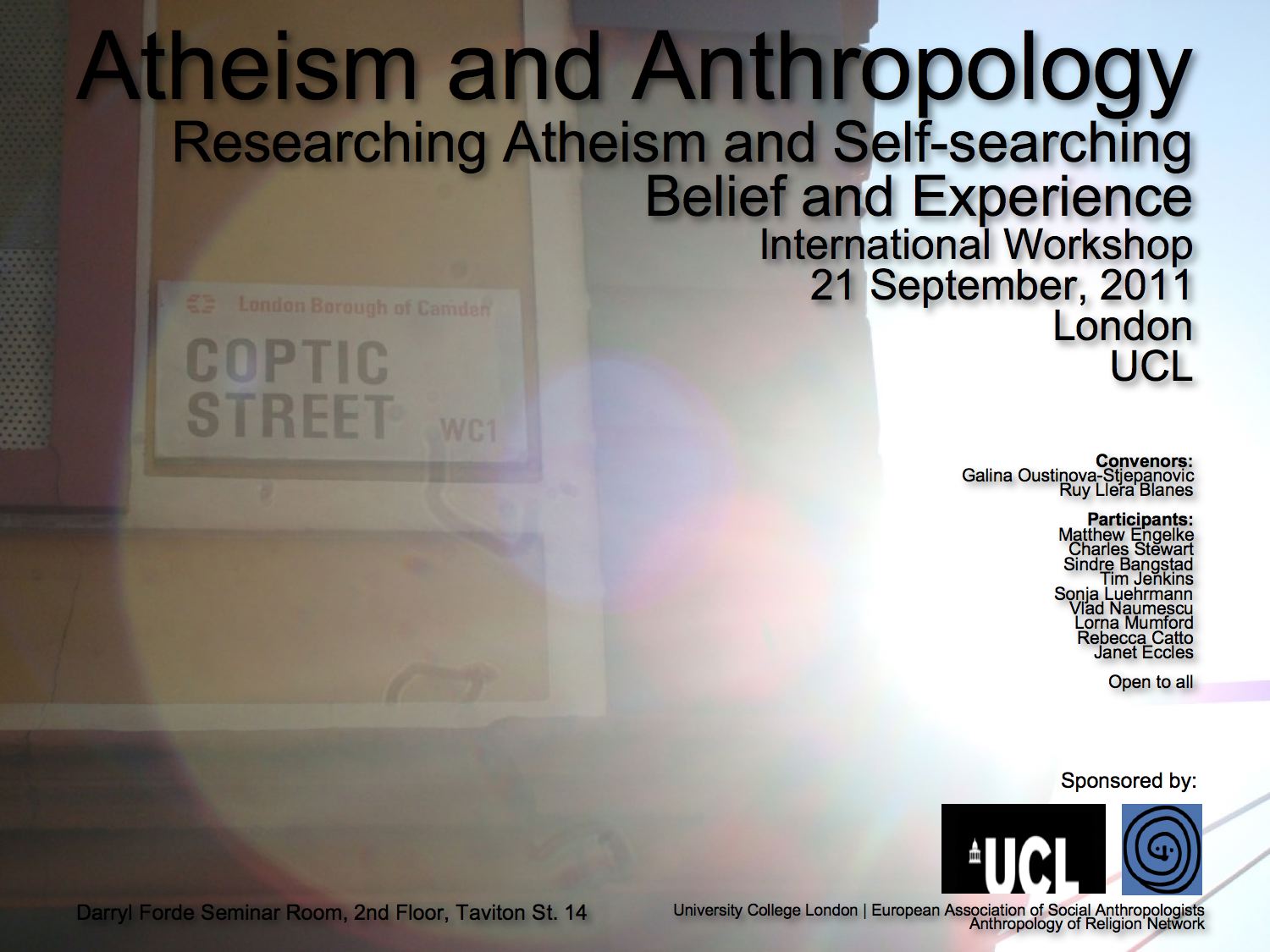
New Events Report: Atheism and Anthropology

To coincide with the launching of our new website, the NSRN are proud to announce the publication of a new Events Report by Lorna Mumford, on the recent ‘Atheism and Anthropology’ Workshop in London.

Please see the details and link to the document below:

Atheism and Anthropology: Researching Atheism and Self-Searching Belief and Experience Workshop

University College, London, 21 September 2011
Report by Lorna Mumford, University College London
Published by the NSRN, 14 December 2011

The Routledge Handbook of Research Methods in the Study of Religion

The Routledge Handbook of Research Methods in the Study of Religion

Edited by Michael Stausberg, Steven Engler
Published November 16th 2011 by Routledge – 546 pages

This is the first comprehensive survey in English of research methods in the field of religious studies. It is designed to enable non-specialists and students at upper undergraduate and graduate levels to understand the variety of research methods used in the field. The aim is to create awareness of the relevant methods currently available and to stimulate an active interest in exploring unfamiliar methods, encouraging their use in research and enabling students and scholars to evaluate academic work with reference to methodological issues. A distinguished team of contributors cover a broad spectrum of topics, from research ethics, hermeneutics and interviewing, to Internet research and video-analysis. Each chapter covers practical issues and challenges, the theoretical basis of the respective method, and the way it has been used in religious studies, illustrated by case studies.

Rethinking Secularism – A Seminar Discussion, Santa Barbara

The Orfalea Center for Global & International Studies, Santa Barbara

 presents

 Rethinking Secularism – A Seminar Discussion

Friday, November 18, 2011 – 12:00 noon, Orfalea Center seminar room – 1005 Robertson Gym

 With:

Craig Calhoun, President, Social Science Research Council, and Prof of Sociology, NYU

Jonathan Van Antwerpen, Editor-in-Chief, The Immanent Frame, SSRC online magazine

Mark Juergensmeyer, Director, Orfalea Center for Global and International Studies

 Comments by:
Benjamin (Jerry) Cohen, UCSB Political Science
Wade Clark Roof, UCSB Religious Studies
Giles Gunn, UCSB Global & International Studies

 The speakers will discuss the background and content of the multi-year project of the Social Science Research Council on the crisis of secularism that resulted in their recently published, co-edited volume Rethinking Secularism (2011 Oxford UP). The project (and the volume) involved an interdisciplinary group of leading theorists and scholars, including the philosopher Charles Taylor, the literary theorist Talal Asad, the political scientist Peter Katzenstein, the sociologist Jose Casanova, and many more. The project focused on the central issues of how ”the secular” emerged historically, how it is now constituted and understood in different ways around the global, and how it has presented an analytic challenge for the social sciences, the humanities, and international affairs.