Secularism and Nonreligion Journal: Article publication Vol. 1 January 2012

The first article published in Vol 1, January 2012, Stephen M. Merino, Irreligious Socialization? The Adult Religious Preferences of Individuals Raised with No Religion

ABSTRACT: Recent birth cohorts of Americans are more likely than previous cohorts to be raised outside of a religious tradition. In addition, those raised with no religion are increasingly likely to have no religion as adults. Despite their growing numbers, individuals raised with no religion have received little  attention from scholars. The adult religious preferences of these individuals provide researchers with a unique opportunity to test theories of religion and social change. Using General Social Survey data, I examine the adult religious preferences and beliefs of individuals raised with no religion. I provide evidence of a shift in socialization and social influences experienced by those who report growing up with no religion. Compared with earlier cohorts raised with no religion, more recent cohorts have had more secular upbringings and tend to be more secular, liberal, and wary of organized religion as adults. They are also more likely to have a religiously unaffiliated spouse, if they marry at all. Results from a logistic regression analysis indicate that these trends explain much of the cohort differences in the likelihood of remaining unaffiliated as an adult.

KEYWORDS: NONRELIGION, SOCIALIZATION, SOCIAL INFLUENCE

To see the latest publication please follow the link to the Secularism and Nonreligion Journal current issue

http://secularismandnonreligion.org/index.php/snr/issue/current
Announcement and Thank You from the NSRN Directors

We are extremely excited to announce the publication of the Journal of Contemporary Religion  Vol. 27, No. 1 January 2012

Special Issue: Non-religion and Secularity

This special edition of the Journal of Contemporary  Religion is a publication resulting from the NSRN’s inaugural conference in Dec. 2009. At that time, work in progress vastly outweighed completed empirical work in the field – I’m happy to say, in fact, that, even as this area of work has expanded, this ratio is still the same: a sign of continued growth. But this collection presents some of the earliest-realised major research projects in the field, and is intended to highlight the diversity of possible approaches. Happy reading – and we look forward to any comments the collection/articles prompt in this space.

With thanks to Elisabeth Arweck, for her support of this project and for  the NSRN’s work in general. This is the first special edition in the history of the JCR and we were very honoured to be invited to develop it.

Best wishes

Lois and Stephen

You an view the issue when it is released or order the journal through the Taylor and Francis website

Journal of Contemporary Religion: January 2012 Special Issue: Non-religion and Secularity

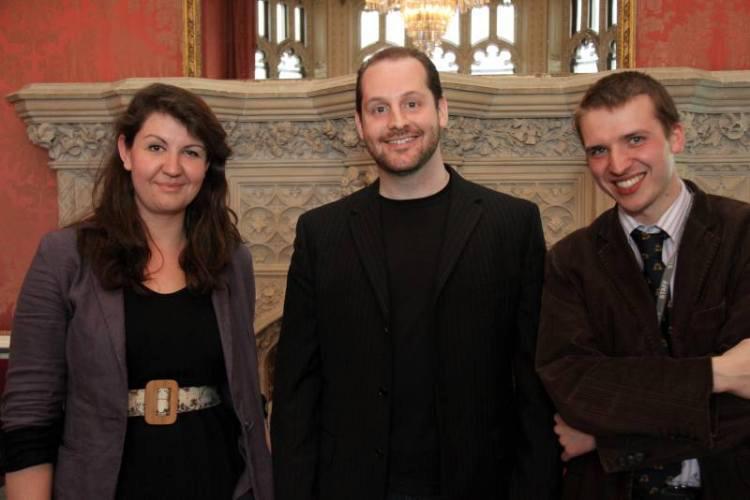
Lois Lee (NSRN Director), Jonathan Lanman and Stephen Bullivant (NSRN Director) - Contributors to the JCR Jan 2012 © 2011 St Mary’s University College, Twickenham

Journal of Contemporary Religion  Vol. 27, No. 1 January 2012

Special Issue: Non-religion and Secularity 

Peter B. Clarke: Tributes

Articles

Stephen Bullivant & Lois Lee – Interdisciplinary Studies of Non-religion and Secularity: The State of the Union

David Voas & Siobhan McAndrew – Three Puzzles of Non-religion in Britain

Jonathan A. Lanman – The Importance of Religious Displays for Belief Acquisition and Secularization

Johannes Quack – Organised Atheism in India: An Overview

Stacey Gutkowski – The British Secular habitus and the War on Terror

Ryan T. Cragun, Barry Kosmin, Ariela Keysar, Joseph H. Hammer & Michael Nielsen – On the Receiving End: Discrimination Toward the Non-Religious in the United States

Lois Lee – Research Note: Talking about a Revolution: Terminology for the New Field of Non-religion Studies

Plus Book Reviews and Book Notes

Religion and Society Programme Conference: New Forms of Public Religion

The event has been announced to take place on  7 September 2012 and more details will follow in the new year. Please put this event in your diary.

10.30 a.m. Wednesday 5th to 3.30 p.m. on Friday 7 September 2012 at the Divinity School, St John’s College, University of Cambridge

This conference will feature presentations from projects funded by the Religion and Society Programme on religion and politics, violence, law, the markets, media, education and health and welfare.

Plenary speakers include Lori Beaman (Ottawa), Grace Davie (Exeter) and Jim Spickard (Redlands).

More details on the events pages of the Religion and Society Programme website.

Religion and Society Programme Event: Sacred Practices of Everyday Life

Religion and Society are running a conference on Sacred Practices of Everyday life on 9 May 2012. A call for papers will be released in early 2012

Details of the event so far are:

10.30 a.m. on Wednesday, 9th May to 3.30 p.m. on Friday 11th May 2012 at the John McIntyre Conference Centre, University of Edinburgh

This conference will feature presentations from projects funded by the Religion and Society Programme on themes including ‘Sex, Life and Love’, ‘Life-styles and (After)Death-styles’ and ‘Fate, Destiny and the Future.’

There will also be plenary sessions with David Morgan (Duke), Mary Jo Neitz (Missouri) and Robert Orsi (Northwestern).

More information can be found on the events page of the Religion and Society website

CFP: Biological and Cultural Evolution and Their Interactions: Rethinking the Darwinian and Durkheimian Legacy in the

Context of the Study of Religion

Call for papers and poster proposal.

International Conference at the Section for the Study of Religion, Faculty of Arts, Aarhus University, 26– 30 June 2012.

2012 marks the centennial of Durkheim’s Les formes élémentaires de la vie religieuse. The Section for the Study of Religion at Aarhus University will be celebrating the centennial by revitalizing one prominent aspect of Durkheim’s work, i.e., the evolutionary question. Cultural evolutionary thinking had its heyday from 1870-1920, and for various reasons, a deep skepticism of biological and cultural evolutionary thinking became entrenched in the humanities. It not only turned its back on evolutionary perspectives but also on science in general. Broader questions pertaining to human biology and cultural evolution were largely dismissed with a few notable exceptions such as Robert Bellah, Shmuel Eisenstadt and Jan Assmann.

The aim of the present conference is to revisit evolutionary questions with a special focus on the study of religion. We think that progress in the field of cognitive science may enable us to once again raise a number of classic evolutionary questions in a fashion which avoids the pitfalls of the ideologically loaded presumptions of Western and Christian superiority of former days. New insights in cognitive science and evolutionary psychology have provided new opportunities for merging biological and cultural evolutionary perspectives. This combination gives us the unique possibility of once again understanding humans from the Durkheimian perspective of homo duplex, i.e., both natural and cultural beings. In order to examine the possibilities for revitalizing evolutionary questions in biology and culture and their interactions in the context of the study of religion, we have invited a number of prominent scholars with an interest in evolutionary questions. Keynote lectures will be given by: Robert Bellah, Pascal Boyer, Jan Bremmer, Joseph Bulbulia, Merlin Donald, Eva Jablonka, Russel Gray, Bernhard Lang, Alexandra Maryanski, Doron Mendels, Guy Stroumsa and Jonathan Turner.

The conference is hosted by the Section for the Study of Religion, the Laboratory on Theories of Religion and the Religion, Cognition and Culture Research Unit (RCC) at Aarhus University, and the Aarhus University Research Foundation. The International Association for the Cognitive Science of Religion (IACSR) will also be hosting its workshop in connection with the conference.

Proposals for papers and posters should be sent to Anders Klostergaard Petersen (akp@teo.au.dk) by March 1, 2012. Please send an abstract of maximum 500 words. Acceptance of papers and posters will be announced by the end of March 2012.

The deadline for registration for the conference will be April 15, 2012. A conference homepage will be available from the beginning of January.

The conference fee will be $200 (students and retirees $150). Further information will be made available when the conference site is opened.

Conference organizers:

Anders Klostergaard Petersen

Hans Jørgen Lundager Jensen

Armin W. Geertz

British Social Attitudes Survey Reveals 50% of Britons have “No Religion”

The National Centre for Social Research has published its British Social Attitudes Survey 2011-2012. You can see the full report, authored by Lucy Lee, on the website of the “National Centre for Social Research”, which conducted the survey.

Table 12.1 Religious Affiliation Taken from the BSA survey 2011_12

The report demonstrates that the proportion of those who claim to be Christian [Church of England] is much lower at 20%, than suggested by the 2001 Census, which claimed 71.7% of people in England and Wales were identified as Christian. The second overwhelming finding was that 50% of the population claimed no religion, in comparison to the 14.5% stating no-religion in the 2001 Census. The other statistics remain fairly consistent, suggesting perhaps that many of the “nones” have migrated from the category of “Christian” or “Church of England” self-identification to having none. However, more data is needed before such hypothesis can be upheld so we eagerly await the Census Data 2011, but perhaps this show early signs of the success of the BHA Census 2011 campaign and others like it, which have bought identification as an issue to the fore.

The Census 2001 Key Statistics, Local Authorities in England and Wales can be found on the Office for National Statistics website.

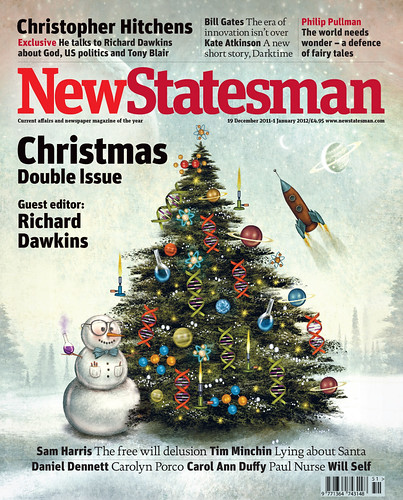
New Statesman Guest Edited by Dawkins out this week

New Statesman Guest Edited by Richard Dawkins 19th Dec 2011


Richard Dawkins has taken the role of guest Editor for the 19 December 2011 to 1 January 2012 issue of the New Statesman. The issue gives space to the “four horseman” of New Atheism and includes a contribution from Sam Harris on the neuroscience of freewill, Daniel Dennett contributes a Christmas essay “The Social Cell” addressing the social ties that bind us and the remaining two “horseman” come together in a conversation between Richard Dawkins and Christopher Hitchens. Other notable inclusions include authors Phillip Pullman and Kate Atkinson, Microsoft giant Bill Gates, planetary scientist Carolyn Porco and commenter and human rights activist Maryam Mamazie.

The edition gives an interesting overview of the current issues dominating the British nonreligous/secular/religious public debate. Dawkins opens with a letter to the British Prime Minister, David Cameron, in which he declares his “cultural Anglicanism” and urges Cameron to acknowledge the British Social Attitudes survey. The survey found 50% of the population declare themselves to be of no faith and the number declaring themselves to be Church of England, Christian, at 20% which for Dawkins undermines  the privileging of religion over non religion, especially the particular privilege he sees accorded to the Anglican state church. He urges Cameron to consider the need for neutrality “in all matters pertaining to religion”.

The New Statesman site quotes Dawkins on his venture:

“To guest-edit a great magazine with the status of a national treasure is the literary equivalent of being invited to imagine your ideal dinner party – Christmas dinner, in this case – and then of actually being allowed to send out real invitations to your dream companions. Every acceptance is like a present off the Christmas tree, gratefully unwrapped and treasured.

At the same time, I couldn’t help being daunted by the New Statesman’s historic reputation for serious, well-written radical commentary, and by the need in my literary Christmas dinner to temper merriment with gravitas.

We have no reindeer, but four horsemen; no single star of wonder and no astrologers bearing gifts, but a gifted star of astronomy who knows wonder when she sees it; no kings from the east, but the modern equivalent of a king from the west; and wise men – and women – all around the table. Please join us at the feast.”

Details of his editorial and how to access the magazine can be found on the New Statesman website

Memories of Religious and Secular Ceremonies Site Launch

[Image]

The Religion and Society funded, cross-cultural project Memories of Religious and Secular Ceremonies has involved oral history research in Bulgaria, Romania and the UK.

Visit http://www.southampton.ac.uk/mrasc/ to read more about the project and its findings.

Memories of Religious and Secular Ceremonies has been led by Professor Peter Coleman, a gerontologist based at Southampton University who recently published a book on belief and ageing with Policy Press. Click here for details.