Teaching and Studying Religion: Choices and Challenges

BSA Meeting Room, Imperial Wharf, London

15 December 2011, 10 a.m. – 5 p.m.

Religion is not a neutral subject. As with other significant constituents of identity, such as sexuality, gender, ethnicity, or class, the subject of ‘religion’ as a topic for study is not straightforward. And yet, we study it, deconstruct it, analyse, and measure it, recognising as we do that definitions are bound to be contested, fluid, and sometimes slippery. What are the particular challenges and choices this presents in different disciplines, in different places and times? And what are the ethical, political and methodological implications of this?

To find out more about how participants from a variety of disciplines and contexts have engaged with the choices and challenges of teaching and studying religion, join us on December 15 at the BSA Meeting Room in London, for a BSA Socrel symposium, chaired by Abby Day (Department of Religious Studies, University of Kent and Department of Anthropology, University of Sussex) and Anna Strhan (Department of Religious Studies, University of Kent). We are grateful to the Higher Education Academy, for funding. It won’t be your usual ‘stand-and-deliver’ event. Our presenters are working hard to condense their work into short summaries that will be distributed to all participants in advance of the day via e-mail. All participants will be expected to read the summaries and come prepared for a full day of engaging in vibrant exchanges across disciplines, countries, methods and other conventional boundaries.

Total delegate numbers are restricted to 30. Registration for the symposium is now available on the BSA website at http://bsas.esithosting.co.uk/public/event/eventBooking.aspx?id=EVT10172

Information on the venue location and transport links, is available at http://www.britsoc.co.uk/NR/rdonlyres/62CE3722-EE65-4B30-8058-90E8ACEFB636/0/BSA_Imperial_Wharf_directions041209.pdf

For any further information, please contact Abby Day (a.day@sussex.ac.uk) and Anna Strhan (as702@kent.ac.uk). The full programme for the day will be published on the BSA Socrel website:http://www.socrel.org.uk/

Pakistan Workshop 2012

Pakistan Workshop 2012

The Lake District, 11th-13th May 2012

Secularity, Globalisation and Power

Both secularity and globalisation are understood to be phenomena that are intrinsically connected to rise of the post Enlightenment modern world. However, in order to understand the relationship between secularity, globalisation and power it is necessary for these themes to be contextualised in order to give them and the links between them, analytical meaning.

For further information, contact pakistanworkshop@gmail.com or become a fan of the facebook group “Pakistan Workshop”. Further information is also available on the Pakistan Workshop website: http://www.pakistanworkshop.org

The deadline for abstracts is 10th February 2012, after which the organisers will make a selection and inform the participants of their decision. The finished papers would be required two weeks before the workshop, so they can be pre circulated to all participants.

Rethinking Secularism – A Seminar Discussion, Santa Barbara

The Orfalea Center for Global & International Studies, Santa Barbara

 presents

 Rethinking Secularism – A Seminar Discussion

Friday, November 18, 2011 – 12:00 noon, Orfalea Center seminar room – 1005 Robertson Gym

 With:

Craig Calhoun, President, Social Science Research Council, and Prof of Sociology, NYU

Jonathan Van Antwerpen, Editor-in-Chief, The Immanent Frame, SSRC online magazine

Mark Juergensmeyer, Director, Orfalea Center for Global and International Studies

 Comments by:
Benjamin (Jerry) Cohen, UCSB Political Science
Wade Clark Roof, UCSB Religious Studies
Giles Gunn, UCSB Global & International Studies

 The speakers will discuss the background and content of the multi-year project of the Social Science Research Council on the crisis of secularism that resulted in their recently published, co-edited volume Rethinking Secularism (2011 Oxford UP). The project (and the volume) involved an interdisciplinary group of leading theorists and scholars, including the philosopher Charles Taylor, the literary theorist Talal Asad, the political scientist Peter Katzenstein, the sociologist Jose Casanova, and many more. The project focused on the central issues of how ”the secular” emerged historically, how it is now constituted and understood in different ways around the global, and how it has presented an analytic challenge for the social sciences, the humanities, and international affairs.

Teaching Atheism and Nonreligion

The British Higher Education Authority have just published an article on teaching atheism and nonreligion in its online journal Discourse. Our very own Stephen Bullivant discusses the module he has developed on the subject, as well as detailing some resources available for teachers and students. The article is open access and available here…

http://prs.heacademy.ac.uk/view.html/PrsDiscourseArticles/221

 The NSRN is developing a new web resource dealing with teaching and funding resources, and will point students in the direction of Bullivant’s module at St Mary’s University College, Twickenham, a module that has been developed at Aberdeen University and and the Secularism major at Pitzer College. If anyone knows of other teaching resources or dedicated funding calls that they think it would be helpful for researchers to be aware of, please email Lois at ll317@cam.ac.uk.


Callum Brown Lecture on “The People of No Religion”

Members of the Modern Cultural History Seminar are reminded that Professor Callum Brown, of the University of Dundee, will speak tomorrow, Wednesday, 12 October, at 5:00 pm in the Panelled Combination Room, Gonville Court, Gonville and Caius College.

The title of the paper is:  ‘The People of No Religion:  The Demographics of Secularisation in the English-Speaking World since c.1900’.

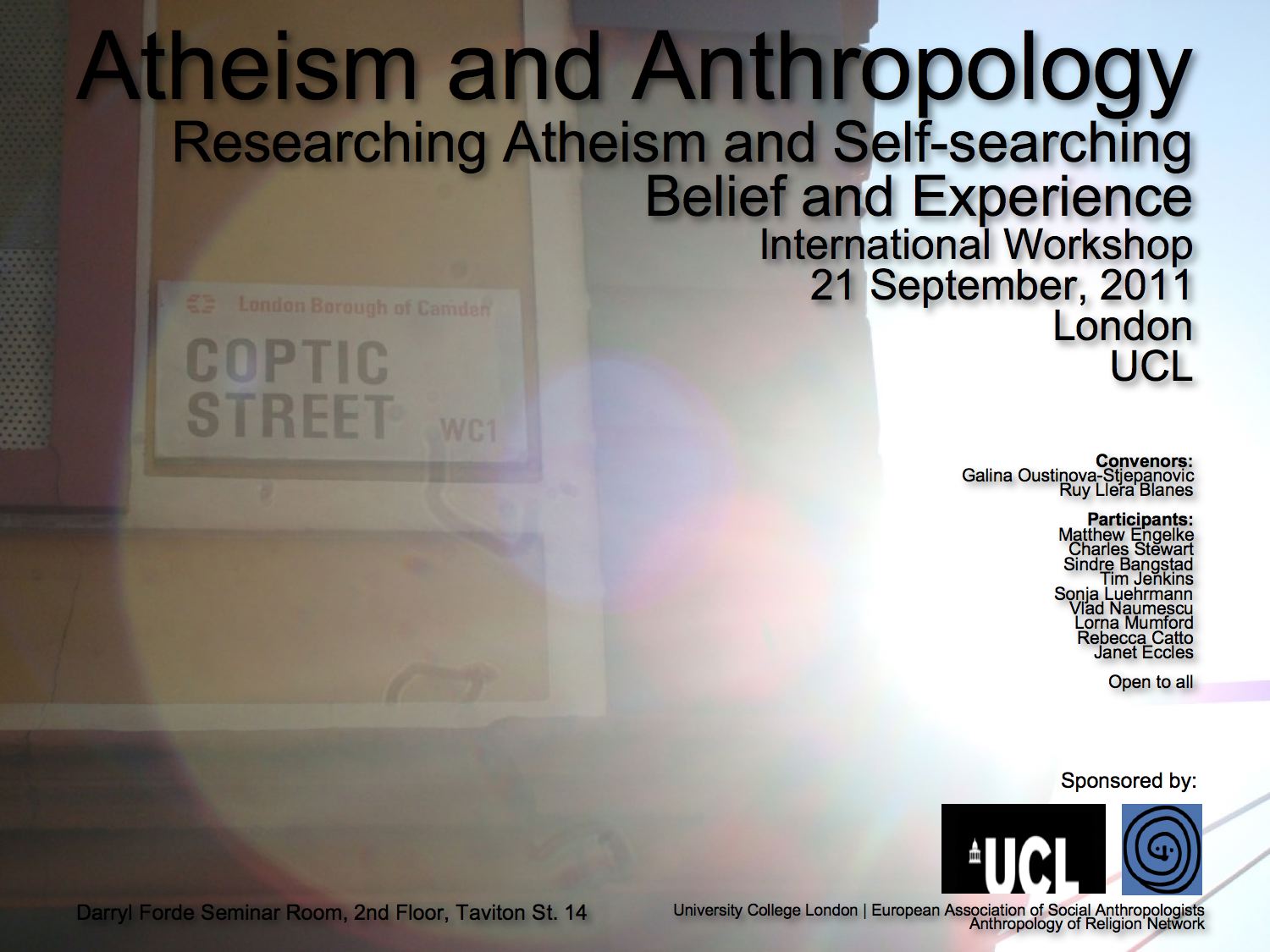
Atheism and Anthropology: Researching Atheism and Self-searching Belief and Experience

21 September, 2011
EASA Network Conference
Atheism and Anthropology: Researching Atheism and Self-searching Belief and Experience

University College London, Daryll Forde seminar room, 2nd floor, Taviton Street 14
Sponsored by the European Association of Social Anthropologists and EASA Anthropology of Religion Network

Convenors
Ruy Llera Blanes (Institute of Social Sciences, University of Lisbon)
Galina Oustinova-Stjepanovic (University College London)

Headline clashes between new atheists such as Daniel Dennett and Richard Dawkins and various religious leaders have shown that strong convictions inform atheist and religious discourses, searching to convey their own propositional truths. Some people argue that atheism has turned militant; others suggest religious education is a menace. Yet, what is atheism? How are subjectivities, ideas, embodied practices and material environments inflected with atheism? These matters are often neglected in anthropology for the simple reason that the discipline itself is an offspring of methodological atheism caught in an awkward relationship with theology and religious performances.

This workshop adopts a two-pronged approach to the research of atheism. We have invited scholars who research atheism as historical, political, and cultural articulations of non-belief, atheistic critique, political and practical disinterestedness in matters of religions. Through our workshop, we will explore the definitions and manifestations of atheism through the comparison and analysis of a number of ethnographic case studies. Furthermore, we will address the questions of specifically religious reflexivity in anthropology by considering the ethical and methodological implications of conducting research as atheist anthropologists and representing religious traditions and ontologies in the secular language of anthropology.. A few questions worth considering:

  • Is an anthropology of atheism possible, or necessary?
  • Are atheism and religiosity competing, opposed regimes of truth? Can atheism be researched as a form of belief? What are the additional dimensions of atheism that are not covered by the concept of belief?
  • What does secularism tell us about atheism?
  • Is atheism as awkward as theology for anthropology? Is anthropology an inevitably non-theistic discipline? Can you teach anthropological theories of religion to students of anthropology who take witchcraft seriously?

Keynote Lecture given by Matthew Engelke (London School of Economics)

Update: December 2011 – The NSRN have published an Event Report on this event. Here are the details:

Atheism and Anthropology: Researching Atheism and Self-Searching Belief and Experience Workshop
University College, London, 21 September 2011
Report by Lorna Mumford, University College London
Published by the NSRN, 14 December 2011

The Secular Outpost offers praise for the NSRN

9th September 2011

The Secular Outpost offers praise for us at the Non-religion and Secularity Research Network

Posted by Taner Edis .

I’ve occasionally complained about the lack of attention to secularity and nonbelief as an academic area of study.

Fortunately, this appears to be changing. There are enough nonreligious people around to justify some social scientific interest. Enterprises such as The Non-religion and Secularity Research Network are up and running, and should produce some interesting stuff as the field matures. (I fully expect that there will be plenty of information coming out that will not flatter secular people as well as material that confirms our self-perceptions.)

Meanwhile, the work of NSRN and similar organizations are worth paying attention to.

http://secularoutpost.infidels.org/2011/09/non-religion-and-secularity-research.html

Europe’s Forgotten “religion”

25th August 2011

Lois Lee – Europe’s Forgotten “religion”

Hundreds of millions of people in Europe alone are “non-religious”, but non-religion remains an understudied field. To mark the launch of a new journal on the subject, associate editor Lois Lee discusses its significance and its role in defining the identities of the “silent majority” in Europe.

Read full discussion here: http://www.cam.ac.uk/research/discussion/europe%E2%80%99s-forgotten-%E2%80%9Creligion%E2%80%9D/

NSRN Journal Launch

In partnership with the Institute for the Study of Secularism in Society and Culture (ISSSC), Trinity College, CT, the NSRN as launched a new academic journal for the field, Secularism and Nonreligion.

We are are now accepting submissions of scholarly articles in the diverse areas of secularism, secularity, nonreligion and atheism research. The journal is social scientific and submissions will be accepted from all social science subjects; we also welcome relevant contributions from other subject areas, including history, philosophy, cognitive science and so on. Full details for how to submit and author guidelines are available here.