Event Report: Sun, Surf, and Symposia: Attending the Society for the Scientific Study of Religion’s 2015 Annual Meeting

Alex Uzdavines reflects on the Society for the Scientific Study of Religion (SSSR) 2015 annual meeting.  He reflects on what the field of nonreligious studies has achieved so far, and where it may go in the future.
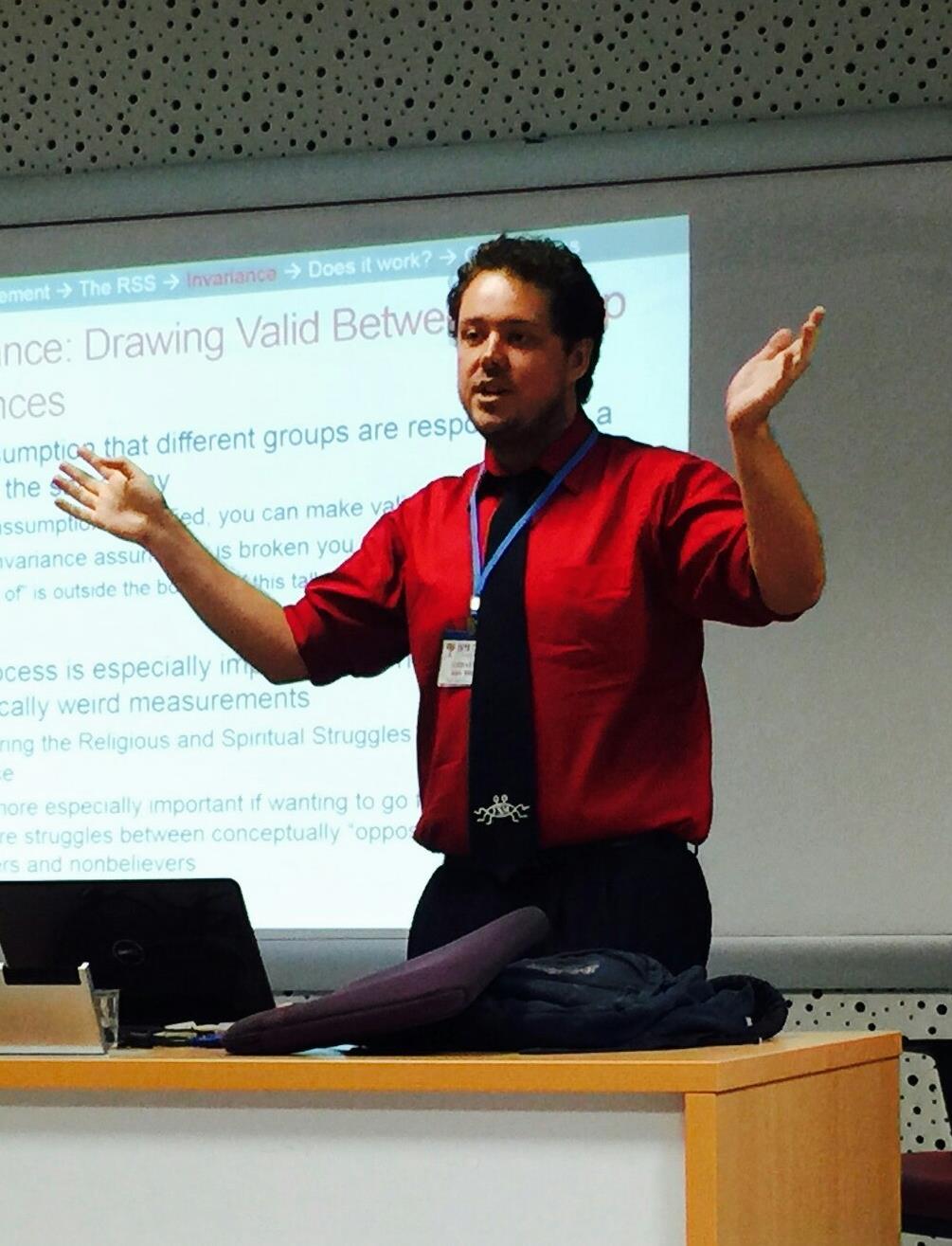

Alex

Having attended the University of California, Irvine for both an undergraduate and a master’s program, I learned how to enjoy Orange County. This was one of the reasons I was looking forward to this year’s Society for the Scientific Study of Religion (SSSR) Annual Meeting in Newport Beach, California, which was held October 23-25, 2015. Before the opportunity to take in some excellent research presentations, meet up with conference buddies, and make new ones, I got to show these buddies quite a few of the things that make Orange County a damned nice place to be. (The fact that the ocean was unseasonably warm was icing.) To put it academically: body surfing was accomplished, great Mexican food occurred, and a great deal of fun was partaken in.

By Friday morning we were plenty relaxed and ready to soak in some scholarship in addition to the rays. For me, the conference was bookended by book sessions. The first was an Author(s) Meet Critics session featuring Joseph Baker and Buster Smith’s book, American Secularism: The Cultural Contours of Nonreligious Belief Systems (2015), organized by Andrew Whitehead. The session began with an overview of the book, which outlines what it means to be secular in America through both quantitative and qualitative work. The authors break secularity into groups and show why this is important given the heterogeneous nature of their population; they make a case for both expanding the “Sociology of Religion” to include secularity, and arguing that it should encompass diverse “secularities” in much the way it encompasses sub-groups of religious categories. The biggest take-away from the panel was simple: it’s a very good book and is probably the new default citation when discussing the basics of American secularity.

Penny Edgell began the critical part of the session by providing a good grounding for the rest of the panel. She suggested that privilege and power (i.e. whiteness and maleness) matter when looking at “stronger” secularities like those found among the New Atheist movement, and discussed how research into secular people’s meaning-making processes is likely to be the next step for the field. David Voas framed the book in terms of secularization theory and how it calls the idea of American Exceptionalism to Secularization into doubt. He also commented on the co-option of the term “secularism” away from its original usage, which has been restricted to the “separation of church and state”. The latter half of the panel was held down by Phil Zuckerman and Ryan Cragun. Phil further shifted the framing of the book as a bridge between secularization theory and secular studies, which focuses more on the interdisciplinary investigation of “lived experience”. He also argued that the book undervalues the roles of the Internet and individualism as possible reasons for increasing secularity in America. Ryan brought up a number of critiques, while also keeping the “love fest” going. He mentioned that the authors should have included more theory; specifically, the book would have been even stronger had it included testable predictions rather than just descriptive theory.

The most personally striking moment of the session came when Phil made a call for more interdisciplinary work by outright saying, “We need more Psychology of Secularity.” As a psychology trainee, my reaction was to both agree wholeheartedly and think back to what Penny had mentioned about looking into the meaning-making processes of secular Americans. While I also agree with Phil’s general commentary that Psychology is still catching up to Sociology in terms of working with secularity, when it comes to meaning-making my field has quite a bit to contribute. While my own interest in meaning-making is strongly pulled toward clinical and health psychology and is grounded in work by Crystal Park (e.g. Park, 2010, 2005), meaning-making is researched in many areas of psychology (e.g. Heine et al., 2006; Singer, 2004). Hopefully, those of us interested in studying secularism can continue to work interdisciplinarily, allowing for a cross-pollination of ideas.

SSSR

At the end of the conference, the book session for Heinz Streib and Ralph Hood’s Semantics and Psychology of Spirituality: A Cross-Cultural Analysis (2016) was prefaced by a session in which several members of the book’s research team spoke about its different aspects. Of particular interest to NRSN readers was Thomas Coleman’s talk (2015). Thomas highlighted the narrative of a man who described himself as religious, spiritual, and atheist. While my initial reaction was to be somewhat perplexed, as the talk went on this man’s worldview began to make more sense, especially in light of the idea of “secularities” discussed a few days before. He religiously oriented himself around the meditative practice of Zen Buhddism and spoke of spiritually extending to something beyond his physical self through meditation, yet also strongly rejected both the idea of a god and even the existence of the supernatural, placing him squarely in the realm of atheism. Hearkening back to Phil’s discussion of “lived experience,” it will be important to allow the data we collect from the secular people we study to define our terms. Fortunately, that’s precisely what both American Secularism and Semantics did (Baker and Smith, 2015; Streib and Hood, 2016). In the case of Semantics, their focus on “spirituality” went beyond secular populations; to define the term, they collected data using a combination of survey scales and qualitative interviews with both believers and nonbelievers. The authors used these data to generate a conceptual space that attempts to cover the broad meanings of “spirituality” in a way that is validly inclusive of believers and nonbelievers. While their conceptual map of “spirituality” is still a work in progress, by allowing nonbelievers to describe their own meaning of the term, Streib and Hood’s work is an excellent step beyond simply applying a construct of “spirituality” to nonbelievers that was generated solely through believers’ definitions.

Obviously, there were many excellent talks of interest to secularity researchers at this year’s SSSR annual meeting. Almost every timeslot in the program had a session with at least one talk directly related to secularity. Two sessions which stood out in particular were Atheism: Varieties, Well-Being, Moral Decision Making, and Distress and Non-Religious, Nones, and “Dones”: Origins, Identity,

Community, and Participation. I’ve learned to anticipate a high level of scholarship within our field at religion conferences, and this one set the bar even higher.

References

Baker, J.O., Smith, B.G., 2015. American Secularism: Cultural Contours of Nonreligious Belief Systems. NYU Press.

Coleman, T.J.I., 2015. Identity is Complex: On Becoming a “Spiritual” and “Religious” “Atheist,” in: Changes in Religion and Worldview: Longitudinal Perspectives. Presented at the Society for the Scientific Study of Religion Annual Meeting.

Heine, S.J., Proulx, T., Vohs, K.D., 2006. The Meaning Maintenance Model – On the coherence of social motivations. Personality and Social Psychological Review. 10(2), 88–110.

Park, C.L., 2010. Making sense of the meaning literature: An integrative review of meaning making and its effects on adjustment to stressful life events. Psychological. Bulletin. 136(2), 257–301.

Park, C.L., 2005. Religion as a Meaning-Making Framework in Coping with Life Stress. Journal of Social Issues. 61(4), 707–729.

Singer, J.A., 2004. Narrative Identity and Meaning Making Across the Adult Lifespan: An Introduction. Journal of Personality. 72(3), 437–460.

Streib, H., Hood, R.W.J. (Eds.), 2016. Semantics and Psychology of Spirituality. New York: Springer International Publishing.


Alex Uzdavines was born in San Diego, CA and existed for a number of years before deciding to pursue Psychology after taking most of the coursework in it offered by the San Diego Community College District. He transferred to and earned his BA in Psychology and Social Behavior and MA in Demographic and Social Analysis from the University of California, Irvine. He is a Clinical Psychology graduate student in the Department of Psychological Sciences at Case Western Reserve University, working under Professor Julie Exline. His primary research interests are in the psychology of (non)religion and (non)spirituality, with an emphasis on studying how (non)beliefs contribute to spiritual struggles and well-being.
Book Review: Childrearing among the “nones”

ManningProfessor Christel Manning shares some findings from her new book Losing Our Religion:  How Unaffiliated Parents are Raising their Children – the first empirically researched book to consider “religious nones” as families, not just individuals.


The growth of the “nones” has been called “the decade’s biggest story about religion in America”[i]. Americans, especially young people, are leaving organized religion in record numbers. There are now more “nones” than there are Catholics in the US population, and one third of those under 30 say they have no religion. Ten years ago, most people writing about the “nones” seemed to assume the story was temporary: that today’s “nones” would be like the baby boomers a generation ago, many of whom dropped out of church in their youth but eventually returned to church or synagogue when they married and raised their own families.  But nobody was doing the research to find out if that was actually the case. So I decided I would take that project on. Losing Our Religion tells the story of what I found.

Losing our religion

Figure 1: Cover of Losing Our Religion: how Unaffiliated Parents are Raising their Children, by Christel Manning

The book combines existing survey data with qualitative research conducted across different regions of the United States. My central argument is that the surge in “nones” is not merely a temporary rejection of organized religion, but neither is it necessarily about secularization. Being a “none” is really about choice. Americans, especially the younger generation, are asserting their right to choose their own worldview rather than having somebody else (their family, an organization, a tradition) define it for them.  And they seek to pass on this choice to their children.

The term “none” comes from survey research, when they ask people “what is your religious preference?”, and the respondent says “none”, or “nothing in particular.” But when you actually talk to the unaffiliated, you find they span a wide spectrum of people ranging from deeply religious to very secular. Many “nones” adhere to a secular philosophy of life. There are also unchurched believers, like Jefferson Bethke of You-tube fame, who “love Jesus but hate religion.” There are spiritual seekers who embrace bits and pieces of various traditions and don’t want to commit to just one.  And there are “nones” who are just plain indifferent to religion. What ties these diverse worldviews together is a deep commitment to what I call “worldview choice”—a belief that religious and secular worldviews are expressions of deeply personal experiences, and therefore the individual has a right to choose one, or a combination, that best suits him or her.

So will “nones” raise their children to be nonreligious? Not necessarily.  In contrast to churched parents who usually try to transmit their own religion to their children, “none” parents insist they want their children to choose for themselves. That means providing options, and parents go about this in many different ways. I describe the five most common strategies in the book.  But what I found most striking was how deeply committed “nones” were to the narrative of choice. Some even went so far as to follow their children’s lead, providing religious education to a child who seems spiritually inclined while allowing a disinterested sibling to grow up secular!

The book examines various contexts and processes that influence how “nones” negotiate these choices. One is, of course, the parent’s own religious or secular orientation. Another is their relationship with spouses and extended family in the raising of children (e.g., a secular Jew whose in-laws want her child to be baptized). A third is the pubic culture of the local community they live in (e.g., an atheist in a Bible belt suburb whose teenagers are being evangelized at school). No matter where “nones” live, they must contend with a media environment that tends to emphasize the positive impact religion has on children. Many parents I interviewed raised questions about this, and for this reason I included a chapter examining the relevant research literature on this topic, and how it should be interpreted.

I am myself a “none” parent who also happens to be a sociologist of religion. This project started because I had questions about how I should raise my own child and because I was wondering how other nonreligious people are raising their children. As I talked with more and more “none” parents, I realized that many had similar questions. So it seemed appropriate to write a book that would be of value not just to academics but to “none” parents as well.

At one level this means answering basic questions that people have about “none” parents. Who are they? Why did they leave religion? What do they believe and practice instead? What do they want to pass on to their children, and what options are available to them? What are the challenges of letting your children choose? What is the impact of raising children with or without religion?  But the book also reflects on this information, raising bigger questions that may challenge the reader. Americans tend to assume that choice is good. Does this mean that more choice is better, especially in religion? What are the benefits and risks of our culture’s ever intensifying orientation towards personal choice? Is this good for individuals or for society? Is it really possible for children to choose their own worldview? There is considerable debate on these questions, and I have tried to give voice to a variety of perspectives. This is the first empirical research based book about “nones” as families (rather than individuals) and much remains to be learned. My hope is to begin a conversation and encourage future research on families who have no religion.

[i] By Professor Mark Silk, founder and director of the Centre for the Study of Religion in Public Life at Trinity College


Christel Manning is a Professor at Sacred Heart University, Connecticut.  Her past research has examined the intersection of religion, gender, and sexuality; and new religious movements.  For the last decade, she has researched the rise of the “nones” in America.  Her recent book, Losing Our Religion:  How Unaffiliated Parents are Raising their Children, has been rated one of the top ten religion books in 2015.

Event Report: Why Nonreligion is the New Religion

LoisLaunching the new website, the first NSRN blog of the year is director Lois Lee’s report on Linda Woodhead’s recent British Academy lecture. This event provided an opportunity, she argues, to reflect on the development of the study of nonreligion to this point, including its relationship with the study of religion – and to celebrate its rosy prospects. 


Linda Woodhead’s lecture at the British Academy in London last week – on ‘Why Nonreligion is the New Religion’ – felt momentous. Quite appropriately, as this was Woodhead’s inaugural speech as a Fellow of the Academy. But I was also struck by the foregrounding not of religion but of nonreligion at this most auspicious of occasions.

Woodhead’s interest in nonreligion is not surprising in itself. She has been a long-term advocate of its study and her interest pre-dates the formation of the NSRN and has continued in conversation with it. Rather, I was struck by the context and the setting. To get to my seat, I forged a path from Trafalgar Square, passing Whitehall and the Mall – those seats of British power – and down Pall Mall, then passing the plush, dimly lit rooms of the Institute of Directors, lined with gilt-framed oil paintings, to the buildings of the British Academy. Inside the BA, we passed along marbled lobbies, carpeted corridors, a grand staircase up to the chamber (surely ‘room’ is too plain a word) where the lecture was to given, under the warm glow of chandeliers. If mine and others’ work has agitated for the academy (small ‘a’) to ‘recognise the nonreligious’, it was hard to escape the feeling that this welcome into the Academy (big ‘A’) was a noteworthy point on its journey. And that is something that many in the NSRN should and will celebrate.

Still, I was drawn out of these self-interested reveries by Diarmaid MacCulloch[i]’s  small but significant aside: to paraphrase, ‘some might think that faith was not worth the BA talking about’. To a sociologist of religion, like myself, the reminder that anyone might think this so often comes as a surprise. One does not need to hold MacCulloch’s view that religion is a growing force in society to have a strong sense that it is still a force to be reckoned with.

But this opening statement brings home an important point about the historic neglect of nonreligious populations in the academy, too – that its own marginalisation is also built upon the marginalisation of religion as an object of study. Nonreligious subjectivities may be under-studied because they have been naturalised – as Talal Asad, Timothy Fitzgerald, Colin Campbell and others have pointed to. But, since the secularisation paradigm understood religiosity itself to be a transient, increasingly outmoded phenomenon, sociologists can be primed to notice when religion expires, rather than the emergence of alternatives – the beliefs, identities and practices that it transforms into.

MacCulloch’s remark reminded me once more that sociologists of religion were not so much hogging the field, refusing to make room for the study of the nonreligious, as they were absorbed in their own battles to have religion recognised as an object of study – and that the study of religion remains precarious still.

Ultimately, both the study of religion and of nonreligion are vulnerable, though each for their own and culturally contingent reasons. If there is cause for optimism – and I think that there is – that is because recognising the nonreligious in scholarship is one important way of supporting, even guaranteeing the study of religion for the longer term. And vice versa. To recognise the nonreligious is to adopt an inclusive understanding of the field ‘religious’ studies. This should broaden its relevance and appeal – especially in contexts in which the nonreligious make up a sizable portion of the population, even a majority as it now does in the UK (a point that Woodhead discussed). An inclusive approach to thinking about religion – or beyond it – should not be the preoccupation of a few , but something which we recognise that we all have a stake in, whether traditionally religious, alternatively spiritual, nonreligious or areligious.

Woodhead’s talk demonstrated that knowledge about the religious and the nonreligious have the capacity to enrich one another. She pointed to several intriguing findings of her current, UK-focused research. She pointed, for example, to the remarkable stickiness of nonreligious identities compared to religious ones: nonreligious parents will almost always pass on this identity to their children, whilst religious parents will only be half as successful. She also made a powerful argument in support of the view that nonreligious affiliates – i.e. those who identify themselves as having ‘no religion’ on surveys – should be recognised as a significant and heterogeneous constituency in its own right and one demanding further study – something that NSRN researchers will no doubt salute.

Woodhead also made interesting observations about the way in which ‘no religion’ has replaced the Church of England as a national ‘religion’. It is not only that nonreligion is the new norm, but that it overlaps with other, authorised notions of Britishness: whiteness, being British-born and politically liberal. At the same time, she described a disjunction between the conservative messages of Anglican leaders in the UK and the liberalism of the majority of church-members. Thus, liberals are being drawn to nonreligion and pushed away from religion at the same time – a notion that nicely illustrates how the study of nonreligion and religion often need to be done together.

Woodhead raised points for debate, too. I would challenge, for example, her reliance on ‘positive atheist’ beliefs (i.e. ‘I believe that God does not exist’) to measure non-theistic believers. In The God Delusion, Richard Dawkins claims to be an agnostic with a leaning towards positive atheism – 6 out of 7 on a scale from certain theist to certain non-theist; hence the ‘probably’ in the Atheist Bus Campaign slogan, ‘There Probably Is No God. Now Stop Worrying and Enjoy Your Life’. It’s not clear, therefore, that even Dawkins would select the positive atheist category rather than the strong agnostic one also provided. In general, in fact, analysts do not give the strong agnostic category enough attention compared to the positive atheist one.

I wasn’t wholly convinced either by the suggestion that Denmark and the UK differ very greatly in terms of religion. Other data show a remarkably similar profile between the two countries overall, even when the high rate of Church membership that Woodhead pointed to is taken into consideration. [ii]

But such points of contention only prove the point of how fruitful the study of nonreligion is and could be, not only in its own right but also as an aspect of an integrated study of religion, spirituality, nonreligion and areligion – how many debates there are to have, how many questions to pursue, how much light to be shed on the one from accounting for the other. The event was a celebration – most importantly for Woodhead and her great achievements in the study of religion – but also, I think, for a dynamic, creative, outward-looking field of nonreligious studies that is really coming into its own.

Siegers, Pascale. 2010. A Multiple Group Latent Class Analysis of Religious Orientations in Europe. In Cross-Cultural Analysis: Methods and Applications, edited by E. Davidov, P. Schmidt and J. Billet. New York, NY: Routledge: 387-413.

Zuckerman, Phil. 2008. Society without God: What the Least Religious Nations Can Tell Us about Contentment. New York: New York University Press.

[i] Historian of Christianity and our chair for the evening

[ii] Phil Zuckerman, for example, uses Denmark in his 2008 study of ‘godless societies’, whilst Pascal Siegers (2010) comparative work shows the UK and Denmark having extraordinarily similar profiles when it comes to the balance of traditional religion, alternative spirituality, active nonreligiosity and general indifference.


Lois Lee is research associate at the Institute of Advanced Studies, UCL, PI on the Scientific Study of Nonreligious Belief project (John Templeton Foundation) and Nonreligion and Secularity Research Network co-director. Recent publications include Recognizing the Non-Religious: Reimagining the Secular (OUP, 2015) and Negotiating Religion: Cross-Disciplinary Approaches (Ashgate, in press).