The Soul in a Secular World: Investigating a Discrepancy in Beliefs

Dani Gaudette, The University of Tampa

Keywords: soul belief, afterlife, Norway, Finland, nonreligion, secularism


Developing countries are experiencing secularization, leading to a noticeable decline in religious beliefs. Since this change is still underway, its long-term impacts on people’s beliefs around the world are unclear. Without religious traditions offering guidance, we may ask: What do the nonreligious value? What do they believe? How do they make sense of their lives? During my junior year at The University of Tampa I began working with Dr. Ryan Cragun, who introduced me to the Nonreligion in a Complex Future (NCF) Project. This project aims to investigate the above questions and more. Together we began exploring data from the Cultural and Social Values Survey administered by the NCF project, in search of some insight on the perspectives and beliefs of the nonreligious.

In 2023, the Pew Research Center released a report on religious ‘nones’ – those without a religious affiliation – in the United States, finding that approximately 67% believed in a soul, while only 36% believed in an afterlife. We found this discrepancy intriguing, as it seems counterintuitive at first glance. If someone believes in a soul, wouldn’t it make sense for them to also believe in a life after death? We began by questioning what causes this discrepancy. Could it be that a significant proportion of people hold inconsistent beliefs? Or could something else be at play, like respondents interpreting survey questions differently from researchers?

To explore this further, we analyzed whether our own survey data reflected a similar trend as the Pew report. Of the eight countries surveyed, we began with Norway and Finland. Just as the Pew report observed in the US, we found a gap of about 30% between ‘nones’ who believe in a soul and those who believe in an afterlife.

The percentages of participants from each country who answered “Yes” for each concept

A quick Google search for the definition of “soul” gives the following: “the spiritual or immaterial part of a human being or animal, regarded as immortal.” This was the definition that I held at the start of this project. I found that many others I discussed the topic with shared the same understanding. Similarly, if you search for a definition of “life after death” you’ll get a similar answered with some aspect of a person continues to exist even after their physical body dies.

Given these definitions, it is surprising that many people report believing in a soul but not in life after death. After all, the two concepts seem so deeply related. This disconnect is exactly why we found these results so intriguing.
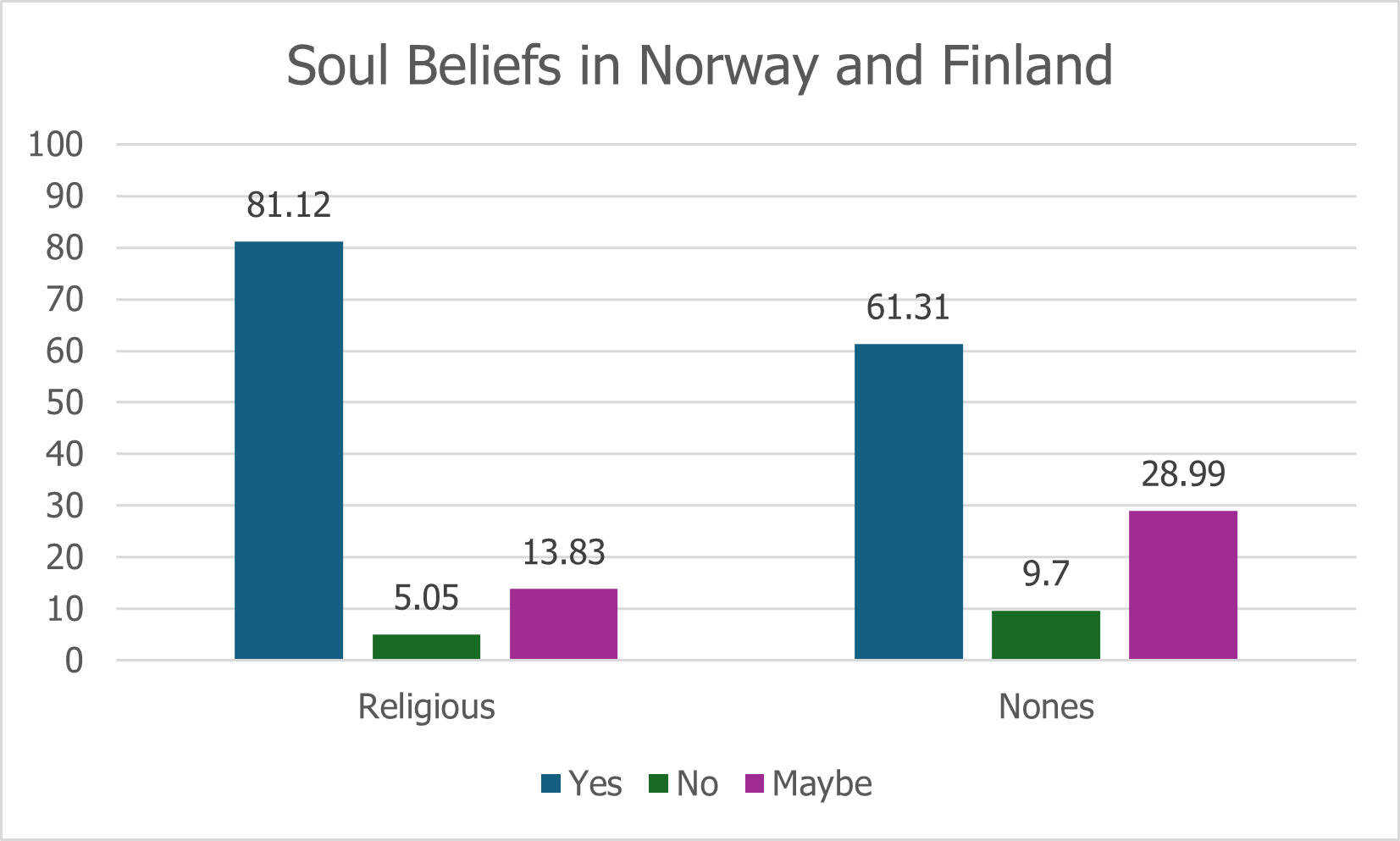
The figure above attempts to illustrate this peculiarity. Not only do a significant proportion of ‘nones’ believe in a soul; there is a notable proportion of the religious who do not believe in a soul. Together, these observations suggest that the soul as a natural concept – in contrast to a supernatural concept – is not exclusive to the religious. Furthermore, this belief is not universally held among the religious.

Much of the literature on the soul is rooted in theological or philosophical perspectives. There are few sociological studies to base our work on. Regardless, some relevant research exists. Richert and Harris, for example, investigated the concept of dualism – the belief that the physical and mental properties of the body are distinct.[i] Martyn has also conducted several studies on how people (specifically medical students) conceptualize the soul, and what it means for them.[ii]

A few key themes throughout the literature are worth noting: there is no single, universal soul concept, and the soul is often closely connected to notions of identity. In W. E. B. Du Bois’s famed work, The Souls of Black Folk, soul is referenced in a distinctly different manner.[iii] Here, it captures the ideas of the shared experiences, culture and history of the Black community, in contrast to the more personal interpretations we focus on in our research.

To explore what factors influence belief in a soul, our study uses statistical analysis to uncover patterns across different demographics. We are investigating religious factors such as religiosity and religious affiliation, as well as basic demographics like gender, education, and age. Based on existing research on beliefs and related concepts, we anticipate trends in soul beliefs associated with these factors. By identifying those who hold belief in a soul, we can lay the groundwork for qualitative analysis to look deeper into how people conceptualize the soul. As secularization continues, understanding the different ways people think about concepts like the soul becomes important in discovering how they experience the world around them. Our work not only addresses the gap we observed in the sociological literature, but also opens up opportunity for deeper discussions about ways that we find meaning. By exploring these beliefs, we may uncover unexpected commonalities that connect the religious and nonreligious in unexpected ways.


Dani Gaudette is a senior undergraduate student at The University of Tampa studying Applied Sociology and Biochemistry. She began working with Dr. Ryan Cragun on this research in January 2024 as a part of the Nonreligion in a Complex Future project. Since the start of her research, Dani has presented this work on various occasions including the ASR Annual Meeting in Montreal this past summer. She hopes to continue this research through her senior year with the goal of publishing the results.


References

[i] Richert, Rebekah A., and Paul L. Harris. 2008. “Dualism Revisited: Body vs. Mind vs. Soul.” Journal of Cognition & Culture 8(1/2):99–115. doi: 10.1163/156770908X289224

[ii] Martyn, Helen, Anthony Barrett, and Helen D. Nicholson. 2013. “Medical Students’ Understanding of the Concept of a Soul.” Anatomical Sciences Education 6(6):410–14. doi: 10.1002/ase.1372.

[iii] Du Bois, W. E. B. (William Edward Burghardt). 1996. The Souls of Black Folk. Project Gutenburg.


Podcast – The Anthropology of Nonreligion

Mascha Schulz, The Max Planck Institute for Social Anthropology

Keywords: podcast, nonreligion, anthropology, lived nonreligion


A podcast video with Mascha Schulz on the Anthropology of Nonreligion has recently been published by the Max Planck Institute for Social Anthropology in Halle, Germany. In this episode of the series Talk On!, Christoph Brumann talks to Mascha Schulz about her research on non-religion in Bangladesh. They also discuss the special issue ‘An Anthropology of Nonreligion?’, published in the Berghahn Journal Religion and Society (2023) and edited by Mascha Schulz and Stefan Binder. In their introduction, Schulz and Binder suggest that recent ethnographic studies of what might be called lived, embodied, situated, or everyday forms of nonreligion have opened up possibilities for new questions that address the different ways in which nonreligious positionalities and their attendant social dynamics are shaped by the contexts in which they are embedded. Consequently, many of the papers in this special issue address nonreligion in ways that offer comparative perspectives on how specific dispositions, sensibilities and expressions—including those of everyday, ambivalent or less obvious forms of lived nonreligion—are linked to specific social configurations and imaginaries, power structures and transnational entanglements. They examine not only what people doubt or disbelieve—or how these positions are shaped by particular intellectual traditions—but also when, how and why critiques of religion, skepticism or unbelief emerge in particular embodied and situated practices in the first place. In this podcast episode, Brumann and Schulz summarize some of the points made in the special issues, covering topics such as forms of non-organized non-religion, the Satanic Temple, and why anthropology is a latecomer to the study of non-religion but is nevertheless important in this field. Watch the full podcast below!


Mascha Schulz is a Research Fellow at the Max Planck Institute for Social Anthropology in Halle, Germany, whose research focuses on politics, (non)religion, and law in Bangladesh. Her recent publications include the edited volume “Global Sceptical Publics: From Non-religious Print Media to ‘Digital Atheism’” (UCL Press, 2022, co-edited with Jacob Copeman) and the special section “The Anthropology of Nonreligion” in Religion & Society (2023, co-edited with Stefan Binder).


Beyond the Sacred-versus-Secular Dichotomy: Humanist Wedding Ceremonies in Contemporary Poland

Agata Rejowska, Jagiellonian University

Keywords: humanism, marriage, weddings, Poland, sacred, secular


Humanist marriage ceremonies are an emerging form of civic rituality in Poland, and their popularity is on the rise. The first official humanist marriage ceremony was conducted in 2007 by the Polish Rationalist Association. As advocates of this type of rituality argued, this is an alternative to both religious and civil marriage ceremonies. The latter, although secular, meaning in theory suitable for non-religious couples, are often perceived as formulaic, bureaucratic, and devoid of meaning. I conducted empirical research on humanist weddings conducted in Poland between the years 2016 and 2020. As my study shows, as a hybrid phenomenon, humanist marriage ceremonies elude such binary divisions as secular/sacred or non-religious/sacred.

The conducted research reveals the various motivations of couples who decide on such form of celebration. In addition to ‘nonreligious’ or ‘antireligious’ motivation, there are also ‘anti-institutional’, ‘individualistic’, and ‘practical’ motives. It also shows that even if some couples decided on humanist marriage ceremony, that did not necessarily mean that they were deeply steeped in rationalism and materialism. In Europe, the majority of non-religious individuals believe in a ‘spirit or life force’ rather than embracing hard atheism and a rationalist-materialist viewpoint. In the same vein, for some of my research participants, spiritual or religious frameworks were still the important points of reference in their marriage ceremonies.  

But even when they did not refer to spiritual and religious outlooks, the ceremonies remained sacred despite being secular/non-religious. By ‘sacred’ I mean something that ‘people take to be absolute realities that have claims over their lives’ (Lynch 2012, 15). Sacred is not an exclusively religious category, although for a long time it has been reduced to this field. Also, it does not have any actually existing ‘ontological referent’ but it is a social construction. For this reason, people can experience ‘the sacred’ as very diverse social phenomena.

For instance, love and intimacy are feelings that are often experienced as sacred. This is often expressed through terms such as ‘my one and only’ or ‘soulmate’. Sometimes the romantic narrative presents a meeting of two people as an effect of ‘destined coincidences’. The opposition between destiny and coincidence was a subject of reflection at one of the weddings I observed, during the groom’s speech:

I have the impression that you could easily divide people into those who believe in coincidence and those who think there are no coincidences and everything happens for a reason. I belonged to the first group until the ski camp [where the couple met]. And 15 minutes in the bus was enough (…). And then for the first time in my life I felt really calm, an emotion I didn’t know before came over me and I felt somehow looked after by the energy of the world, and since then I think that everything happens for a reason. You are definitely here for a reason.

Sacred is something that needs to be ‘set apart’ and protected from ‘any profanation’ and, by the same logic, the loved person is set apart from other women or men and the relationship is something that needs to be protected (for instance being unfaithful could profane it). Relationship can be symbolically polluted by the interference of the external institutions that represent irrelevant and rejected values, and are ‘inauthentic’.  For this reason one of the research participants, Harry[1], did not want to have a religious ceremony:

It was kind of conflicting to have something that really meant a lot to me, which was my love for my wife, with something that meant nothing to me, which is a belief in God. That means zero to me. So, I didn’t want to mix those two things.

Although advocates of humanist marriage ceremonies consider these rites of passage to be the alternative not only to religious but also to civil marriages (similarly in the UK), in Poland the civil ceremony is still the only legally recognized option for non-religious couples who do not want to be married within any institutionalized religious tradition. Hence, because humanist marriages in Poland do not have legal recognition, contrary to other countries like Australia, Canada, Ireland, New Zealand, Norway, Scotland, and some parts of the United States (Kasselstrand, 2018), if couples wish to have a legally valid wedding, an additional civil ceremony is required (usually a modest ceremony at the registry office is held on another day).

At this wedding, everyone was asked to wear white, preferably linen, clothes. As the bride said: ‘it was very important for us for everyone to be in white, for everyone to participate in the ceremony, be part of the ceremony, so not just the bride in white, but everyone participating in it.’ (photo: Dorota Koperska)

The interviewees often complained that civil marriage ceremonies are impersonal and generic. Couples usually associate civil ceremonies not only with something cheesy and anachronistic, but also emotionless and mundane. As Norbert, one of the interviewees, put it: ‘a woman plays some “da-da-da-daa” [imitates Mendelsson’s Wedding March] on a tape recorder and there’s nothing sublime about it and you don’t feel any emotions either’. According to participants, civil marriage ceremonies deploy ossified symbols and meanings that have lost their power. It is either ‘funny’ or grotesque in its seriousness. The civil ceremony represents the secular-profane; it belongs to the mundane, emotionally uncharged everyday life. Many couples I spoke to treated it rather as a ‘necessary evil’ and something grotesque in its ‘seriousness’. Dominika laughed as she described how, when the official told them that ‘the mayor of the district joins in sending wishes’, they were not able to treat it seriously, especially as this was a random district with which they had no attachment.

Lighting a candle is a common element of humanist marriage ceremonies. It can symbolise, for example, the home hearth and the couple’s new life together (photo: Maciej Butkowski)

In the background of humanist marriage ceremonies there is a belief in universal moral order, common values, immanent interconnectedness between people and a universal foundation of humankind. These shared beliefs are another source of potential sacralization. As Helena said: ‘We have something in common because we are human beings. And those values are important to all of us. Like love, relationships, happiness, and things like that’. The equation of humanism with something that is universal often triggered comparisons and allusions to religion (as something particularistic). During the research, I often encountered the narrative that humanist values are something that unify people, while belonging to a particular religion constitutes a dividing factor. In this sense, humanism in general and humanist rites of passage in particular are perceived as the means that help people to function despite or above the already existing divisions and to avoid generating new ones. As Harry put it:

I think it’s important to recognize that there is a way of being spiritual amongst people without being attached to a religion. (…) We have to find a way, or start to find ways to love one another and to be with one another, without turning to any mainstream religious beliefs (…). So I think that’s what humanistic means to me.

This narrative alludes to the understanding of humanism as an ethical project, striving to build a democratic and open society, and humanist ceremonies are one of its tools.  This is relevant especially in Poland, as sociologists note that Poles lack identities other than the religious Polak-katolik one. This lack of other identities means a deficit of ritual alternatives to Catholic rites of passage, which are an important tool for the institutional Church to maintain its power in Poland. Humanist rites of passage, therefore, can be a tool for forging an alternative identity to the Polak-katolik one.

Some weddings also involve non-human actors to emphasize that they are also part of the community. Here, a dog is bearing the rings (a small bag with wedding bands is attached to his collar). (photo: Kamila Piech http://www.kamilapiech.com)

Humanist ceremonies are a sign of the secularization of the ritual sphere, yet do not indicate its desacralization. Participants expressed a rejection of impersonal and formulaic civil ceremonies, but also a need to saturate the marriage rite with meanings that are perceived as contemporary and relevant. Although secularization undermines the authority of institutional religions, secularized social life is not devoid of the sacred. However, secularization also affects ‘the sacred’ and its manifestations, including marriage ceremonies, as its form is flexible and adjusts to the changes taking place throughout society.


Agata Rejowska is an assistant professor at the Institute of Sociology at the Jagiellonian University in Krakow. In 2021 she was a Visiting Assistant in Research at Yale University, Center for Cultural Sociology. In 2023 she received the Best Early Career Article Award granted by the International Society for the Sociology of Religion for the article “Humanist Weddings in Poland: The Various Motivations of Couples” published in Sociology of Religion. From 2024 she has been a member of the research group for the project “Practices of Secularity in Catholic Poland: Forming a New Social Order?” (led by Professor Katarzyna Zielińska).


References

[1] The names of all participants have been replaced by pseudonyms.

Kasselstrand I (2018) ‘We Still Wanted That Sense of Occasion’: Traditions and Meaning Making in Scottish Humanist Marriage Ceremonies. Scottish Affairs 27: 273-293.

Lynch G (2012) The Sacred in the Modern World: A Cultural Sociological Approach. Oxford: Oxford University Press.


Religion and Prosociality? The Volunteerism of Canadian Atheists

David Speed, University of New Brunswick

Keywords: volunteering, civic engagement, atheism, nonreligion, comparative religion, Canada


If I may don my Hat of Mild Hyperbole for a moment: one of the discussed virtues of religion is that it is steeped in prosociality. Give a gal or fella a religious text, and lo and behold they are out there making society a better place. In contrast, those folks who aren’t on the religion train are, perhaps, less motivated to make the world a better place. At least, this is the common refrain from clergy, pundits, politicians, and surprisingly, some researchers. There are several valid scientific studies that show the religious are more prosocial than the nonreligious. In particular, this has been studied extensively in the context of volunteerism, that is, donating your time to help others.

Now, as a somewhat skeptical person, I have always felt that religion as a driver of volunteerism was … well, a bit lazy. Yeah, a lot of religious citizens may volunteer their time and effort, but the proffered explanation seemed too neat. Last year, Penny Edgell and I investigated patterns of volunteering in Canadians, and how different atheists were in this regard. Fortunately, Statistics Canada collects tons of data on this topic and we were fortunate enough to be able to access it. Our questions were pretty simple: 1). Do the religious volunteer more than atheists? and 2). Why might religion be connected with volunteerism at all?

Science is all about mechanisms; what is the reason that X and Y are related? For example, it’s all well and good that Newton noticed the apple falling toward the ground, but his real contribution was in explaining the mechanism for this behaviour (i.e., gravity). In a similar vein, it’s all well and good that the religious may volunteer more, but why is this the case? Broadly speaking, there were two contenders to account for this relationship. While I describe these mechanisms as two separate entities, I will say up front that they are not an exhaustive or exclusive list of why religion and volunteering are connected.

The first mechanism to explain the relationship between religion and volunteering is that people who are religious are more prosocial by their very involvement in religion. To put it a bit reductively: once you accept tenets X, Y, and Z, you now want to be a more prosocial person. Let’s call this the inclination explanation; people who are religious want to behave in a prosocial manner. The second mechanism was that people who are religious have more opportunities to volunteer. Once you do activities A, B, and C, you find yourself inundated with chances to help out your fellow human. Again, to put it a bit reductively: once you join a religious organization there are opportunities galore to be more prosocial. Let’s call this the opportunity explanation.

Our study had a simple logic: if religion is associated with greater prosociality, then individuals who are super-duper-not-religious should report lower levels of volunteerism than people who are more religious. Atheists would be non-volunteers because they should, in theory, lack inclination and opportunity. But we wanted to know if it was specifically inclination or opportunity that drive volunteering. Fortunately, the data we had access to addressed prayer and religious attendance. Using this information, we reasoned that if it was inclination driving the relationship, then people who reported higher levels of prayer should volunteer more. Similarly, if opportunity was driving the relationship, then we would expect religious individuals who frequently attended religious services would volunteer more.

Our results were a mixture of the expected and unexpected. To our shock, in less complicated models, atheists out-volunteered most religious groups. In other words, the average atheist was more likely to volunteer than the average religious individual. However, this effect transformed slightly when we modelled prayer and religious attendance. The gist of our findings is that religious affiliation and religious behaviours influence volunteering behaviours together.

When we compared atheists who never pray to religious individuals who never pray, there were few differences between the groups. When we compared atheists who never pray to religious individuals who pray daily, there were also few differences between the groups. Recall that while prayer was our measure of the inclination explanation, private religious activity seemingly had little impact on volunteerism. When we compared atheists who never go to church to religious individuals who never go to church, atheists volunteered more than several groups. However, when we compared atheists who never go to church to religious individuals who go to church weekly, atheists are out-volunteered by several groups. Recall that religious attendance was our measure of the opportunity explanation, and it looks pretty reasonable as a mechanism. Basically, differences in volunteerism emerge when religious individuals report higher levels of religious social activities, not higher levels of religious non-social activities. As the youth say, opportunity explanation FTW.

But wait, there’s more! When we compared the amount of time spent volunteering once an individual reported volunteering, there weren’t a lot of differences between atheists and others. Once nonbelievers started volunteering, they ostensibly approached it with the same gusto as believers did. Finally, we teased apart what activities the religious were volunteering for, and then filtered out individuals who only volunteered in a religious context (and no other contexts). In this case, we found that the differences between atheists and non-atheists volunteering evaporated. So the religious do volunteer more than atheists, but they are volunteering in a narrow religious context.

Penny made the point that there are social activities that help to connect different elements of society (bridging social capital) and there are social activities that help to reinforce the group that an individual is a part of (bonding social capital). Congregants aren’t finishing Sunday service and sprinting to sign up for the PTA; they are finishing Sunday service and then volunteering at (presumably) their religious organization. Granted, religious organizations may do public outreach that benefit everyone, but it’s also possible that the people who benefit the most from religious people volunteering are other religious individuals.

The nonreligious have been maligned for their disinterest in prosociality. Given the results of our study, this seems pretty unfair. Atheists likely aren’t a part of an organization that calls for volunteers, which means that they are disadvantaged in partaking in altruistic behaviours. There needs to be a greater interest in interrogating how atheists see themselves as a part of society, because the status quo is in dire need of help.


Dr. David Speed (BA, Brock University, 2008; MASP, MUN, 2011; PhD, MUN, 2015) is an Associate Professor at the University of New Brunswick in the Department of Psychology. David’s specialization is in the topic of atheism and nonreligion and how they relate to health and well-being. To date, David has authored over a dozen studies addressing nonreligion, which included the largest study of Canadian atheists in the literature. David a co-editor of Secularism & Nonreligion, which is an academic journal dedicated to advancing knowledge of ‘the secular’. He teaches a variety of classes including graduate statistics, research methods, and is the coordinator of the Master’s of Applied Psychology, Research, and Evaluation program. When David isn’t researching, teaching, or groaning at the amount of administrative work he must perform, he enjoys spending time with his wife and three children.


Event Report: 2024 NSRN Lecture


In this post, Chris Miller reports on the NSRN’s 2024 Annual Virtual Lecture, presented by Dr. Donovan Schaefer and moderated by NSRN President Dr. Atko Remmel on May 8, 2024. Chris summarizes Schaefer’s lecture, highlighting his argument of how disenchantment has been misunderstood, and how scholars can move forward in their work with a renewed understanding of this concept.


On 8 May 2024, the NSRN welcomed Dr. Donovan Schaefer (University of Pennsylvania) to deliver the 2024 NSRN Annual Lecture, titled “The Re-Disenchantment of the World: Thinking, Feeling, and Secularity.”This lecturebuilt upon ideas developed in two of his previous monographs: Religious Affects: Animality, Evolution, and Power (2015) and Wild Experiment: Feeling Science and Secularism After Darwin (2022) to argue that we have been looking at disenchantment ‘inside out.’

Schaefer began with an outline of what he calls the ‘common sense’ of disenchantment. This approach to disenchantment posits a fundamental break in human history. Simply, it claims we humans used to live in an enchanted world, and now we don’t. This shift was triggered by the advancement of science, leading to a state of disenchantment as a new epistemic and existential condition.

To problematize this simplistic understanding, Schaefer offered a close reading of Michel Foucault’s The History of Sexuality Volume I: An Introduction. He explained that this book’s enduring resonance is the concept of biopolitics, or how power functions through control of human bodies. However, since Foucault only turns to this idea in the volume’s final pages, Schaefer suggests that we are better served by a wider focus on the book as a whole.

Schaefer drew attention to the book’s original French subtitle: La volonté de savoir, or ‘Will to Knowledge.’ In a reference to Nietzsche, Foucault highlights the will to knowledge as something that manifests in our impulses, or an intellectual conscience that drives us forward. Schaefer argues that rather than trying to understand why (or if) humans are sexually repressed, Foucault is concerned with the emotional dimension of this question. Paraphrasing Foucault, Schaefer asked why we say, with so much certainty, that we are repressed. The answer, Schaefer suggests, is that there is an emotional dimension to posing such a question and feeling a sense of power by defying one’s supposed condition.

Schaefer also turned to Foucault’s power-knowledge nexus, suggesting that we should pay attention to the role of pleasure in this relationship. Schaefer argues that there is a sense of pleasure which flows through the intellectual response to thinking about science. That is, there is a sensualization of power and a gain of pleasure simply through the discourse and science of sex. Rather than view pleasure and knowledge in opposition to each other, therefore, Schaefer suggests that we see a matrix of positions of Power-Knowledge-Pleasure, which bodies can occupy in a range of ways.

In addition to his focus on Foucault, Schaefer analyzed Max Weber’s Science as a Vocation. Before diving into a close reading, Schaefer first gestures to the work of Jason Ā Josephson-Storm, who also pushed back against the ‘common sense’ version of disenchantment, and proposed the idea of ‘secular enchantment,’ which holds that science does not necessarily negate emotion or enchantment but that these forces actually co-exist. Diverging from Josephson-Storm, and other thinkers working with ‘secular enchantment,’ Schaefer argues that secular enchantment is disenchantment, at least in the way Weber originally intended.

Turning to Weber, Schaefer first highlighted the definition of disenchantment in the original German, which translates more closely to ‘de-magification’ or removing magic from the world. This describes a state of the world in which there is no part of the world that is not understood. Schaefer clarifies that it does not mean that everything is understood, by everyone and at present. He offered the example of the average person who might not understand how their phone works. While this technology’s inner workings are unknown to many individuals, one could theoretically read enough books and figure it out, just as the many scientists who worked on that technology have done.

Schaefer reflected on a passage in which Weber describes a student asking him how he might attain the post of academic that he so strongly desires. Weber squashes this dream quickly, telling the student to not aim for it, as there are many aspects of academic life which are undesirable (little pay, lack of respect, so on). However, Weber clarifies that there are some who see science as a passion or intoxication. These people, Weber says, have the calling for science, and they are the ones who should pursue this vocation. For these people, science is saturated with feeling and passion, not bereft of it. Schaefer argues that science draws from the same reservoirs of inspiration as art, as one is driven by a profound passion to understand the surrounding world. Linking back to Foucault, Schaefer explained that to Weber, disenchantment represents the affective dimension of pursuing knowledge. Schaefer concluded that whatever the secular is, it has something to do with the advancement of knowledge, and he calls on scholars to attend to new configurations of emotional formation. Just as Foucault asks why we are obsessed with asking why we’re oppressed, Schaefer asks why we are obsessed with asking why we’re disenchanted, or with so loudly claiming that we’re no longer enchanted. It is through asking and pursuing these new questions that we can better understand the meanings of these formative works by Foucault and Weber, in addition to paying more critical attention to the affective contours of knowledge and science.

Nonreligious Afterlife? Death Cafés and Emerging Understandings of Death

Chris Miller, University of Ottawa

Keywords: death and dying, nonreligion, Death Café, afterlife


Religion has traditionally been a major influence on how people and societies make sense of death. Questions such as why people die, what happens after we die, and what rituals should we perform to mark someone’s death were typically answered by religious authorities. As religion declines, people’s understandings of and responses to death undergoes shifts as well.

As one of the studies conducted by the Nonreligion in a Complex Future project, our research on Death Cafés explores changing conceptions of death and dying. Death Cafés are informal, pop-up events in which people (often strangers) gather to discuss death, dying, and related issues. Events take place in all manner of venues, from coffee shops and restaurants to libraries or churches. Attendees comprise a range of backgrounds, including people in the ‘death care’ field (funeral directors, hospice volunteers, and death doulas), as well as people interested in death for other reasons, whether they are facing a terminal diagnosis, caring for elder parents, or simply curious to explore the topic. Conversations at events flow freely and cover many topics, including navigating healthcare systems, complaining about the funeral industry, and reflecting on how to best remember loved ones.

To better understand these events and their attendees, our team conducted focus groups and interviews with religious and nonreligious individuals who have attended Death Cafés in Canada, the US, and the UK.[i] Although, like Death Cafés themselves, our research explores a range of topics, one common theme that emerged among participants was the afterlife. Lori G. Beaman and I recently explored such changing conceptions of the afterlife that emerge in these spaces. In what follows I will discuss our key findings, from which we identify four categories of ‘afterlife imaginaries’: cessation, energy, unknown, and transition.

Cessation

Death for some is seen as the end of human activity and consciousness. This reflects a concept in afterlife research that is often labelled extinction or annihilation, which was often framed as the default ‘secular’ or nonreligious outlook.[ii] Participants who maintain this outlook often referred to science, suggesting matter-of-factly that, as one participant stated, “when the brain stops working, it seems likely … that will be the end of my own personal experience.” While most of the participants within this category identified as atheist, there were also some religious believers who see death as a finite end.

Energy

Energy was by far the most popular category that we uncovered, but we encountered several different understandings of how people might continue as energy. Some referenced this in a purely scientific manner. Vanessa[iii] talked about the atoms in her body breaking down, then becoming “all of the things that I love, like waterfalls and sunsets.” Others referenced science indirectly, vaguely alluding to quantum physics and a general understanding that “energy never dies.” For others, energy connected to a more poetic outlook, believing that their energy will continue, in some form, to reverberate throughout the world.

Despite the range of perspectives this category includes, it is important to highlight the pervasiveness of the term. Energy was the exact language that many used, whether referencing scientific or spiritual understandings. This malleability may explain the term’s popularity. Considering all our participants attend Death Cafés, the common use of this term may also point towards a specific discourse that emerges in death positive spaces.

Unknown

Some are content with death being mysterious. These participants often defaulted to the idea that no one truly knows what happens after death, so it remains a mystery. While Terror Management Theory suggests that mortality can invoke fear (especially if one doesn’t find a comforting explanation, like heaven), some were “fascinated” or even “excited” about possible outcomes. These ranged from the continuation of human consciousness to complete cessation. Though open to many potentialities, these participants would ultimately resort back to saying they aren’t quite sure, and that they are okay with not knowing.

Transition

The final category we identify encompasses more definite visions of human consciousness carrying on. Some described traditional religious beliefs in an afterlife where they would reunite with loved ones. Others saw death as a transition to some new world, using such allegories as birth or the wardrobe to Narnia. Finally, some who had experienced near-death experiences spoke with certainty about what happens after death, namely, returning to a peaceful place they had already (briefly) experienced.

Conclusion

Each category we identify reveals an immanent understanding of death. Participants all see death as an important event, and they believe that many important things happen when death occurs. However, most do not see death as dependent on some transcendent or external power. Instead, the significant transformations that will occur are connected to the world here and now. Nature is particularly influential in how people understand death. This includes people like Vanessa, who sees her atoms breaking down into waterfalls and sunsets (or a less romantic possibility which she acknowledges: a parking lot). This also includes people like Abigail, who want a green burial so that their ‘energy’ can re-join the Earth. Finally, this includes participants who believe that consciousness will continue, and that one can experience continuing bonds with deceased relatives through the wind, water, or birds.             As religion declines and transforms, afterlife imaginaries also evolve. We do not seek to identify which categories or beliefs are religious, and which are nonreligious. Indeed, such an attempt would face the challenge that each of our four categories included both religious and nonreligious participants. By mapping the categories that people posit, we identify strong overlap among both religious and nonreligious people. The perspectives that support each outlook reflect a range of influences, including religion, science, literature, and popular culture. By exploring these imaginaries among people who attend Death Cafés, we also uncover new spaces in which people can explore and reflect on this major life event.


Chris Miller wishes to acknowledge that the research on which this post is based was conceptualized, collected, and analyzed in collaboration with Dr. Lori Beaman


Dr. Chris Miller is a Postdoctoral Fellow with the Nonreligion in a Complex Future project at the University of Ottawa. Through projects that focus on Death Cafés, obituaries, and green burial, his work explores death, dying, and nonreligion. His broader research interests include New Religious Movements, and religion and popular culture


References

[i] At the time of writing, researchers working in Norway, Australia, Argentina, and Brazil have also begun exploring Death Cafés. The present reflections, however, are based only on data from participants in Canada. This research was conducted by a team led by Lori G. Beaman, and I would like to thank Hannah McKillop, Sohini Ganguly, Hinna Hussain, Edmundo Maza, and Mathilde Vanasse-Pelletier for their research assistance.

[ii] For studies that include this category, see for example Walker 2000; Cave 2015; DeSpelder and Strickland 2015; Haimila and Muraja 2021. While Haimila and Muraja note that their participants mainly endorse a view of annihilation, similar to our findings, many also allow for continuation in some form.

[iii] The names of all participants have been replaced by pseudonyms.


NSRN 2024 Annual Lecture

The NSRN 2024 Annual Lecture will be taking place virtually on May 8, 2024. Dr. Donovan Schaefer (University of Pennsylvania) will be sharing his presentation, titled “The Re-Disenchantment of the World: Thinking, Feeling, and Secularity” while NSRN President Atko Remmel will moderate a Q & A period following the presentation. Please see the poster below for further information, including the time of the presentation based on your location. Anyone interested in attending can register through this link: https://forms.gle/7oLmvMwStTAvwt7m6


For an abstract of the lecture, see below!

Charles Taylor once wrote that “everyone can agree that one of the big differences between us and our ancestors of 500 years ago is that they lived in an ‘enchanted’ world and we do not.” But what does “disenchantment” really mean? And why do we so often insist that we are disenchanted? By re-evaluating the relationship between thinking and feeling, this talk opens the door to a new view of disenchantment—neither embracing Taylor’s story of decline nor dismissing disenchantment as mere “myth.” Rather than the eradication of feeling, disenchantment is a rearrangement of the way modernity feels. This calls on us to rethink how disenchantment fits in to theories of secularization.


Anti-Atheism as a New Focus for the Study of Nonreligion

Petra Klug, University of Bremen

Keywords: anti-atheism, relational approaches, discrimination of atheists, United States, blasphemy, apostasy


In recent years, the study of nonreligion has experienced significant growth. Following the novel works of scholars such as Colin Campbell, Lois Lee, and Johannes Quack, much research in this field has explored how the nonreligious relate to religion. But what about the other way around? How does religion relate to the nonreligious or to atheism? In this article, I will argue that religion has always defined itself through its demarcation from those who believe differently or not at all. Based on my book Anti-Atheist Nation (Routledge, 2023), I show that, in the US-American context, atheists are the ultimate outsiders, suffering from prejudice, discrimination, and scapegoating.  

At least in monotheism, religion relies on drawing a boundary between a righteous in-group and an unrighteous out-group. This demarcation is already established in the sacred texts: Despite its teachings of love and kindness, the Bible contains passages that express animosity towards individuals deemed as God’s adversaries. Psalm 139: 19–24, for example, explicitly incites hatred: “O that you would kill the wicked, O God, and that the bloodthirsty would depart from me—those who speak of you maliciously, and lift themselves up against you for evil! Do I not hate those who hate you, O Lord? And do I not loathe those who rise up against you? I hate them with perfect hatred; I count them my enemies.” The New Testament in Ephesians 4:17–19 describes the nonreligious—or Gentiles in Biblical language—as “darkened in their understanding, alienated from the life of God because of their ignorance and hardness of heart,” and it depicts them as insensitive, licentious, and “greedy to practice every kind of impurity.” The Quran describes the fate of the nonbelievers, or kuffar in Arabic, as a painful torment. According to Sura 4:56, “those who reject Our revelations” shall be sent to the fire to burn. “When their skins have been burned away, We shall replace them with new ones so that they may continue to feel the pain.”

For the religiously orthodox, the out-group includes everybody who deviates from their narrow dogma. But in religiously pluralistic settings, such as those in most liberal societies, atheists are often considered the ultimate outsiders to the religious in-group.[i] This is visible already in the language we use. The term atheism, from the Greek ‘a-‘ (without) and ‘theos’ (god), means godlessness. In ancient times, it was also used to describe wickedness. However, what is more intriguing than its negative connotation is that the term itself is formed as a negation: the prefix ‘a-‘ denotes a lack or denial. Thus, the word atheism alone characterizes the phenomenon as a deviation from the norm, simultaneously defining theism as normative. This grammatical structure is mirrored in the terms infidelity, impiety, and irreverence, which are negations of fidelity, piety, and reverence, dis- or unbelief, which negate belief, as well as in irreligion, which indicates a lack or neglect of religion. And this might even be reproduced in the term nonreligion although it was introduced explicitly as a more neutral alternative.

So far there has been little systematic attention to this phenomenon, which is best described as anti-atheism. Anti-atheism is a disdain for people who do not believe in God.[ii] It targets not only actual atheists, i.e., people who consider themselves godless, but also those accused of godlessness because they adhere to a different religion.[iii] Thus, anti-atheism is potentially directed against everyone. Furthermore, it can refer to both belief and the non-observance of religious norms in practice. Since religion manifests and reproduces power structures, anti-atheism also intersects with other forms of discrimination, such as racism and patriarchal gender norms.[iv]

Anti-atheism leads to persecution and discrimination against atheists worldwide. Some Islamic states even treat apostasy and blasphemy as a capital offense. In states that do not enforce such laws, fanatic believers sometimes punish atheists and those perceived to hurt religious feelings. But the persecution of atheism and blasphemy has also been a part of Christian countries, from the killing of other nations as heathens and pagans, the persecution of heretics, dissenters and so on.

Even the United States, which prides itself for its religious freedom, was established as an anti-atheist nation. This has led to the discrimination, exclusion, and demonization of atheists and other groups accused of godlessness, such as Native Americans, religious dissenters, Catholics, Jews, so-called witches, freethinkers, secularists, scientists, abolitionists, women’s rights advocates, communists, homosexuals, hippies, people who seek or provide abortions, humanists and so on. And since Pat Robertson’s book New World Order[v] and Qanon, there are also specifically anti-atheist conspiracy theories. They depict atheists and secularists as powerful, hidden forces who persecute Christians, eradicate religious influence and want to govern the entire world.

But what, then, prompts this inclination toward fostering such division? Among the over 90 individuals and groups from different religious backgrounds I interviewed in California and the American South, I observed a tendency in which all the good things in the world are attributed to divine influence, while the bad things must originate from nonreligion. This resulted in a strict binary perspective: allegiance is either to divine will or, by default, to malevolence. This sharp division was first critically examined by Ludwig Feuerbach in the 19th century. He noted that believers project all their positive traits onto God, failing to recognize this projection. This externalization inversely casts perceived negative traits onto humans in general and the nonreligious in particular, branding them as morally corrupt, selfish, greedy, hardhearted, dishonest, vindictive, and prone to follow their sexual desires: as already symbolized by the doctrine of original sin.

The dilemma of reconciling a good, omnipotent, and omniscient deity with the presence of evil in the world—the classical problem of theodicy—persists. My interviewees often rationalized evil as part of God’s plan. So, as Karl Marx has already claimed, religion functions as “consolation and justification” of a world that cannot be justified. A common coping mechanism for the perceived withdrawal of divine favor, such as in the face of calamity, is to attribute blame to a scapegoat, a concept dating back to the Hebrew Bible’s idea of a collective covenant with God. In contemporary times, this blame is often cast upon atheists and secularists, accused of removing God from public life and education, thus inviting divine retribution.

This perspective is deeply entrenched in the psychocultural fabric of patriarchal societies, where, as Sigmund Freud observed, the concept of a monotheistic God is modeled on the paternal figure, offering protection and guidance in a world fraught with uncertainties. Atheism, by challenging this divine protectorate, becomes a threat not just to individual belief but to the societal order underpinned by such an authoritarian system.

My interviews also suggested that suppressed wishes and desires of the highly religious are projected onto atheists. Oftentimes, when believers fail to live up to their own restrictive religious norms, this failure is projected onto atheists, who are then portrayed as devoid of any kind of morality and accused of all kinds of atrocities, including murder. This leads to discrimination of atheists and exclusion even within their families. Many atheists therefore choose to remain in the closet.

So the persistence of anti-atheism not only shows the challenges faced by atheists in asserting equal rights, it also highlights the responsibility of religious studies scholars to analyze the ways in which atheism and secularism have been marginalized in academic discourse.


Dr. Petra Klug is an Assistant Professor at the University of Bremen, Germany, and has served as a Guest Professor for the Critical Theory of Society at Justus-Liebig-University Gießen, Germany. She is the author of “Anti-Atheist Nation: Religion and Secularism in the United States,” published by Routledge in 2023. Her work focuses on religion, nonreligion, gender relations, human rights, climate change, and Critical Theory.


References

[i] Petra Klug, Anti-Atheist Nation: Religion and Secularism in the United States (New York, London: Routledge, 2023), 9.

[ii] Kenneth Sheppard, Anti-Atheism in Early Modern England 1580–1720: The Atheist Answered and His Error Confuted (Leiden, Boston: Brill, 2015), 4.

[iii] Martin E. Marty, The Infidel: Freethought and American Religion (Whitefish: Literary Licensing, 2012 [1961]).

[iv] Petra Klug, Anti-Atheist Nation: Religion and Secularism in the United States (New York, London: Routledge, 2023), 2.

[v] Pat Robertson, (1991). The new world order: It will change the way you live. Dallas: World Publishing.


NSRN Annual Lecture (2023)

Beyond Doubt: The Secularization of Society

In this webinar, Isabella Kasselstrand, Phil Zuckerman, and Ryan T. Cragun will discuss their new book, Beyond Doubt: The Secularization of Society (NYU Press, 2023). The webinar will take place on Zoom at noon EDT on September 19th, 2023. The event is jointly organized by the NSRN and the Nonreligion in a Complex Future (NCF) project.

The Zoom webinar will be free to register and attend, and open to all. All attendees must register beforehand. To register, please click here.

To view the poster click here.

Nonreligion and Secularity Research Network Conference (2023)

Towards Substantive Understandings of Nonreligion and Secularity

University of Ottawa, Canada, 6-9 June, 2023

The 2023 NSRN conference will be delivered using a hybrid virtual and in-person format. For those who can travel, we strongly recommend you join us in person at the conference venue at the University of Ottawa in Ottawa, Canada from 6-9 June 2023. However, for those who cannot join in person, there will be at least one hybrid session room (out of two session rooms in total) throughout the days of the conference where participants can present virtually, listen to other virtual and in-person presentations
and ask their questions. There will be no fee to attend the 2023 NSRN conference either in person or virtually.

Deadline for session and paper proposals: 16 December 2022