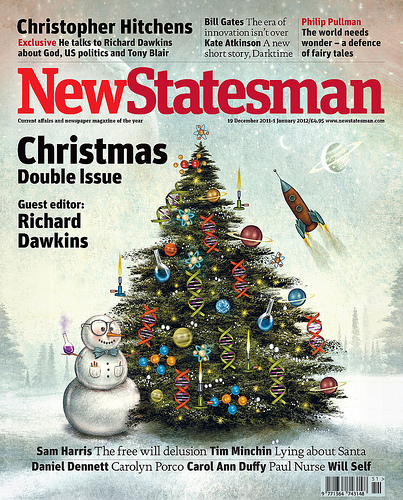
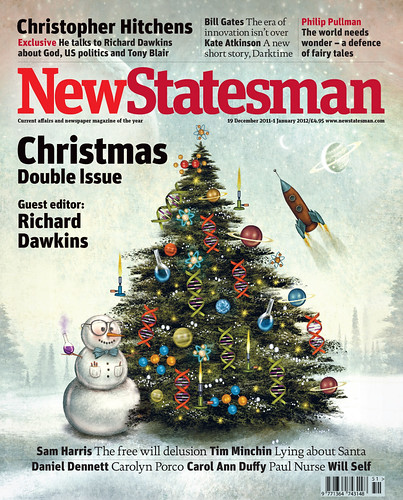
New Statesman Guest Edited by Richard Dawkins 19th Dec 2011
Richard Dawkins has taken the role of guest Editor for the 19 December 2011 to 1 January 2012 issue of the New Statesman. The issue gives space to the “four horseman” of New Atheism and includes a contribution from Sam Harris on the neuroscience of freewill, Daniel Dennett contributes a Christmas essay “The Social Cell” addressing the social ties that bind us and the remaining two “horseman” come together in a conversation between Richard Dawkins and Christopher Hitchens. Other notable inclusions include authors Phillip Pullman and Kate Atkinson, Microsoft giant Bill Gates, planetary scientist Carolyn Porco and commenter and human rights activist Maryam Mamazie.
The edition gives an interesting overview of the current issues dominating the British nonreligous/secular/religious public debate. Dawkins opens with a letter to the British Prime Minister, David Cameron, in which he declares his “cultural Anglicanism” and urges Cameron to acknowledge the British Social Attitudes survey. The survey found 50% of the population declare themselves to be of no faith and the number declaring themselves to be Church of England, Christian, at 20% which for Dawkins undermines the privileging of religion over non religion, especially the particular privilege he sees accorded to the Anglican state church. He urges Cameron to consider the need for neutrality “in all matters pertaining to religion”.
The New Statesman site quotes Dawkins on his venture:
“To guest-edit a great magazine with the status of a national treasure is the literary equivalent of being invited to imagine your ideal dinner party – Christmas dinner, in this case – and then of actually being allowed to send out real invitations to your dream companions. Every acceptance is like a present off the Christmas tree, gratefully unwrapped and treasured.
At the same time, I couldn’t help being daunted by the New Statesman’s historic reputation for serious, well-written radical commentary, and by the need in my literary Christmas dinner to temper merriment with gravitas.
We have no reindeer, but four horsemen; no single star of wonder and no astrologers bearing gifts, but a gifted star of astronomy who knows wonder when she sees it; no kings from the east, but the modern equivalent of a king from the west; and wise men – and women – all around the table. Please join us at the feast.”
Details of his editorial and how to access the magazine can be found on the New Statesman website


![[Image]](https://i0.wp.com/www.religionandsociety.org.uk/uploads/images/2011_09/1315840161_colemanprojectimage0.jpg)
 NSRN Online